
30.07.1866–15.10.1944
Eliseu Visconti
Eliseu Visconti (1866–1944), a native of Campania, came to Brazil as a boy, studied in Rio de Janeiro and in Paris under Eugène Grasset, and later decorated the Theatro Municipal in Rio: the curtain, the ceiling and the foyer. He is regarded as the most striking Impressionist in Brazil and a pioneer of Brazilian design: stamps, posters, ceramics, textiles, stained glass.
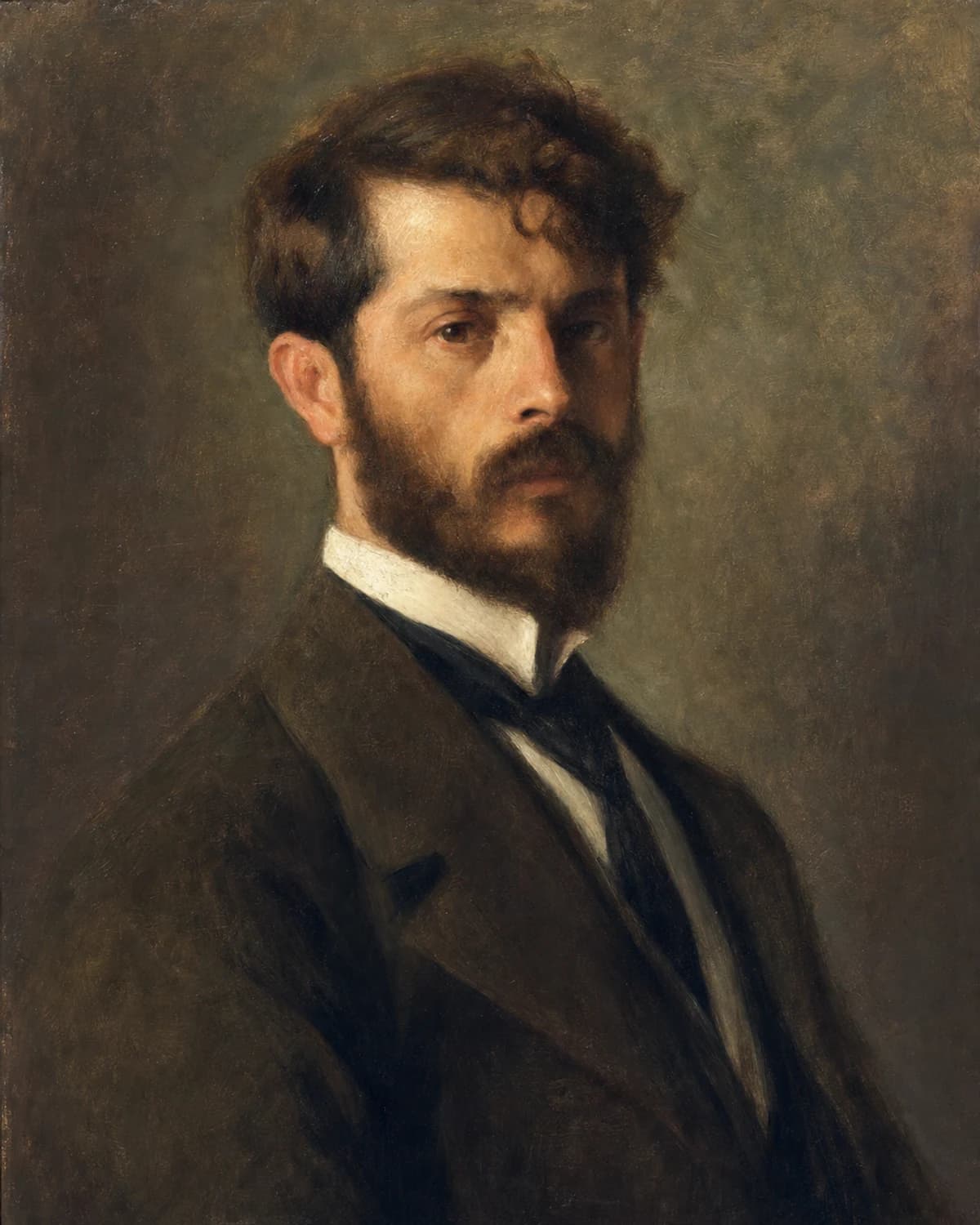
Biography
In 1903 Eliseu Visconti submitted sixteen designs in the Art Nouveau manner to a postage stamp competition announced by the Brazilian Mint. They won, and they were praised in Brazil and abroad, even in the French magazine “L’Illustration”. They were never printed, and the artist took this very hard. Only in 1926, at an exhibition of his design work at the Galeria Jorge, did he finally show the stamps, together with the bookplate and the emblem of the National Library.
Design as a profession did not yet exist in Brazil.
He was born on 30 July 1866 in Giffoni Valle Piana, in the province of Salerno, and at birth was named Eliseo D’Angelo; Visconti was the surname of his mother, Cristina. In 1873 the boy and his sister Marianella were sent to Brazil, to the fazenda of the Baron of Guararema at Além Paraíba, and the baroness, who grew very fond of him, arranged for him to study in Rio de Janeiro. After an unsuccessful attempt at music, in 1882 he entered the Liceu de Artes e Ofícios, and three years later, without leaving the Liceu, the Imperial Academy of Fine Arts, where his teachers were Victor Meirelles, Rodolfo Amoedo, Henrique Bernardelli, Zeferino da Costa and José Maria de Medeiros. In 1888 he received the Academy’s gold medal. In 1890, together with the “moderns”, teachers and students who rebelled against outdated rules, he left the Academy and founded the “Ateliê Livre”. After the reforms of the republican government the Academy became the Escola Nacional de Belas Artes, and in 1892 Visconti won the first travel prize awarded under the Republic. In 1893 he arrived in France and entered the École des Beaux-Arts in Paris, but as early as 1894 he left that conservative institution for the school where the Art Nouveau master Eugène Grasset taught, while also attending the Académie Julian under Bouguereau and Ferrier. In Madrid, fulfilling the duties of his scholarship, he copied Velázquez and learned from him how to render reflected daylight.
At the Exposition Universelle of 1900 in Paris his “Oréadas” and “Youth” (“Gioventù”, 1898) won a silver medal. “Youth” is now in the Museu Nacional de Belas Artes in Rio. In 1901 Visconti held his first solo exhibition at the Escola Nacional de Belas Artes: next to his oil paintings hung, for the first time, his work as a designer, the fruit of Grasset’s lessons. Posters, ceramics, textiles, wallpapers, stained glass and lamps followed. In 1904 “The Reward of Saint Sebastian” won a gold medal at the World’s Fair in St Louis.
The critics liked the 1901 exhibition, and partly because of it the mayor, Pereira Passos, invited Visconti to decorate the Theatro Municipal of Rio de Janeiro, then under construction. He worked in Paris, in two stages. In 1905–1908 he made the curtain, the ceiling over the auditorium and the frieze above the stage; in 1913–1916 the panels for the foyer, which are considered the summit of Brazilian decorative painting; in 1915, in the middle of the war, they were sent to Brazil. At the Salon of 1905 he showed a portrait of the sculptor Nicolina Vaz de Assis. In June 1906 he was elected to succeed Henrique Bernardelli as professor of painting at the Escola Nacional de Belas Artes; he took up the post the following year and taught until 1913, and among his pupils were Henrique Cavalleiro, Marques Júnior and Raimundo Cela. He also made decorative paintings for the National Library, and in 1912 the museum in Santiago de Chile bought his “Mystical Dream”. In France, in the village of Saint-Hubert in the Île-de-France, where his wife’s family lived, he fully absorbed the lessons of Impressionism and painted landscapes there. The First World War kept him in Europe until 1920.
After his return his Impressionism changed. His landscapes of Teresópolis are full of transparent tropical light. The critic Mário Pedrosa wrote in 1950 that with them “a new landscape is born in Brazilian painting”, and regretted that the Brazilian modernists, at the start of their movement, had had no contact with the old master. It seems to me that the regret is understandable: in 1922 he was not invited to the Week of Modern Art in São Paulo, although he followed its events closely. That same year his triptych “Hearth” won him a medal of honour at the exhibition marking the centenary of Brazilian independence. He decorated the hall of the Rio municipal council (1923), made a panel of the signing of the first republican constitution for the building of the former Federal Court (1924), and worked for the Palácio Tiradentes. In the mid-1930s, when the stage of the Theatro Municipal was enlarged, he painted a new frieze above the proscenium arch, and in 1934–1936 he taught a course in decorative art at the Escola Politécnica. The old frieze was found by chance in 2008, during the restoration for the theatre’s centenary: it had survived behind the new one.
Eliseu Visconti died in Rio de Janeiro on 15 October 1944.
Related context
Associations
Works connected through artistic movements, cultural context and period. Priced works available in this market appear first.








Profile notes
Profile and sources
Image
Artist image
На основе открытого изображения: Eliseu Visconti; Wikimedia Commons; Public domain.
