
16.04.1755–30.03.1842
Élisabeth Vigée Le Brun
Élisabeth Vigée Le Brun (1755–1842) painted more than thirty portraits of Marie Antoinette and her family and in 1783 was admitted to the Royal Academy of Painting, one of fifteen women in a century and a half. On the night after the Parisian women’s march on Versailles she left by stagecoach, and for twelve years she worked in Italy, Vienna, Saint Petersburg and Berlin. In her memoirs she counted 662 portraits and about 200 landscapes.
Biography
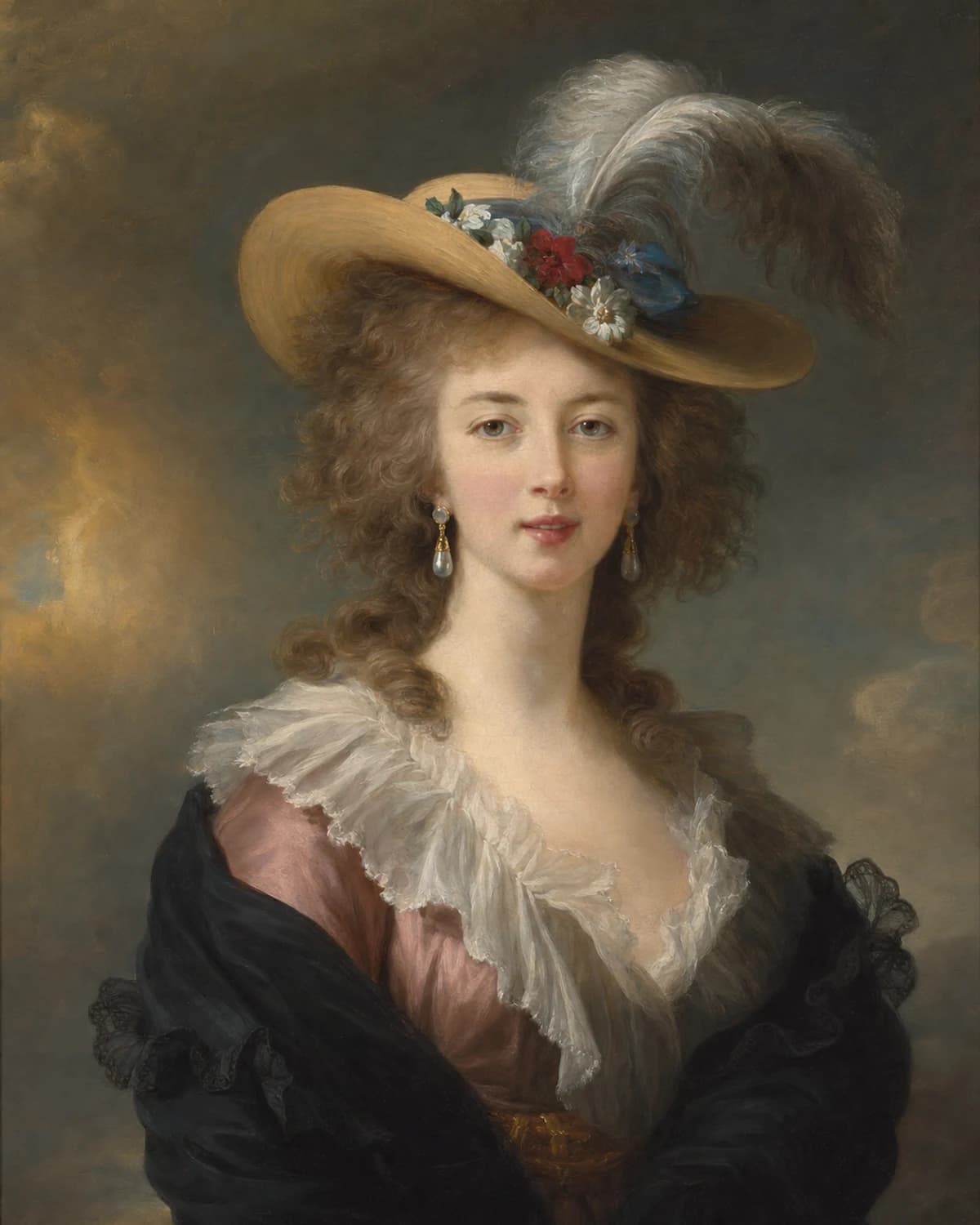
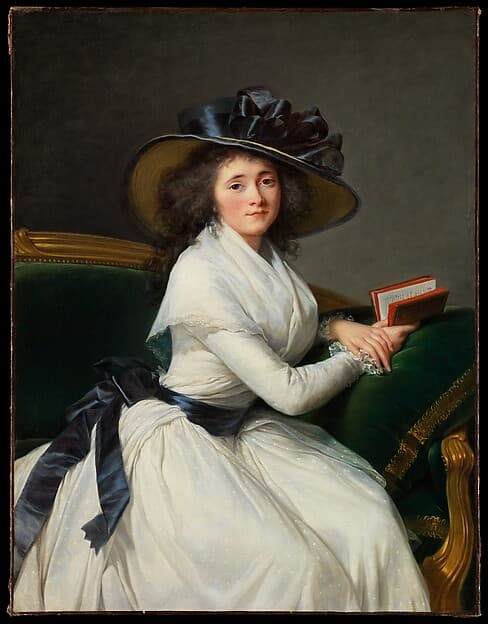
At the Salon of 1783 Élisabeth Vigée Le Brun showed the Queen in a plain muslin dress of the kind worn at home, and in a large straw hat. The public decided that the Queen of France had been put on display in her shift. The portrait was taken down, and the painter quickly produced another, in formal silk and with a rose in her hand. In all she painted more than thirty portraits of the Queen and her family.
She was twenty-eight. That same year she was received into the Royal Academy of Painting and Sculpture.
She was born in Paris on 16 April 1755. Her father, Louis Vigée, painted portraits in oil and pastel and belonged to the Académie de Saint-Luc, the guild of Parisian painters; her mother was a hairdresser. From the age of five to eleven the girl lived in a convent school; at seven or eight she drew a bearded man, and her father, on seeing the drawing, declared that she would be a painter. He died in 1767, when his daughter was twelve. After that she learned from friends of the family: Gabriel-François Doyen, Jean-Baptiste Greuze and Joseph Vernet gave advice, and Gabriel Briard, an academician with a studio in the Louvre, gave lessons. Portrait commissions began when she was about fifteen. The studio she had opened without a licence was closed by the authorities, and in 1774 she joined the same Académie de Saint-Luc as her father. She signed herself “Louise Élisabeth”, reversing her given names, and only in old age admitted that the baptismal order had been the other way round.
In January 1776 she married Jean-Baptiste-Pierre Le Brun, a painter and picture dealer from the family of Charles Le Brun, first painter to Louis XIV. He let her copy paintings from his collection, and his connections opened Versailles to her. In 1778 she became painter to the Queen; in 1780 her daughter Julie was born, whom she later painted beside herself more than once. One such self-portrait, at the Salon of 1787, caused a fresh stir: the painter was smiling with her mouth open, showing her teeth, which, as the Mémoires secrets wrote, neither the Ancients nor people of taste had ever allowed themselves. The same year her large portrait of Marie Antoinette with her children was hung at Versailles, with the little Dauphin pointing at the empty cradle of a recently dead child; after the Dauphin’s own death in 1789 the picture was removed.
The Academy at first refused her: her husband traded in pictures, and academicians were forbidden to trade. Marie Antoinette put pressure on the King, and on 31 May 1783 Vigée Le Brun was admitted by order of Louis XVI. Instead of a portrait she submitted an allegory, “Peace Bringing Back Abundance”, although no reception piece had been asked of her, and the Academy never did decide which genre to assign her to. Between 1648 and 1793 only fifteen women became full academicians.
On 5 October 1789 a crowd of Parisian women brought the King and Queen from Versailles to the Tuileries. At midnight Vigée Le Brun, her nine-year-old daughter and their governess, dressed as shabbily as they could, left Paris by stagecoach; her husband and brother saw them as far as the city gate. For twelve years she did not come back. In Italy she was elected to the academies of Parma and Bologna and, in 1790, to the Accademia di San Luca in Rome; in Naples she painted Emma Hart, the future Lady Hamilton, as a bacchante and as a sibyl, Queen Maria Carolina with her children, and the composer Paisiello at work on a score. The “Sibyl” travelled with her and was shown in Venice, Vienna, Dresden and Saint Petersburg; it is mentioned in her memoirs more often than any other picture, and to my mind she herself thought it her principal work. In France, meanwhile, she was entered on the list of émigrés, her property was marked for confiscation, and her husband, to save the house, obtained a divorce (3 June 1793).
She spent two and a half years in Vienna, left for Saint Petersburg on 19 April 1795 and on the way, in Dresden, stood before Raphael’s “Sistine Madonna”, after which, she wrote, every other face looked to her like a grimace. In Russia she spent six years. She painted the last King of Poland, Stanisław Poniatowski, and the Grand Duchesses Elena and Alexandra Pavlovna in Greek tunics with bare arms, for which the favourite Platon Zubov relayed the Empress’s displeasure to her: the sleeves had to be repainted. Catherine II agreed to sit, but died on the eve of the appointed day; in a letter to Grimm she had complained that in Vigée Le Brun’s picture her granddaughters sat “in monkey poses”. The Saint Petersburg Academy of Arts made her a member. In 1801 she went to Moscow and, despite the entreaties of the new Emperor, Alexander I, set off home by way of Berlin, where she painted Queen Louise in pastel.
She returned to Paris in January 1802, struck off the list of émigrés, and three months later left for England for almost three years.
In London the Prince of Wales was among her guests, the actress Sarah Siddons called at her studio in Maddox Street, and the portraitist John Hoppner published a speech against her and against French painters in general; her reply, by letter, she later included in her memoirs. The only commission from the Napoleonic court, a portrait of Caroline Murat with her daughter, shown at the Salon of 1807, she called a torture: the sitter missed her appointments and arrived each time with a new hairstyle. In the summer of 1807, at Coppet, she painted Madame de Staël as Corinne, the heroine of her newly published novel.
The house she had bought at Louveciennes, outside Paris, was looted by Prussian soldiers late on the evening of 31 March 1814, and a year later, during the Hundred Days, by English ones. Between 1835 and 1837 the three volumes of her “Souvenirs” appeared, written with the help of her nieces Caroline Rivière and Eugénie Tripier Le Franc; there she reckoned that in her life she had painted “six hundred and sixty-two portraits and about two hundred landscapes”. She died in Paris on 30 March 1842, in her eighty-seventh year, and was buried in the cemetery at Louveciennes, near her house. Her gravestone reads: “Here, at last, I rest.”
Artist works
Works by the artist
Works by Élisabeth Vigée Le Brun available in this edition of NEOARCA.
Related context
Associations
Works connected through artistic movements, cultural context and period. Priced works available in this market appear first.








Profile notes
Profile and sources
Image
Artist image
На основе открытого изображения: Élisabeth Louise Vigée Le Brun; Wikimedia Commons; Public domain.
