
12.02.1843–25.07.1914
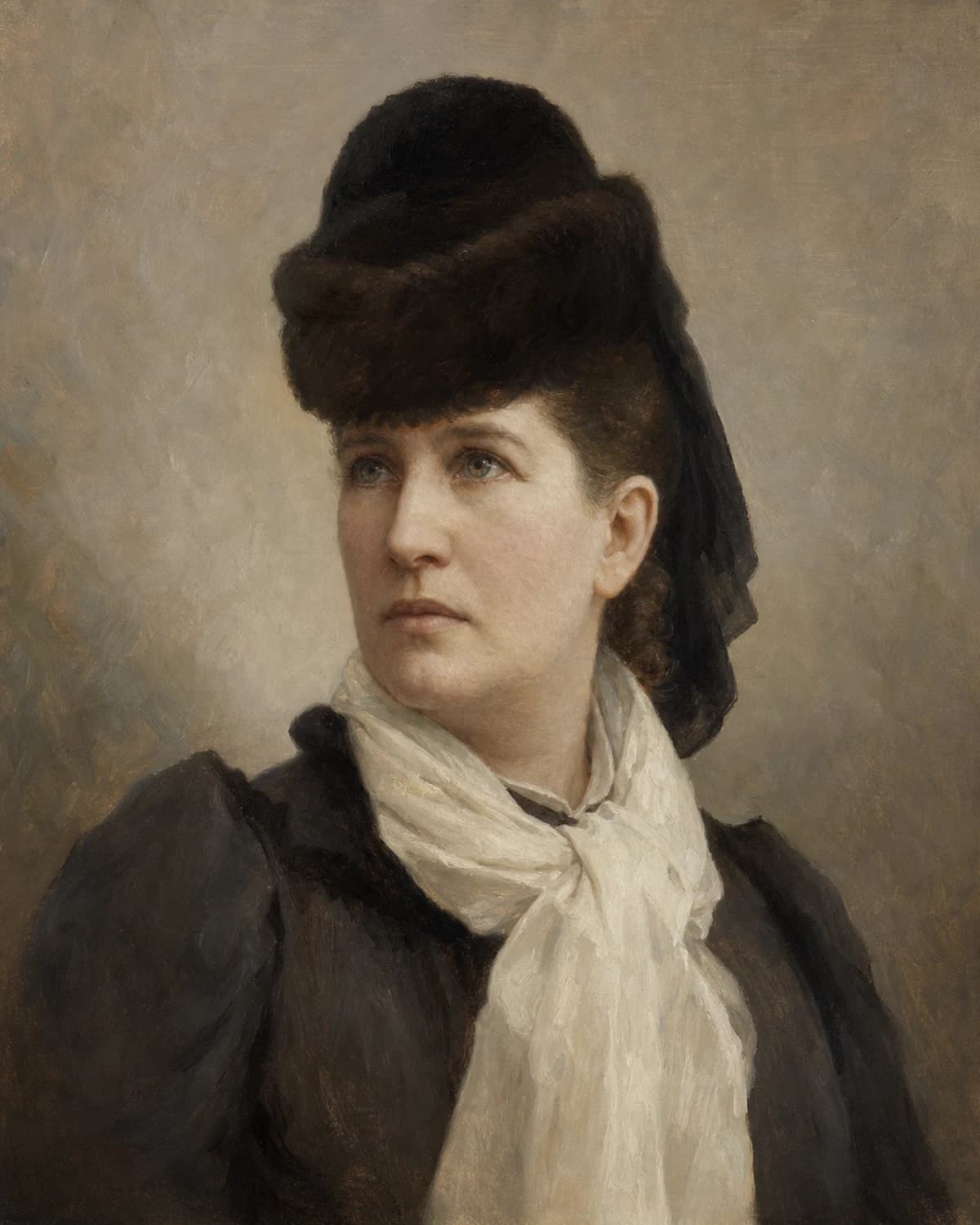
Elisabeth Boehm
Elisabeth Boehm (1843–1914), née Endaurova, made her name with silhouettes and postcards of children’s faces, proverbs and sayings in pictures, and her “Alphabet”. She illustrated Nekrasov, Turgenev and Krylov, worked for the Posrednik publishing house at Leo Tolstoy’s invitation, and when her eyesight began to fail she turned to designing glass “in the Russian style”, which won recognition at exhibitions in Chicago and Paris.
Biography
At the 1900 World’s Fair in Paris, in the pavilion of Russian handicrafts and needlework, glass “in the Russian style” made to designs by Elisabeth Boehm was on show. A salt cellar after her sketch was presented to the President of France, and the newspapers wrote about it.
By then she was no longer making silhouettes: towards the end of the 1880s her eyesight had begun to weaken, and in 1896 she gave up the technique for good.
She came from an old family. Her Tatar ancestors bore the name Indigir, meaning “Indian cockerel”; according to tradition, a charter of Ivan III made them Endaurovs. Elisabeth was born on 12 (24) February 1843 in St Petersburg and spent her childhood on the family estate, the hamlet of Shcheptsovo in Poshekhonye uyezd of Yaroslavl Governorate, in a large family with three brothers and two sisters. In 1857–1864 she studied at the Drawing School of the Society for the Encouragement of Artists and graduated with a silver medal; Ivan Kramskoi and Pavel Chistyakov are named among her teachers. On the Yaroslavl estate she illustrated Nekrasov, drew scenes of peasant life and lithographed her own drawings.
In 1867 she married the violinist Ludwig Boehm, a professor at the St Petersburg Conservatory and eighteen years her senior; a year later their only daughter, also Elisabeth, was born. In 1875 her album “Silhouettes” came out, and in 1877 “Silhouettes from Children’s Life”; both were printed by the cartographic establishment of her uncle, A. A. Ilyin. Then came “The Pie” (1880) and “From Village Memories” (1882), the children’s magazines Igrushechka (1882–1886) and Malyutka (1886–1887), “The Turnip” (1882), “Proverbs in Silhouettes” (1884), “Sayings and Saws in Silhouettes” (1885) and the “Alphabet”. She illustrated Krylov’s fables and Turgenev’s “A Sportsman’s Sketches”. Leo Tolstoy, who knew her work without having met her, invited her to Posrednik; Ivan Sytin also often commissioned drawings from her. In the early 1890s she worked on illustrations for Leskov’s story “The Insulted Netteta”.
In the 1890s, without giving up watercolour, Boehm took up designing glassware. Success came at once: at the World’s Fair in Chicago in 1893, at the All-Russian Exhibition in Nizhny Novgorod in 1896, then in Paris. Whether these two changes, the failing eyes and the new material, were connected is nowhere stated outright, but to my mind the coincidence in time speaks for itself. For her silhouettes, etchings and glass she received medals in Chicago, Paris (1900), Munich (1902) and Milan (1906), where she was given a gold.
In the early 1900s she discovered the postcard. Boehm’s postcards appeared under her name in print runs large for their time and were reissued again and again; there are more than three hundred and fifty of them, and most were printed by the St Eugenia Charitable Society. According to one study, she was reprinted more often than any other postcard artist in the Russian Empire. Boehm’s silhouettes were published in Berlin, Paris, London, Vienna and America. In 1907 I. S. Lapin published two albums of her postcards in Paris, “A Little of Everything” and “For a Dear Friend, Even an Earring from My Ear”, and in the 1910s she worked with M. O. Wolf’s publishing house on the series “My First Book…”.
In 1904 her husband died. In her last years she was often ill and worked less, but she did not abandon the “Alphabet”, which Ilya Lapin published in Paris in 1913–1914: large sheets with seven to ten drawings and words for each letter, French coated paper, a calico binding with clasps in imitation old silver. The edition was a thousand copies, in five instalments of six sheets each, plus a hundred numbered albums signed by the artist.
Elisabeth Boehm died in St Petersburg on 25 July (7 August) 1914. She was buried beside her husband in the Novodevichy Cemetery; the grave has been lost. The “Alphabet” went on being reissued: twice in Prague in the 1920s, as a set of 28 postcards for émigré children; after the Second World War part of the Prague edition was published in New York by Nikolai Martyanov; and in 2013 it came out in Kyiv.
Related context
Associations
Works connected through artistic movements, cultural context and period. Priced works available in this market appear first.








Profile notes
Profile and sources
Image
Artist image
На основе открытого изображения: Брокгауз, Ф.A.; Wikimedia Commons; Public domain.
