
16.12.1882–17.10.1939
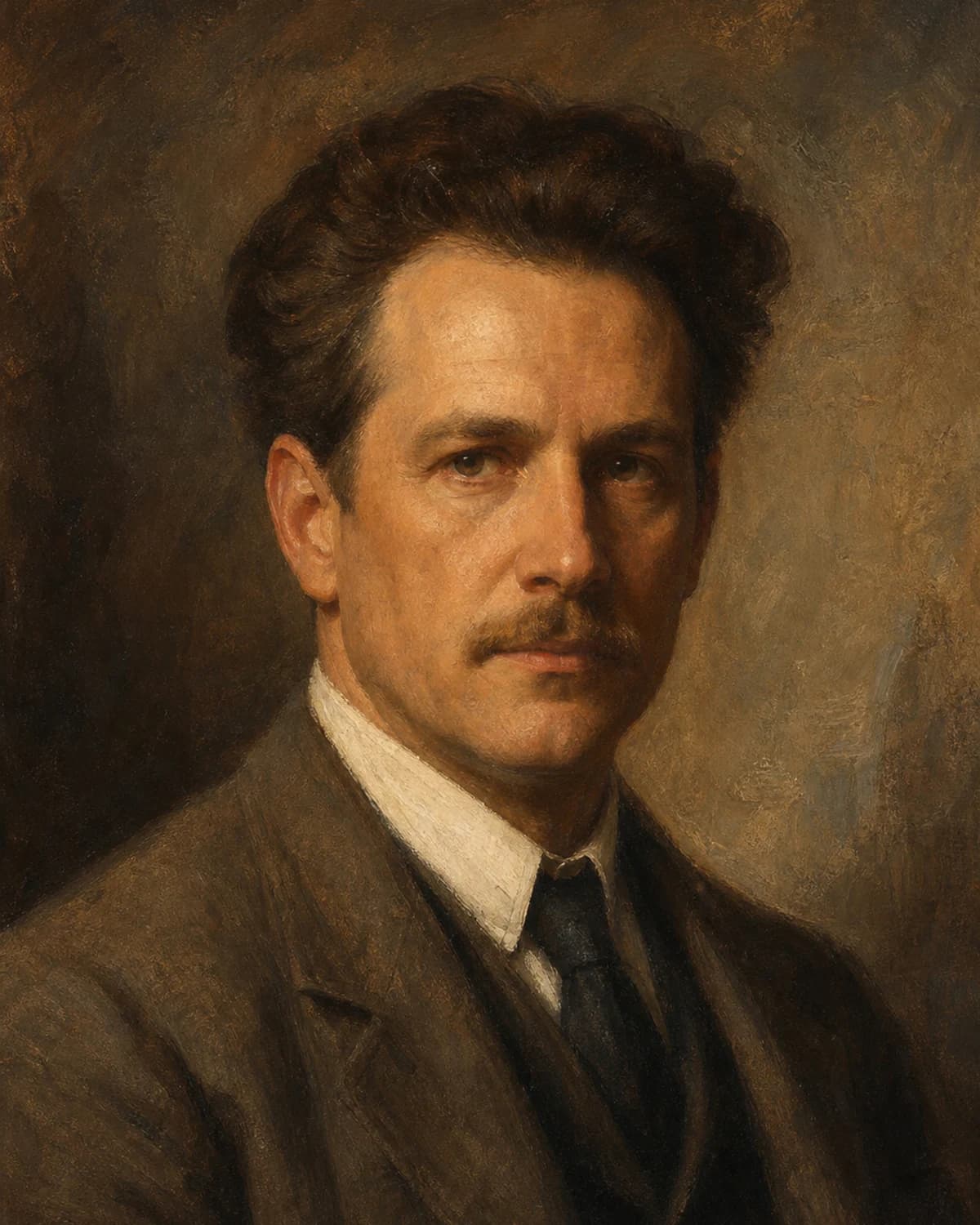
Elioth Gruner
Elioth Gruner (1882–1939) was born in New Zealand but grew up in Sydney, and from the age of fourteen worked in a shop fourteen hours a day, drawing only at weekends. He won the Wynne Prize for landscape seven times; his best-known picture, “Spring Frost” (1919), is in the Art Gallery of New South Wales. He painted small canvases, chiefly light over the Australian countryside.
Biography
In 1916 a small landscape, “Morning Light”, won the Wynne Prize, awarded for the best Australian landscape of the year. The canvas shows Jim Innes’s farm at Emu Plains, near Sydney. The Art Gallery of New South Wales bought the picture, and the painter was thirty-three.
Elioth Lauritz Leganyer Gruner was born on 16 December 1882 in Gisborne, New Zealand, the younger son of Elliott Grüner, a bailiff born in Norway, and his Irish wife Mary Ann. Before he was a year old the family moved to Sydney. He wanted to draw from early childhood. When he was about twelve, his mother took him to Julian Ashton, who gave him his first lessons.
Then his father and older brother died. At fourteen Gruner took a job in a shop to help keep the household going, and worked there from 7.40 in the morning until 9.30 at night. He painted at weekends. From 1901 he sent work to the exhibitions of the Society of Artists in Sydney, and from about 1907 he began to attract serious attention; among his admirers was Norman Lindsay, the artist and critic.
In 1911 a small shop selling works by Australian artists was opened in Bligh Street, Sydney, and for a time Gruner ran it. He then became an assistant to Ashton at the Sydney Art School, and when Ashton fell ill he took over all the classes for about three months.
After “Morning Light” he won the Wynne Prize again in 1919 with “Spring Frost”, which shows Jim Innes and his cattle. The picture later became, perhaps, the best-loved landscape among the Art Gallery of New South Wales collection. The following year the gallery’s trustees commissioned a large picture from him, “The Valley of the Tweed”. It also won the Wynne Prize, in 1921, but is regarded as a capable work rather than one of his best. After that he seldom used a canvas larger than twenty-four inches. In all he won the prize seven times: for “Morning Light”, “Spring Frost” and “The Valley of the Tweed”, and then in 1929 (“On the Murrumbidgee”), in 1934 (“Murrumbidgee Ranges, Canberra”) and twice in a row, in 1936 (“An Australian Landscape”) and 1937 (“Weetangera, Canberra”). Among Australian artists only Hans Heysen has won it more often.
In 1923 Gruner went to Europe and for about two years was away from Australia. The journey noticeably changed his painting: there was more simplification, more attention to pattern, and his brushwork became freer and broader. Sir William Orpen made comments on his work that affected his manner. Light now interested him less, and his pictures sometimes took on a slightly cold cast. His admirers did not always welcome the changes. I think he was right not to let himself settle into a groove.
In 1927 he held a one-man show. He painted little and sold almost everything he produced. He spent a long time looking for a suitable subject and longer still thinking about it before the first brushstroke. He later returned to light, and the best works of his last years, by report, combined the strengths of his art with his old passion. In 1930 he painted “The Dry Road” (untitled; that is what it is called), which the Canberra Museum and Gallery acquired in 2014. It is believed to show a stock route in the Naas Valley, south of Canberra, with Mount Tennent as the mountain behind. In 1938 Gruner joined the Australian Academy of Art, founded by Robert Menzies in opposition to modernism, and exhibited with it.
Gruner died on 17 October 1939 at his home in Waverley. He was cremated with Anglican rites. He never married, but he left descendants in Australia and New Zealand.
Related context
Associations
Works connected through artistic movements, cultural context and period. Priced works available in this market appear first.








Profile notes
Profile and sources
Image
Artist image
На основе открытого изображения: Elioth Gruner (1883-1939); Wikimedia Commons; Public domain.
