
13.11.1878–15.08.1967
Elena Luksch-Makowsky
Elena Luksch-Makowsky (1878–1967), daughter of the court painter Konstantin Makovsky, became the first woman member of the Vienna Secession in the early 1900s. She painted “Adolescentia”, now in the Belvedere in Vienna, and made three reliefs for the façade of the Burgtheater. From 1907 she lived in Hamburg, where her sculpture “Woman’s Fate” was installed.
Biography
In 1897 Elena Makowsky travelled down the Volga from Rybinsk to Samara and brought back a great many sketches. One of them was bought by the railway magnate and patron Ivan Bloch, who gave her a two-year scholarship to study abroad. She would return to those Volga sketches a quarter of a century later.
She was born in Saint Petersburg in November 1878; sources give the exact day differently (1, 13 and 14 November, and her autobiography says 14 November, 26 November in the New Style), so only the month is given here. Her father, Konstantin Makovsky, was a court painter, and her mother, Julia, was his second wife. Her elder brother Sergey became a poet of the Silver Age, the Russian poetry of the early twentieth century. The girl was being prepared for life as a wife and housekeeper, but her father recognised her gift and supported it. In 1889 her mother took the children on a tour of Europe, to Venice, Florence and Nice, and Elena later credited this trip with her fluent English, French and German. She began her studies at the school of the Imperial Society for the Encouragement of the Arts, then at the Academy of Arts, where, according to some accounts, she studied with Ilya Repin.
The scholarship took her to Munich, to the school of Anton Ažbe. There she met Ivan Bilibin, Mstislav Dobuzhinsky, Marianne von Werefkin, Alexej von Jawlensky and Dmitry Kardovsky, and through Igor Grabar the circle of World of Art, the St Petersburg group of artists and designers. In 1898 she moved to the school of Matthias Gasteiger and Julius Exter at Deutenhofen Castle near Dachau. It was there that she met the Viennese sculptor Richard Luksch. She agreed to accept his proposal when he promised in writing not to hinder her trips to Russia and to let her work as an independent artist. The wedding took place on 3 July 1900; from then on she signed herself with a double surname. Their son Peter was born in 1901.
In Vienna she exhibited with the Secessionists until the split of 1905. She was the only woman in the group with a monogram of her own, but she was not given a vote. Her work had a prominent place at the fourteenth Secession exhibition in 1902, known as the Beethoven exhibition, and in 1903 her colour woodcuts appeared in a special issue of the journal “Ver Sacrum”. She also worked for the Wiener Werkstätte, the Viennese arts and crafts workshops. In 1905 she made reliefs for the main façade of the Burgtheater. The painting “Adolescentia” shows a young nude girl at full length. She kept working with Russian motifs and translated them into the language of Austrian modernism.
From 1907 the family lived in Hamburg: Richard Luksch had obtained a teaching post there at the School of Arts and Crafts. Here Elena began the sculpture “Woman’s Fate” (Frauenschicksal), in which art historians see a foreshadowing of her later solitude with her children; in 1926 the work was installed in a city park. In 1910 she travelled to Russia with her two sons. In 1918 a daughter, Maria, was born (sources differ: by some accounts the family had two sons and a daughter, by others three sons, so the make-up of the family needs checking). The marriage broke down in 1921, and the burden of earning a living fell on her alone.
In 1922–1928 she painted pictures based on her Volga sketches of 1897. In 1925 she drew up a design for a monument to Russian prisoners of war. When the National Socialists came to power she joined the professional association attached to the Reich Chamber of Fine Arts (by some accounts in 1933, by others in 1934), but it brought no major commissions, and she lived chiefly on private portraits. After the war, by some accounts, she studied Hamburg culture, by others, she painted icons and made decoration for the Russian Orthodox parish in Hamburg. Many of her late works are lost.
Elena Luksch-Makowsky died on 15 August 1967 in Hamburg. In 2019 her work was shown in the exhibition “City of Women” at the Belvedere, and a year later the same museum held a solo exhibition of her work with the first catalogue.
Related context
Associations
Works connected through artistic movements, cultural context and period. Priced works available in this market appear first.








Profile notes
Profile and sources
Image
Artist image
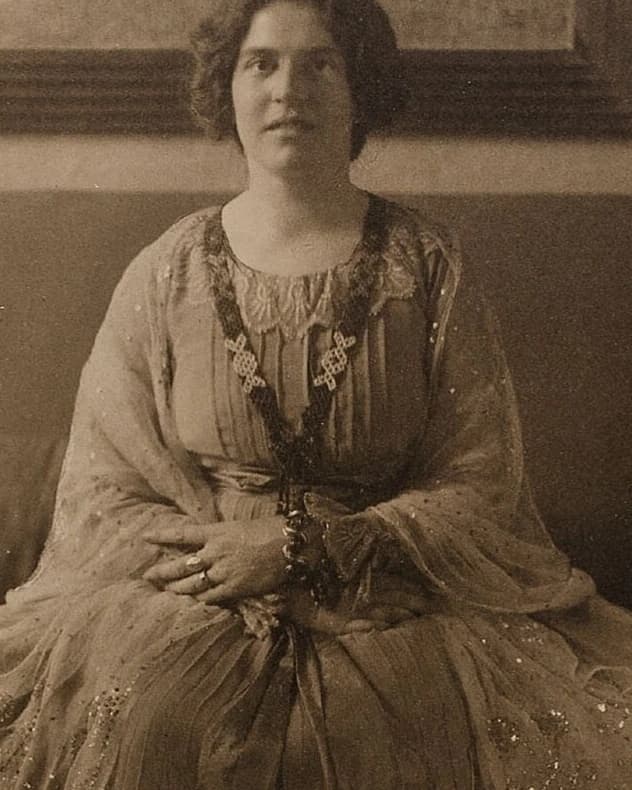
Minya Diez-Dührkoop; Wikimedia Commons; Public domain.
