
18.05.1877–23.04.1913
Elena Guro
Elena Guro (1877–1913) wrote poems, prose and plays and illustrated them herself. She studied under Ciągliński, Bakst and Dobuzhinsky and, together with her husband, Mikhail Matyushin, stood at the origins of Cubo-Futurism. Her books “The Hurdy-Gurdy”, “Autumnal Dream” and the posthumous “The Little Camels of the Sky” were valued by the Futurists and their opponents alike, and her works are held in the Tretyakov Gallery and the Russian Museum.
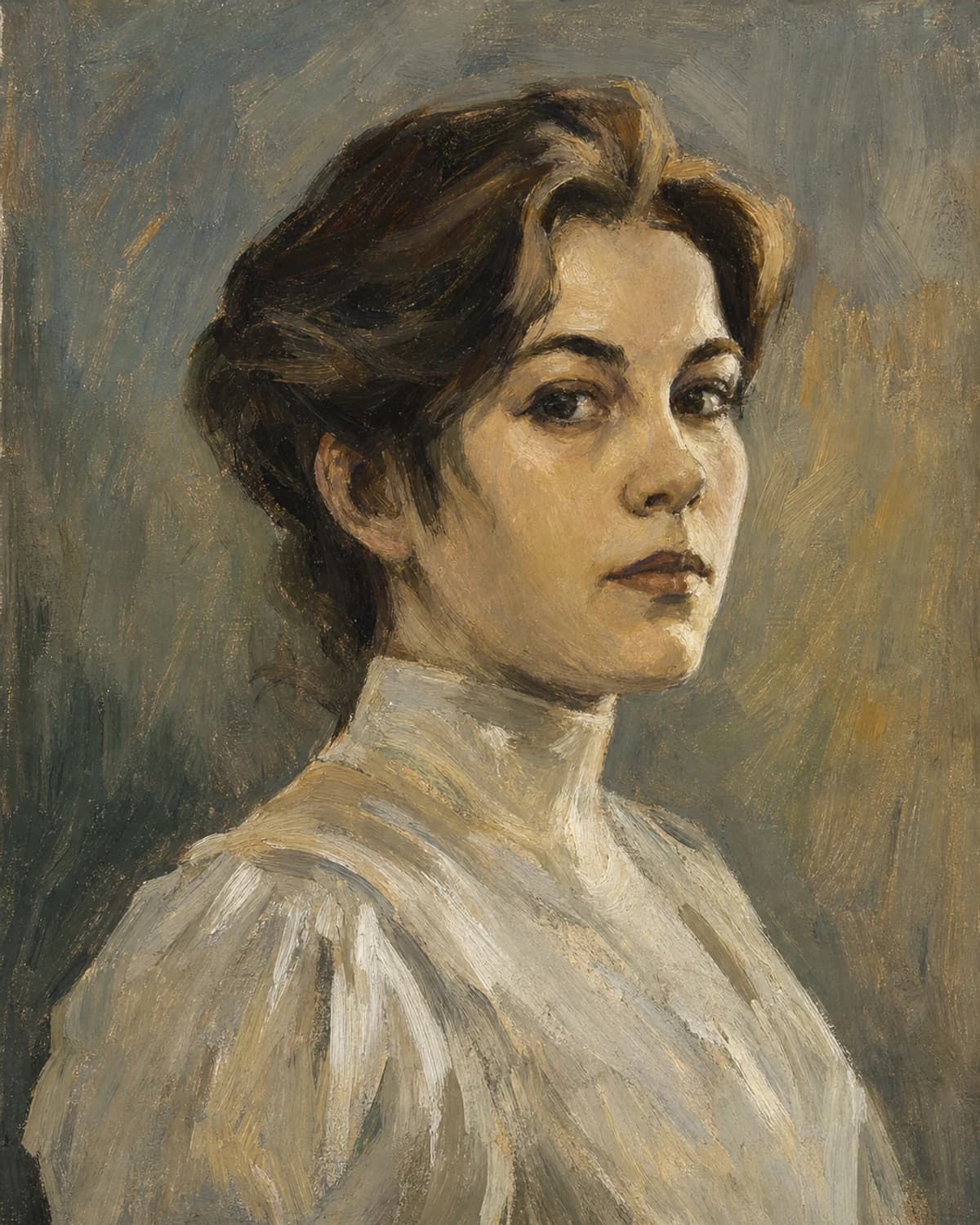
Biography
In 1909 “The Hurdy-Gurdy” came out in Saint Petersburg: stories, poems and plays, with a cover and drawings by the author and music by Mikhail Matyushin. The edition never sold out in Elena Guro’s lifetime, and the remaining copies were put on sale again only after her death. The book was, however, warmly received by Vyacheslav Ivanov, Lev Shestov, Alexei Remizov and Alexander Blok.
She had four years left to live.
She was born on 18 (30) May 1877 in Saint Petersburg. The Guro family traced its origins to Germanised French Huguenots; her father, Genrikh Stepanovich, rose to the rank of general of infantry, and her mother, Anna Mikhailovna, née Chistyakova, drew well. Her maternal grandfather, the educator Mikhail Borisovich Chistyakov, wrote for children and published the “Magazine for Children”. From the 1880s the family spent most of the year on an estate near Pskov and returned to Saint Petersburg only for the winter. Her sister Ekaterina, by marriage Nizen, also became a writer.
Guro learned to draw at home, then in 1890–1893 at the school of the Society for the Encouragement of the Arts, and later in the studio of Jan Ciągliński, where she met the musician and painter Mikhail Matyushin; they married in 1904 or, by other accounts, in 1906. In 1906–1907 she studied under Léon Bakst and Mstislav Dobuzhinsky at Elizaveta Zvantseva’s school, left in 1908 and set up her own studio. Her literary debut came in 1905 with the story “Early Spring” in an “Anthology of Young Writers”; the same year George Sand’s “Grandmother’s Tales” came out in Kharkov with her illustrations. Later she illustrated Blok’s poems in the almanac “Priboi” and knew him personally.
In 1908–1910 the Matyushins’ house on Pesochnaya Street became the place where the future Cubo-Futurists, the “budetlyane”, gathered: David Burliuk, Vasily Kamensky, Velimir Khlebnikov. The publishing house Zhuravl was founded there, and in 1910 it brought out the first Cubo-Futurist miscellany, “A Trap for Judges”, with Guro among the contributors, followed by a second in 1913. Guro and Matyushin paid for both issues themselves. From 1910 to 1913 she exhibited with the Union of Youth. In 1911 a publisher lost the manuscript of her book of fairy tales together with its illustrations. In 1912 “Autumnal Dream” appeared, with the play of that name, fragments, and drawings by the author and Matyushin, and Vyacheslav Ivanov wrote of it kindly. Even Vladislav Khodasevich, who was hostile to Futurism, set Guro apart from the other Futurists. The house, now on Professor Popov Street, is today the Museum of the Saint Petersburg Avant-Garde.
Her poetry and prose are close to painting: the short lyrical fragment, free verse, impression in place of plot. The city in her work is accursed, nature is alive, and through many poems runs a longing for a dead son, Wilhelm Notenberg. There was no such son. I think this invented son explains a good deal in her lyric poetry, where motherhood extends to the whole world. In the poem “Finland” (1913) she builds a transrational language out of the sound of Finnish speech, and she dedicated “Finnish Melody” to the Finnish singer Pasi Jääskeläinen, well known at the time. From 1911 Guro studied the laws of colour and based her theory on the principles of form in Art Nouveau and on Scandinavian folk art; Matyushin applied her ideas after her death.
Guro died on 23 April (6 May) 1913 at her country house in Uusikirkko on the Karelian Isthmus (now the village of Polyany in the Vyborg district of the Leningrad region) and was buried there, in the Finnish cemetery; the grave has not survived. The book “The Poor Knight” was left almost finished. The same year the Futurists dedicated to her memory the miscellany “The Three”, with poems by Khlebnikov and Kruchenykh, her own posthumously published work and drawings by Kazimir Malevich, and in 1914 Zhuravl published “The Little Camels of the Sky” with her illustrations.
Among young Petrograd poets of the 1910s a cult of Guro persisted, and the publishing house “The House on Pesochnaya” continued Zhuravl. A new interest in her was awakened by Vladimir Markov’s book “Russian Futurism” (1968); abroad she was published in 1988, 1995 and 1996, and in Russia two different collections came out under the title “The Little Camels of the Sky” (1993 and 2002). Her works are in the Tretyakov Gallery, the Russian Museum, the Pushkin Museum of Fine Arts, the Museum of the History of Saint Petersburg, the Mayakovsky Museum and the Stedelijk Museum in Amsterdam, and her archives are kept in the Russian State Archive of Literature and Art, the Pushkin House and the National Library of Russia.
Related context
Associations
Works connected through artistic movements, cultural context and period. Priced works available in this market appear first.








Profile notes
Profile and sources
Image
Artist image
На основе открытого изображения: Elena Guro; Wikimedia Commons; Public domain.
