
10.11.1890–30.12.1941
El Lissitzky
El Lissitzky (1890–1941), an architect by training, began by illustrating children’s books in Yiddish, and in Vitebsk, alongside Malevich, invented the “Prouns”, a three-dimensional variant of Suprematism. He designed Mayakovsky’s “For the Voice” and projected “horizontal skyscrapers” for Moscow and the Ogonyok printing plant, but regarded exhibitions as his main work, among them the Soviet pavilion at Pressa in Cologne (1928).
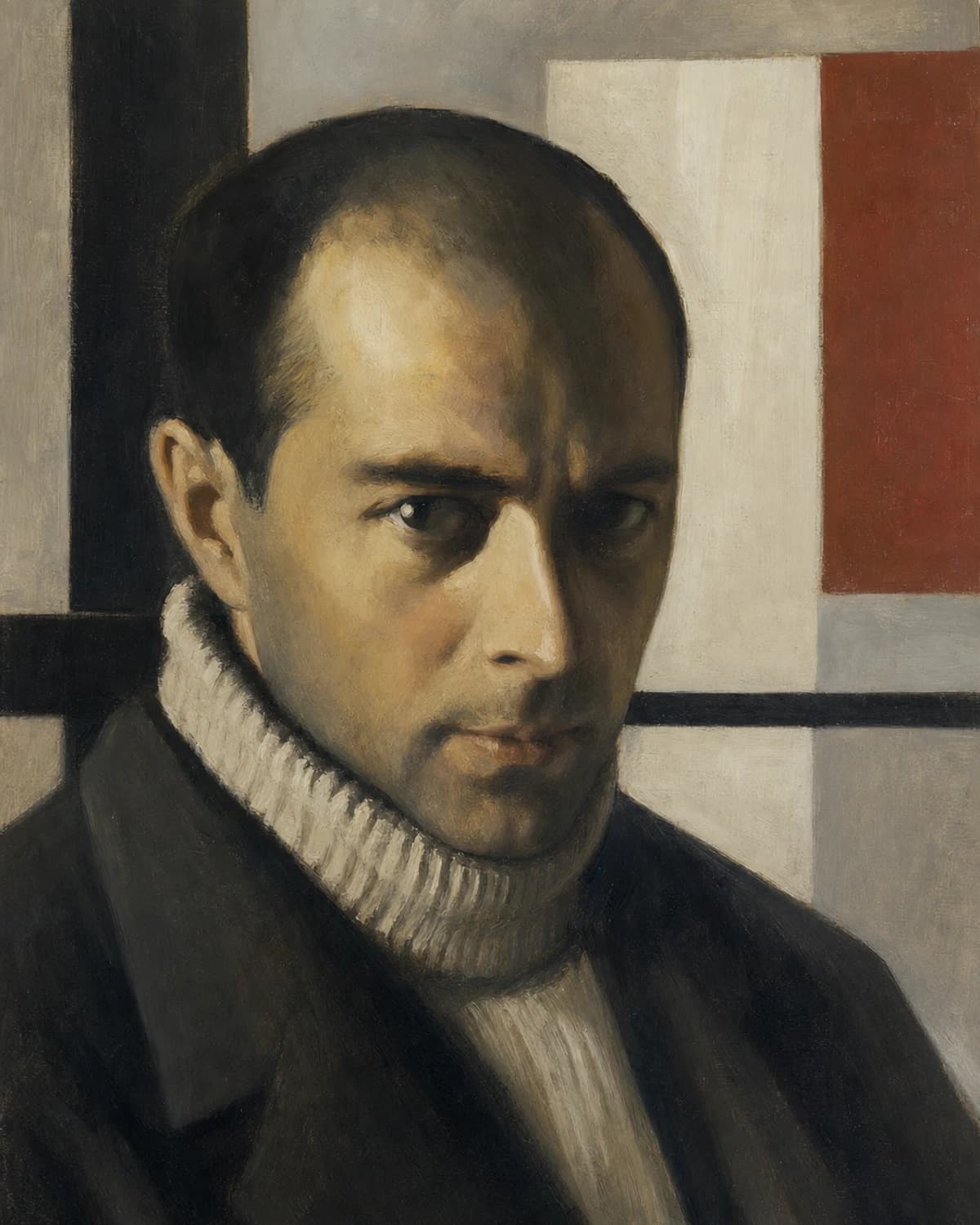
Biography
In the photomontage “The Constructor” (1924), El Lissitzky’s face is superimposed on a hand holding a pair of compasses, with graph paper and letters laid over the top. He made it while undergoing treatment at a Swiss sanatorium near Locarno, and in a letter to Sophie Küppers, his future wife, he called the self-portrait “my monkey-hand”. Later the work would be called an icon of Constructivism.
He was born on 10 (22) November 1890 in the shtetl of Pochinok in Smolensk Governorate, into a Jewish family; his father, Mordukh Zalmanovich (Mark Solomonovich), later opened a crockery shop in Vitebsk. In Vitebsk the boy took drawing lessons at the private school of Yehuda Pen, whose pupils also included Chagall and Zadkine, and from the age of fifteen, by his own account, he earned his living by tutoring and drawing. In 1909 he finished the secondary school in Smolensk. He went to Germany to study architecture, at the technical university in Darmstadt, where he worked on the side as a bricklayer and drew the medieval synagogue at Worms. In 1914 he graduated with distinction, and when the war broke out he returned to Russia by a roundabout route, through Switzerland and the Balkans. To be able to practise at home, in 1915 he enrolled as an external student at the Riga Polytechnic Institute, then evacuated to Moscow, and on 14 April 1918 received the title of engineer-architect. In 1916–1917 he worked as an assistant in the office of Boris Velikovsky, then with Roman Klein.
In 1916, together with Issachar Ber Ryback, he travelled through the shtetls of the Belarusian Dnieper region and Lithuania, searching for monuments of Jewish antiquity; what struck him most were the paintings of the wooden synagogue in Mogilev. From 1917 he illustrated books in Yiddish. The first, Moyshe Broderzon’s “Sikhes khulin”, was made in the form of a Torah scroll in an edition of 110 copies; for two versions of the Passover song “Had Gadya” (1917 and 1919) he coloured each character to match the colour of the word that names it. In 1918 he was among the founders of the art section of the Kultur-Lige in Kiev.
In the spring of 1919 Marc Chagall invited him to Vitebsk to teach graphic art, printing and architecture at the People’s Art School. In the autumn Lissitzky persuaded Kazimir Malevich to move there, and soon went over to his side; Chagall later recalled with bitterness his “most zealous disciple”, who, once made a professor, crossed over to the camp of his opponents. Lissitzky printed Malevich’s book “On New Systems in Art” and became one of the founders of the UNOVIS group; the signature “El Lissitzky” first appeared in its handmade almanac in the spring of 1920. At the same time he began the “Prouns”, from “project of UNOVIS”: axonometric images of geometric bodies that either rest on a solid base or float in the void, with no top or bottom. To these years belong the poster “Beat the Whites with the Red Wedge” and the children’s book “Of Two Squares”, in which a red and a black square fly to Earth.
In 1921 he taught at the VKhUTEMAS, but that same year he left for Germany and lived there and in Switzerland until 1925. In Berlin, together with Ilya Ehrenburg, he brought out the magazine “Veshch” in three languages, became close to Kurt Schwitters, László Moholy-Nagy and Theo van Doesburg, in 1923 designed Mayakovsky’s collection “For the Voice”, made a portfolio of lithographs with figures for the opera “Victory over the Sun”, and built the “Proun Room” at the Great Berlin Art Exhibition, which the viewer entered as if stepping into a picture. In the sanatorium in 1924–1925 he completed his design for “horizontal skyscrapers” for Moscow: eight L-shaped blocks raised on supports fifty metres above the intersections of the Boulevard Ring. It seems to me that this is the most convincing of his paper utopias, because he justified it with an almost everyday argument: as long as people cannot fly, moving horizontally is more natural for them than moving vertically.
On his return to Moscow in 1925 he taught VKhUTEMAS students to design interiors and furniture until 1930. In an autobiography written in June 1941 he noted: “1926. My most important work as an artist begins: the creation of exhibitions.” For Hanover he made the “Abstract Cabinet”, for Dresden a room for Constructivist art, and in Moscow in 1927 he designed the All-Union Polygraphic Exhibition. The Soviet pavilion at the Pressa exhibition in Cologne in May 1928 was put together by a collective of thirty-eight people under his direction; at its centre hung a photo-fresco twenty-three and a half metres long, and for this pavilion he received a government award. Then came “Film und Foto” in Stuttgart (1929), the poster for the Russian Exhibition in Zurich with two merged heads, and exhibitions in Leipzig and Dresden (1930). In 1927, in Moscow, he married Sophie Küppers, the widow of a Hanover art historian.
His only realised building was the printing plant of the magazine Ogonyok in First Samotyochny Lane (1930–1932), with huge square and small round windows.
In the 1930s he and his wife designed the magazine “USSR in Construction”, published in several languages. In 1937 Lissitzky was chief designer of the All-Union Agricultural Exhibition, but in 1938 his project was rejected. His last work was the poster “Give Us More Tanks”. El Lissitzky died in Moscow on 30 December 1941 and was buried in the Donskoy Cemetery. In 1944 his widow and son were deported to Novosibirsk as Germans, and the book about her husband that she wrote there in the 1960s could be published only in German.
Related context
Associations
Works connected through artistic movements, cultural context and period. Priced works available in this market appear first.








Profile notes
Profile and sources
Image
Artist image
На основе открытого изображения: El Lissitzky; Wikimedia Commons; Public domain.
