
24.11.1843–20.01.1913
Ekaterina Junge
Countess Ekaterina Fyodorovna Tolstaya, married name Junge, studied under her father, vice-president of the Academy of Arts, painted Crimean landscapes and portraits in watercolour, and taught in Kyiv and Moscow. With her husband she stood at the origins of Koktebel as a resort of summer villas. Leo Tolstoy read her memoirs of Shevchenko and of her father’s circle.
Biography
Leo Tolstoy, in his own words, “devoured” her memoirs “at the wrong time”. The book was by Ekaterina Junge, who as a child had seen Taras Shevchenko in her father’s house and wrote about him. She herself was, above all, a watercolourist.
She was born in Saint Petersburg on 24 November 1843 (6 December, Old Style). Her father, Count Fyodor Petrovich Tolstoy, was a painter and sculptor, vice-president of the Imperial Academy of Arts; her elder half-sister was the writer Maria Kamenskaya. Writers and artists came to the house, among them Shevchenko, whom her father supported. Ekaterina took her first drawing lessons from her father. In 1860–1861 she travelled with her parents through Germany and France to Italy. In Milan she was struck by Leonardo’s “The Last Supper”; in Florence she visited Nikolai Ge and there met the sculptor Parmen Zabello and Mikhail Bakunin. The family returned through Switzerland. Later, as is generally held, she studied in Düsseldorf with Oswald Achenbach and Benjamin Vautier, and in Paris worked in the studio of Charles-François Daubigny. I would check these details against further sources.
On 15 September 1863 she married the ophthalmologist Eduard Andreyevich Junge, a professor at the University of Saint Petersburg. They had four sons: Vladimir (1864–1902), Fyodor (1866–1927), Alexander (1872–1921) and Sergei (1879–1902). In 1883 the couple bought a large tract of land at Koktebel on the Crimean coast and later sold it off as plots for villas; this is how the resort village arose. From 1890 they lived apart. Vladimir and Sergei, who died in 1902, are buried beside their father in the family crypt on a hill by the sea near the estate.
In the reign of Alexander II she kept a liberal salon in Saint Petersburg. From 1882 to 1887 she lived in Kyiv, where she organised a drawing school for women and taught landscape, flower painting and preparatory drawing. She then moved to Moscow and taught oil painting and watercolour at the Stroganov School of applied art, as well as porcelain painting at courses for women. Her watercolours, landscapes and genre scenes were regularly shown at the exhibitions of the Society of Russian Watercolourists, and they were collected, as is commonly believed, by Pavel Tretyakov. In 1878 she received the small silver medal of the Academy of Arts, and in 1885 she became an honorary free associate of the Academy. Junge’s works are in the Tretyakov Gallery, the Literary Museum in Moscow, the Hermitage, the Vasily Polenov Museum-Estate and private collections. Several studies are in the House-Museum of Maximilian Voloshin in Koktebel; she also painted a portrait of Voloshin, with whom she long remained on good terms.
She met Tolstoy when, after the Crimean War, he came to Saint Petersburg and visited her father. Almost thirty years later the acquaintance was renewed: she had been deeply affected by Tolstoy’s “The Gospel in Brief”, written in 1884. She visited him at Yasnaya Polyana more than once and sometimes corresponded with him. The writer Sergei Elpatyevsky thought that in face she greatly resembled Leo Nikolayevich. In 1903, when Tolstoy was gathering material for “Hadji Murat”, she brought him notes on Nicholas I written at his request: seven episodes, of which two held his attention, and the last he used almost in full.
She knew Nikolai Ge personally and twice, in 1884 and 1891, stayed with him at his farmstead of Ivanovskoye. Detailed recollections of one of the versions of “The Crucifixion”, which the artist himself destroyed, were published in 1978. Ilya Repin drew on her spoken account of meeting Ge and of her impression of this painting in his article in memory of the artist.
She published memoirs of Shevchenko in 1883 and 1905, and of Nikolai Kostomarov in “Kievskaya starina” in 1890. The book “Memoirs (1843–1860)” appeared in Moscow in 1914, after her death. Junge died in Moscow on 20 January 1913 (2 February, New Style) and was buried in the necropolis of the Donskoy Monastery. Her writings and correspondence were collected in a volume published in 2017.
Related context
Associations
Works connected through artistic movements, cultural context and period. Priced works available in this market appear first.








Profile notes
Profile and sources
Image
Artist image
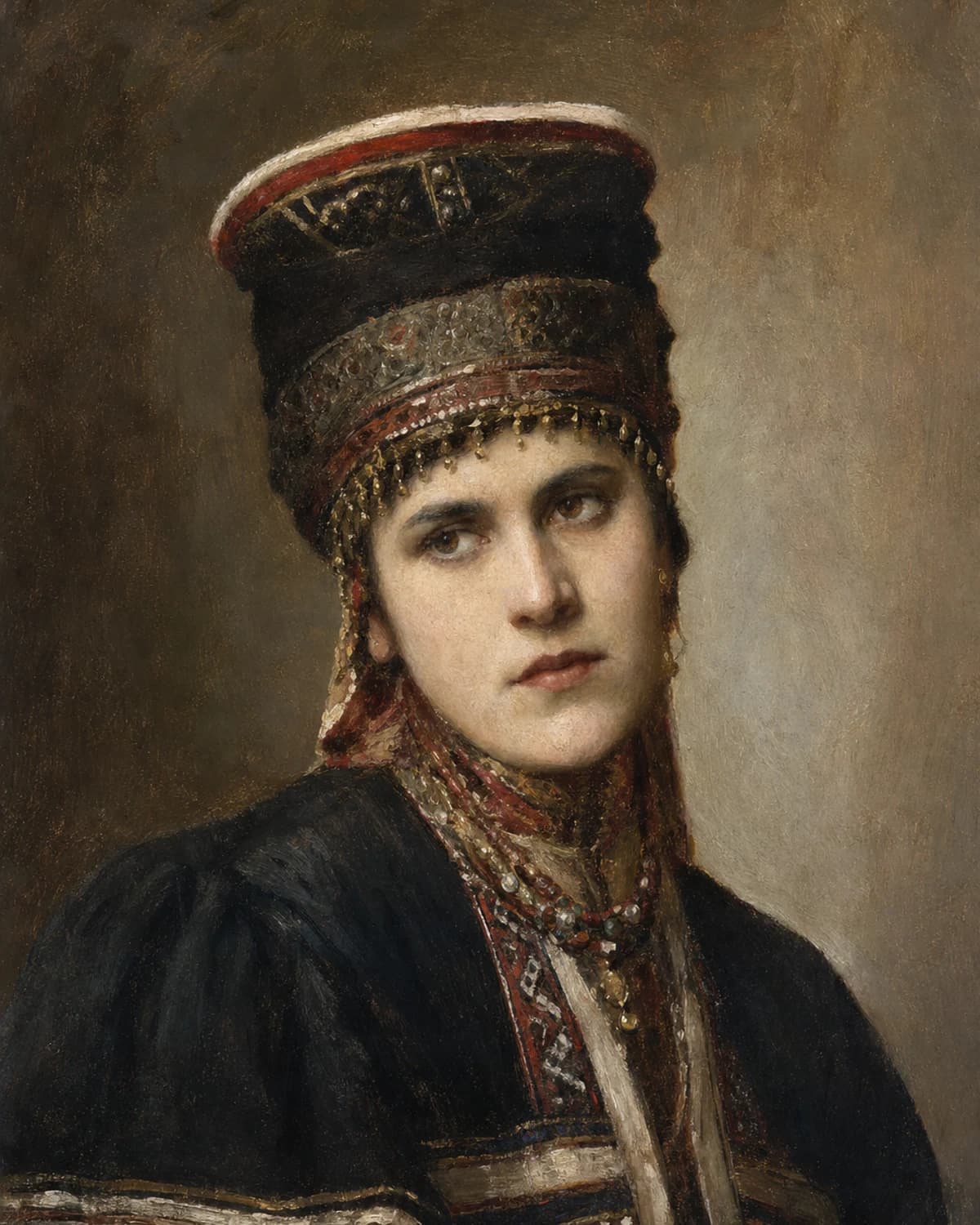
На основе открытого изображения: E.F. Junge (my grand-grandmother); Wikimedia Commons; CC BY-SA 4.0.
