
12.06.1890–31.10.1918
Egon Schiele
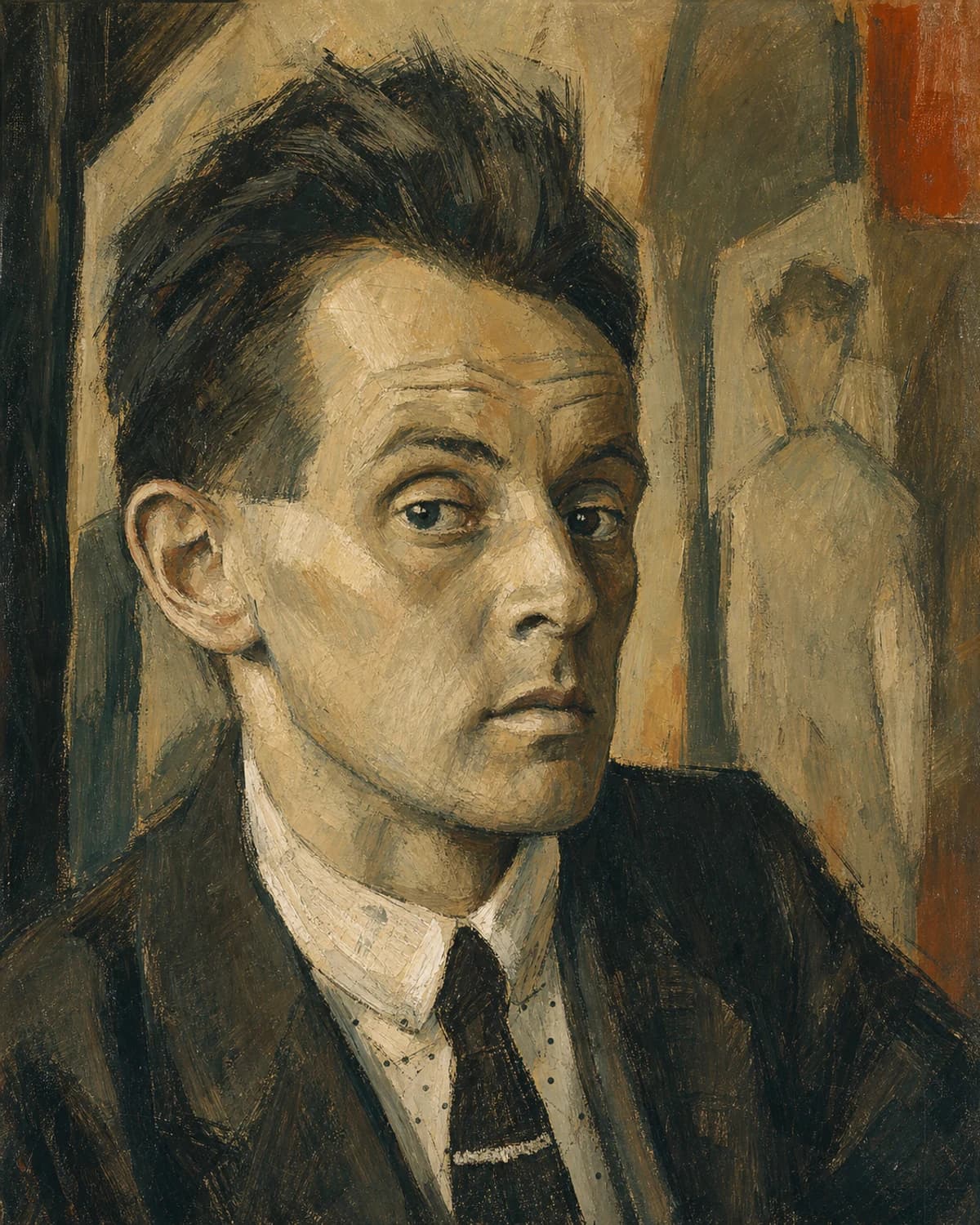
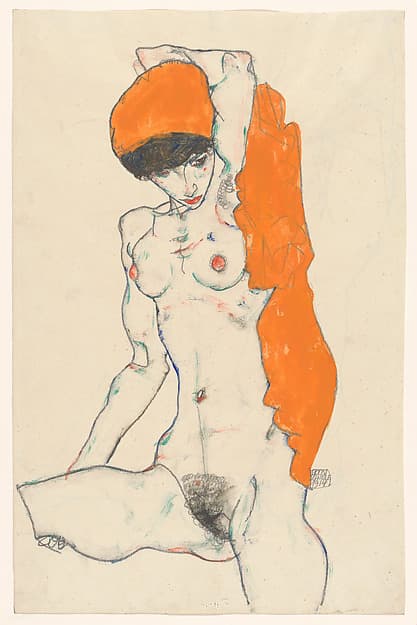
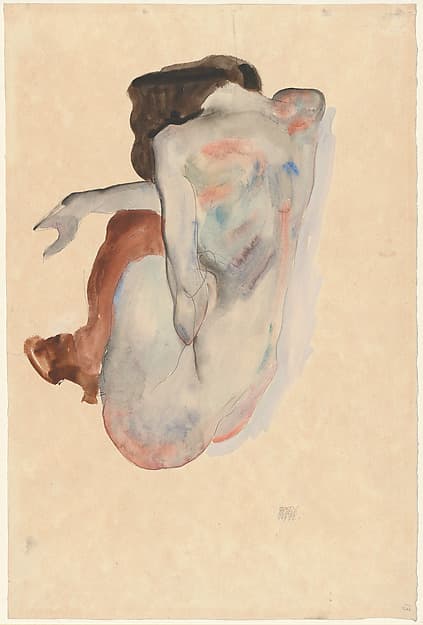
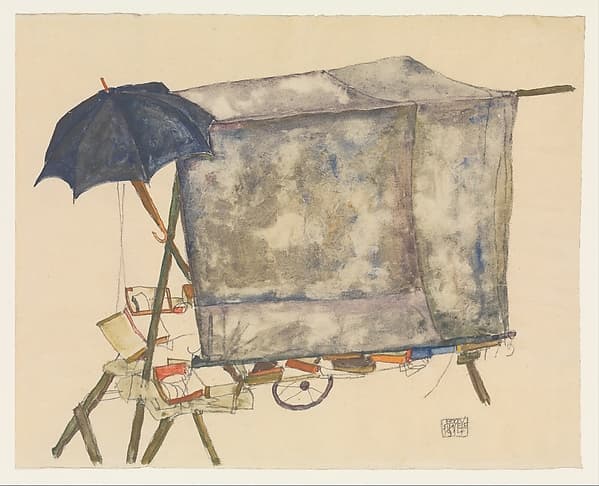
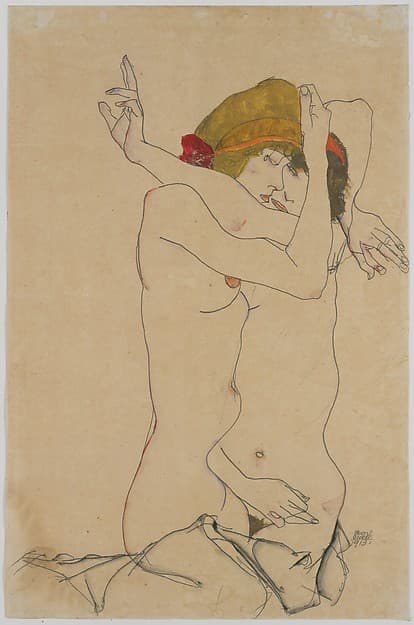
Egon Schiele (1890–1918) lived twenty-eight years and left about three hundred paintings and several thousand drawings: nudes with a broken, angular contour, a great many self-portraits, landscapes. He was Klimt’s pupil and protégé from the age of seventeen, spent more than three weeks under arrest in 1912, and in 1918 fifty of his works filled the main hall of the 49th exhibition of the Vienna Secession.
Biography
For the 49th exhibition of the Vienna Secession in 1918 Egon Schiele drew a poster that resembles “The Last Supper”, except that at the head of the table, in the place of Christ, sits Schiele himself. He was given the main hall, and fifty of his works were accepted. The show was a success, his drawings went up in price, and portrait commissions followed. Klimt had died that spring, and Schiele could now lay claim to the position of Austria’s leading artist.
He had less than a year left to live.
He was born on 12 June 1890 in Tulln an der Donau, in Lower Austria, where his father, Adolf Schiele, was station master. His mother, Marie, née Soukup, came from Krumau, today’s Český Krumlov in southern Bohemia. The boy spent hours drawing trains, and his father, who thought this was harming his schoolwork, once destroyed his sketchbooks. At eleven Egon was sent to secondary school in nearby Krems, and later in Klosterneuburg. He was shy and did badly at school; only sport and drawing came easily to him. When he was fourteen his father died, and the family, until then quite well off, was left poor. His guardian became his uncle, the railway official Leopold Czihaczek: he wanted his nephew to follow him into the service, but he recognised the boy’s talent and hired a drawing teacher for him, the painter Ludwig Karl Strauch.
In 1906 Schiele entered the Vienna School of Arts and Crafts, where Klimt had once studied, and there he modelled small figures in clay and plaster. That same year, at the insistence of his teachers, he was moved to the Academy of Fine Arts. Professor Christian Griepenkerl held to strict, conservative rules, and after his third year, in 1909, Schiele left, founding the New Art Group with other dissatisfied students.
He had met Klimt as early as 1907. Klimt bought his drawings, exchanged some of his own for them, found him models and buyers, and introduced him to the Wiener Werkstätte. Schiele’s early works of 1907–1909 look very like Klimt’s, but to my mind he broke away from his teacher faster than pupils usually manage. His first exhibition took place in 1908 in Klosterneuburg, and in 1909 Klimt invited him to the Vienna Kunstschau, where he saw Munch, Jan Toorop and Van Gogh, and afterwards painted sunflowers of his own in tribute to the Dutchman. By 1910 his manner had taken shape: emaciated nudes in sickly colours with a broken, angular contour, often openly erotic. His work began to be taken for group exhibitions: those of the New Art Group in Prague (1910) and Budapest (1912), the Sonderbund in Cologne (1912), and the Munich Secession from 1911. One of his first patrons was the collector Heinrich Benesch.
In 1911 the seventeen-year-old Wally Neuzil became Schiele’s model and companion. They left Vienna for Krumau, his mother’s town, but the townspeople drove them out: they disliked the couple’s bohemian way of life and the rumours that the artist was drawing local teenage girls. Next came Neulengbach, thirty-five kilometres west of Vienna. In April 1912 Schiele was arrested on suspicion of abducting and seducing a thirteen-year-old girl, and the police seized more than a hundred drawings from his studio that they considered pornographic. The court dropped the charges of abduction and seduction but found him guilty of having erotic drawings in a place accessible to children. The judge burned one of them over a candle flame. The twenty-one days he had spent in custody before the trial were counted, and three more were added. In his cell he painted a series of works.
In 1913 the Galerie Hans Goltz in Munich gave him his first solo exhibition, and in 1914 there was another in Paris.
Across the street from his studio in Hietzing lived the sisters Edith and Adele Harms. In February 1915 Schiele wrote to his friend, the critic Arthur Roessler, that he intended to marry advantageously, “not Wally”. He apparently expected that he would not have to part with Wally, but she left him at once and never saw him again. Soon afterwards he painted “Death and the Maiden”. The wedding to Edith took place on 17 June 1915, the anniversary of his parents’ wedding, and three days later Schiele was called up into the army. He served first in Prague, where Edith lived in a hotel. Later he guarded and escorted Russian prisoners, and because of his weak heart and good handwriting he was made a clerk at a prisoner-of-war camp. The commandant, Karl Moser, who at first took him for a house painter, gave him an empty storeroom as a studio, and Schiele drew the Russian officers held there. His wartime paintings are larger and more detailed than before; the themes of motherhood and family appeared, Edith became the model for almost all his female figures, and from 1915 his nudes are fuller and deliberately doll-like. He kept exhibiting in these years too: in Berlin, Zurich, Prague and Dresden. In January 1917 he was transferred to an army supply depot in Vienna, where he had no particular duties, and was again able to work at full strength.
On 28 October 1918 Edith died; she was six months pregnant. Schiele outlived her by three days and in those days still managed to draw her several times. He died on 31 October 1918 in Vienna, in the house of his wife’s parents. He was twenty-eight.
The largest collection of his work, more than two hundred pieces, is in the Leopold Museum in Vienna; many are in the Belvedere and the Albertina, and in 1990 an Egon Schiele Museum opened in Tulln.
Artist works
Works by the artist
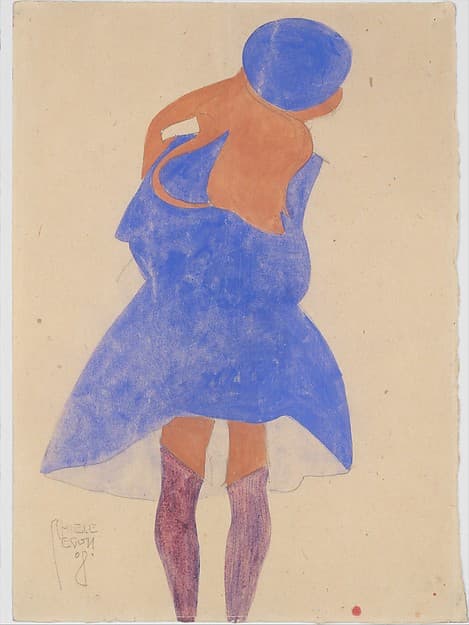
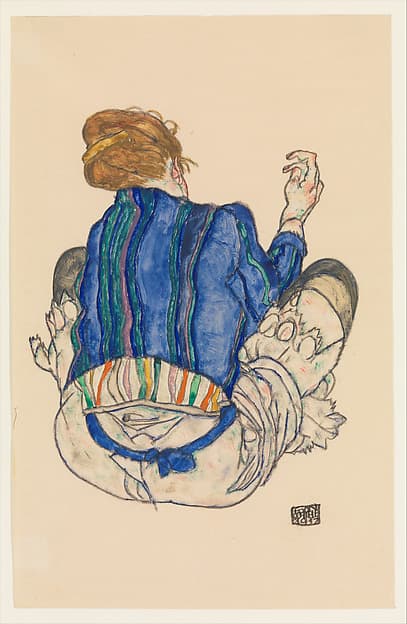
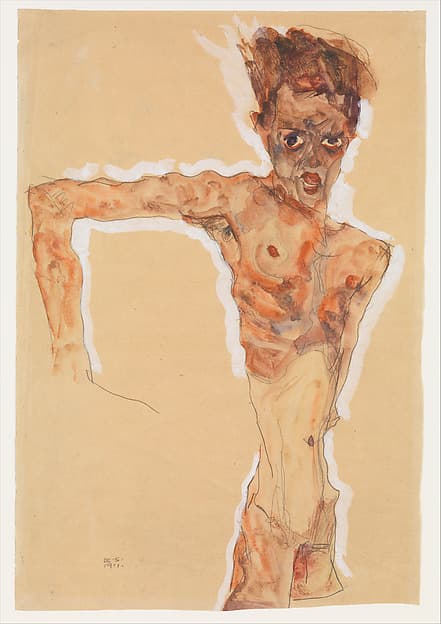
Works by Egon Schiele available in this edition of NEOARCA.
Related context
Associations
Works connected through artistic movements, cultural context and period. Priced works available in this market appear first.








Profile notes
Profile and sources
Image
Artist image
На основе открытого изображения: unattributed; Wikimedia Commons; Public domain.
