
22.07.1882–15.05.1967
Edward Hopper
For almost twenty years Edward Hopper earned his living from commercial illustration, and he won recognition only after forty, first for his watercolors and etchings. His diners, hotel rooms, gas stations and empty morning streets, as in “Nighthawks” (1942) and “Early Sunday Morning” (1930), became an image of American loneliness. He himself insisted that what interested him above all was sunlight on the wall of a house.
Biography
There are no people in “Early Sunday Morning” (1930). A row of shops with dark windows, the windows of apartments above them, a fire hydrant and a striped barber’s pole on the sidewalk, long shadows cast by a low sun. Hopper meant to put someone in the second-floor windows and in the end left them empty. As for the title, he said Sunday had nothing to do with it: the word was thought up later by someone else.
He was born on 22 July 1882 in Nyack, a shipyard town on the Hudson north of New York City. His father, Garrett Henry Hopper, sold dry goods, and his mother, Elizabeth Griffiths Smith, encouraged his drawing; Edward and his sister Marion grew up in a strict Baptist family. By the age of twelve he had shot up to nearly 180 centimeters and was nicknamed Grasshopper at school. In 1895 came his first signed oil painting, “Rowboat in Rocky Cove”. He dreamed of becoming a naval architect.
His parents insisted that he study commercial illustration for the sake of a reliable income. He began in 1899 with a correspondence course and soon moved to the New York School of Art and Design, where he spent six years. He was taught oil painting by William Merritt Chase, but his real teacher was Robert Henri, who demanded that his students paint what interested them in life and forget about “art”. George Bellows and Rockwell Kent studied alongside him. Around 1904 Hopper painted “Solitary Figure in a Theater”, his earliest surviving oil, in which his future theme of the interior is already present.
From 1905 he worked part-time at an advertising agency, drawing covers for trade magazines, work he disliked and kept doing until the mid-1920s. Between 1906 and 1910 he went to Europe three times and spent long stretches in Paris. He worked alone there and, by his own account, never heard of Picasso, but he was overwhelmed by Rembrandt’s “The Night Watch”. Of the Europeans, he later acknowledged the influence of Rembrandt, Goya and the etcher Charles Meryon, with his somber views of Paris.
The next thirteen years were hard ones. At the Armory Show in 1913 he sold his first painting, “Sailing” (1911), and hoped things would go more easily from then on, but nothing came of it. That same year, after his father’s death, he rented an apartment at 3 Washington Square North in Greenwich Village and lived there for the rest of his life. From 1915 Hopper took up etching, and by 1923 he had made most of his roughly seventy plates: “Night on the El Train”, “Evening Wind” with a lone woman in a room. In summer he painted in watercolor and oil in New England, above all on Monhegan Island. In 1918 his war poster “Smash the Hun” won a prize from the Shipping Board, in 1920 his first solo exhibition was held at the Whitney Studio Club, and in 1923 his etchings brought him two prizes.
The turning point came in 1923 in Gloucester, where he met the painter Josephine Nivison again; she too had once studied with Henri. Thanks to her, six of his watercolors went into an exhibition at the Brooklyn Museum, and the museum bought one of them, “The Mansard Roof”. In 1924 they married; that same year every watercolor in his solo exhibition sold, and Hopper gave up advertising work. Jo handled his affairs and his conversations with journalists, was his principal model, and together with him kept a detailed record book of his paintings. From 1930 they spent every summer in South Truro on Cape Cod.
After that things moved quickly. In 1930 “House by the Railroad” (1925) became the first oil painting in the collection of the Museum of Modern Art in New York; it is said to have influenced the house in Hitchcock’s “Psycho”. In 1931 the Whitney Museum and the Metropolitan Museum bought works by Hopper, and in 1933 the Museum of Modern Art gave him his first large retrospective. One after another came “Automat” (1927), “Hotel Room” (1931), “Room in New York” (1932) and “New York Movie” (1939), for which he made more than fifty sketches. The model for “Nighthawks” (1942) was a diner in Greenwich Village, he and Jo posed for it, and the title was her idea. Hopper said there was more of night predators in this picture than of loneliness. To my mind he should be taken at his word: the people at the counter look more like night birds than like sufferers. A similar argument arose over “Cape Cod Morning”: Jo decided that the woman at the window was looking to see whether she could hang out the washing, and her husband objected that she was turning his heroine into a Norman Rockwell character.
In the late 1940s a long dry spell set in; he complained that he was tired of reading and going to the movies. Then came “First Row Orchestra” (1951), “Morning Sun” and “Hotel by a Railroad” (1952), “Intermission” and “Sun in an Empty Room” (1963), in which there is almost nothing except a window and light on the walls. In his last painting, “Two Comedians” (1966), two mimes in white take a bow in front of a dark stage; Jo believed the pair were her husband and herself.
Edward Hopper died on 15 May 1967 in his studio on Washington Square and was buried in the family plot at Oak Hill Cemetery in Nyack. Josephine outlived him by ten months and bequeathed their joint collection, more than three thousand works, to the Whitney Museum.
Related context
Associations
Works connected through artistic movements, cultural context and period. Priced works available in this market appear first.








Profile notes
Profile and sources
Image
Artist image
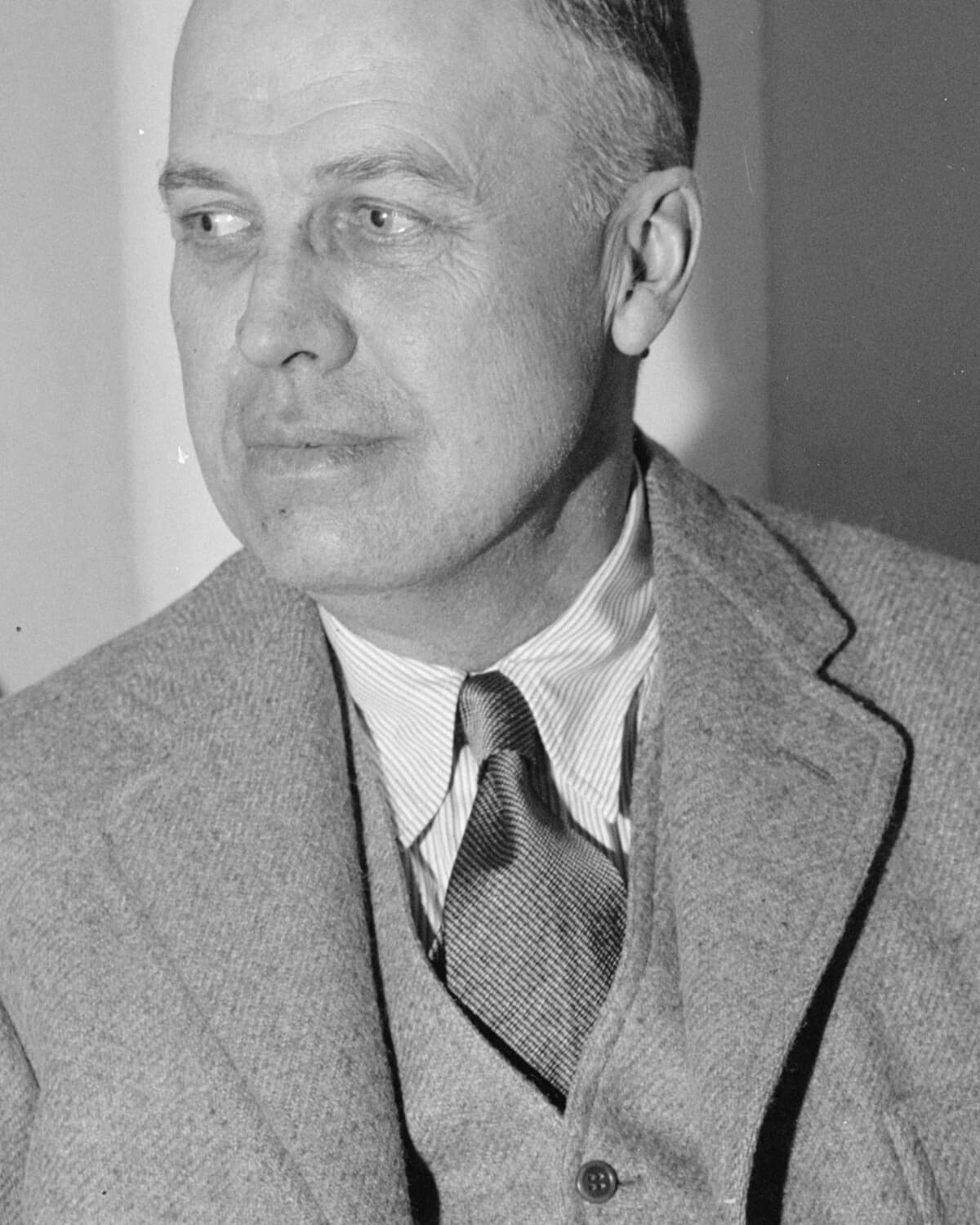
Harris Ewing, photographer; Wikimedia Commons; Public domain.
