
12.12.1863–23.01.1944
Edvard Munch
Edvard Munch (1863–1944) began among the bohemians of Kristiania, and in the 1890s, in Berlin and Paris, built from paintings of love, jealousy, anxiety and death the cycle “The Frieze of Life”, to which “The Scream” belongs. Later he decorated the assembly hall of the University of Oslo and spent his last decades on the Ekely estate. He left his collection to the city, and on its basis the Munch Museum opened in 1963.
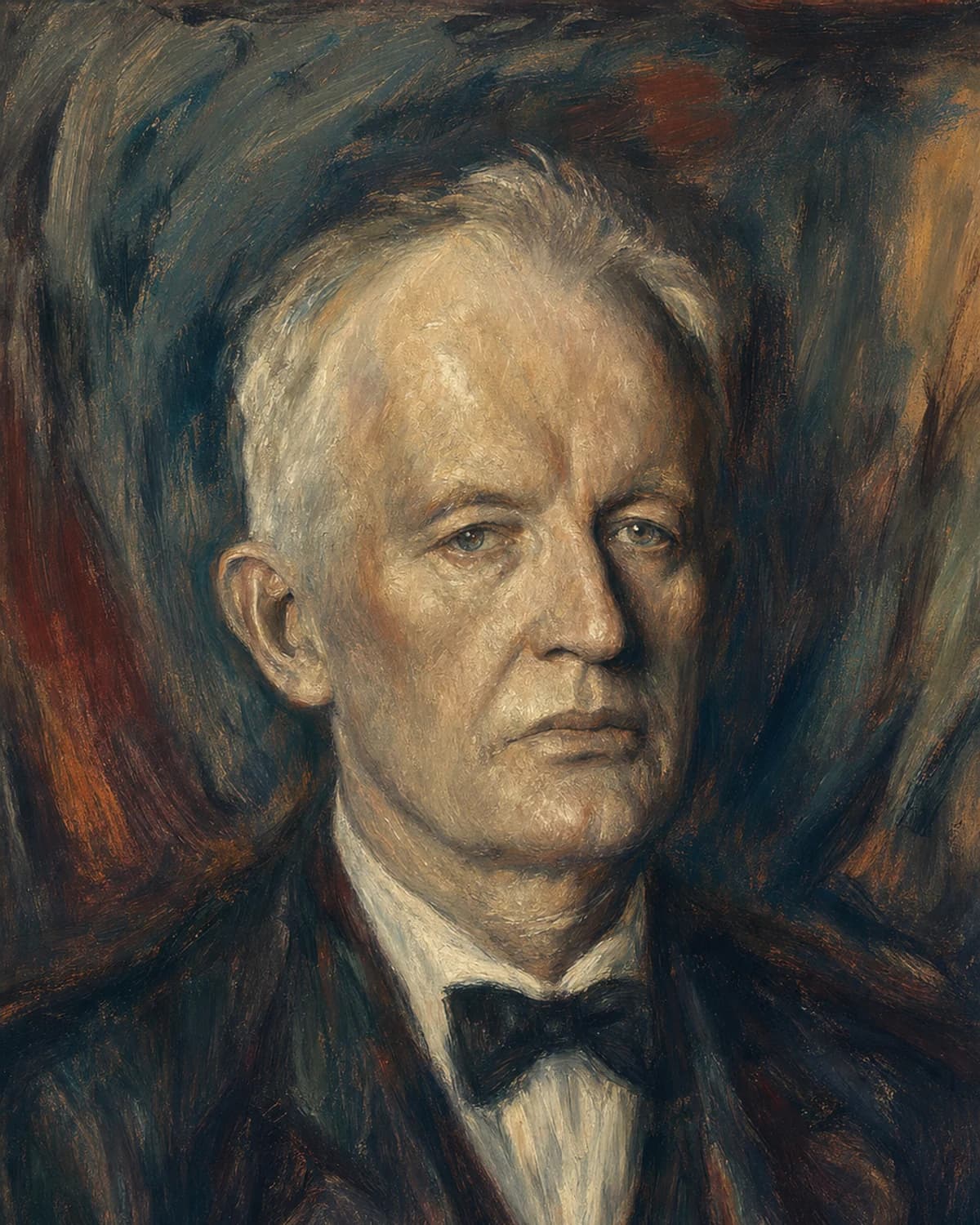
Biography
At the Autumn Exhibition of 1886 in Kristiania, “The Sick Child” was met with abuse. It was called a miscarriage and a hastily daubed sketch, and young realist painters surrounded the artist and declared him a madman. Munch himself recalled trying again and again to convey his first impression: the transparent pale skin against the white, the trembling lips, the trembling hands.
Behind the picture lay his memories of his elder sister Sophie, who had died of tuberculosis in 1877.
Edvard Munch was born on 12 December 1863 in a farmhouse at Ådalsbruk, in the municipality of Løten, the son of the army doctor Christian Munch and Laura Bjølstad, a woman half her husband’s age. Among their relatives were the painter Jacob Munch and the historian Peter Andreas Munch. In 1864 his father obtained a post in Kristiania, and Edvard’s childhood was spent in the capital, moving from one cheaper lodging to another. His mother died of tuberculosis in December 1868, when he was five; the children were brought up by her sister, Karen Bjølstad, who also kept his drawings and watercolours from the ages of eleven and twelve. His father was kind but morbidly pious, and his stories gave the boy nightly visions of hell. His childhood was overshadowed by illness, bereavement and the dread of inheriting a mental condition that ran in the family.
In 1879 he entered a technical college, but left a year later, having decided to become a painter, to his father’s displeasure. He was supported by his aunt, a friend of the family and a distant relative, the painter Frits Thaulow. In 1881 Munch entered the Royal School of Drawing; his mentor was the naturalist Christian Krohg, and through Krohg he entered the circle of Kristiania bohemians led by the anarchist writer Hans Jæger, with his call to “write your life”. In 1883 Munch made his exhibition debut, and in the spring of 1885 a scholarship took him to Paris.
In 1889 a state scholarship brought him to Paris again, to the studio of Léon Bonnat. In December belated news came of his father’s death. In those weeks a diary entry appeared that would later be called the “Saint-Cloud Manifesto”: no more interiors, men reading and women knitting, only living people who breathe, feel, love and suffer. At the same time he painted “Night in Saint-Cloud”, an empty moonlit room with a figure at the window in which some see Munch himself and others his dead father. He spent his summers at Åsgårdstrand, where he later bought a house.
By 1891–1892 his manner had taken shape: expressive line, simplified form, colour as symbol. Krohg called “Melancholy” the first symbolist painting by a Norwegian artist. In 1892 the landscape painter Adelsteen Normann arranged an exhibition of Munch’s work in Berlin; conservative members of the Association of Berlin Artists demanded that it be closed, and the dispute led to a split from which the Berlin Secession grew. He lived for long periods in Berlin and became close to Strindberg, Stanisław Przybyszewski and Dagny Juel. In December 1893, at an exhibition on Unter den Linden, he showed six paintings under the collective title “Study for a Series: Love”. From this series grew “The Frieze of Life”, a poem about love, life and death, on which he worked throughout the 1890s. It was there that “The Scream” was first shown; it had grown out of “Mood at Sunset” of 1891 and was at first called “Despair”. In his note about that evening he was walking along a road with friends as the sun set, and the sky suddenly turned blood red; his friends walked on, and he, trembling with fear, heard the enormous, infinite scream of nature. Four versions appeared between 1893 and 1910.
In 1896 in Paris he took up woodcut and lithography in earnest, translating the motifs of the “Frieze” into print; a year earlier he had made “Self-Portrait with Skeleton Arm” with an etching needle. In 1902 “The Frieze of Life” was shown in full for the first time, as he had conceived it, in a hall of the Berlin Secession, and Munch gained lasting patrons, Albert Kollmann and Max Linde, for whom he painted “Dr Linde’s Sons”.
The following years were hard. By 1908 drinking, quarrels and suspicion had brought him to Daniel Jacobson’s clinic in Copenhagen, where he spent about eight months; there too he drew and made prints, among them a portrait of his doctor. He returned to Norway in 1909 a different painter: his brushstroke grew broad, his colour bright, and workers, peasants and outdoor life appeared on his canvases. In 1911, in the final round of the competition to decorate the assembly hall of the University of Oslo, he was pitted against Emanuel Vigeland; he received the commission in 1914 and in 1916 completed eleven canvases covering 223 square metres, among them “The Sun”, “History” and “Alma Mater”. That same year he bought the Ekely estate outside the capital, lived there almost as a recluse, kept a vegetable garden and poultry, and painted his work horse, Rousseau. Now and then he went out for commissions, for instance for the Freia chocolate factory. To the end he painted unsparing self-portraits, and “Self-Portrait after the Spanish Flu” (1919) seems to me the most honest of them.
In the 1930s the Nazis declared his art “degenerate” and removed eighty-two of his works from German museums. Seventy-one were bought by collectors and returned to Norway; eleven were lost. In 1940 Germany occupied Norway; Munch was seventy-six, almost his whole collection was kept on the upper floor of his house, and he lived in fear of confiscation. He refused to take part in attempts to make him into a “Nordic” hero.
Edvard Munch died on 23 January 1944 at Ekely, a month after his eightieth birthday. He had wanted a quiet cremation with no one present, but the occupation authorities turned the funeral into a propaganda event. Everything in his house he bequeathed to Oslo. On the basis of this collection the Munch Museum opened in 1963; today it holds about 1,100 paintings, 4,500 drawings and 18,000 prints.
Related context
Associations
Works connected through artistic movements, cultural context and period. Priced works available in this market appear first.








Profile notes
Profile and sources
Image
Artist image
На основе открытого изображения: Anders Beer Wilse; Wikimedia Commons; Public domain.
