
13.10.1847–05.06.1918
Eduardo Sívori
Eduardo Sívori (1847–1918) was born in Buenos Aires to a family from Genoa and came to painting only after a trip to Paris with his father. His picture “El despertar de la criada” (“Waking of the Servant”), shown at the Paris Salon in 1887, is regarded as the beginning of naturalism in Argentina. He painted portraits, pampas landscapes and nudes, was one of the first in the country to work in etching, and in 1905 handed the Society for the Promotion of Fine Arts over to the state.
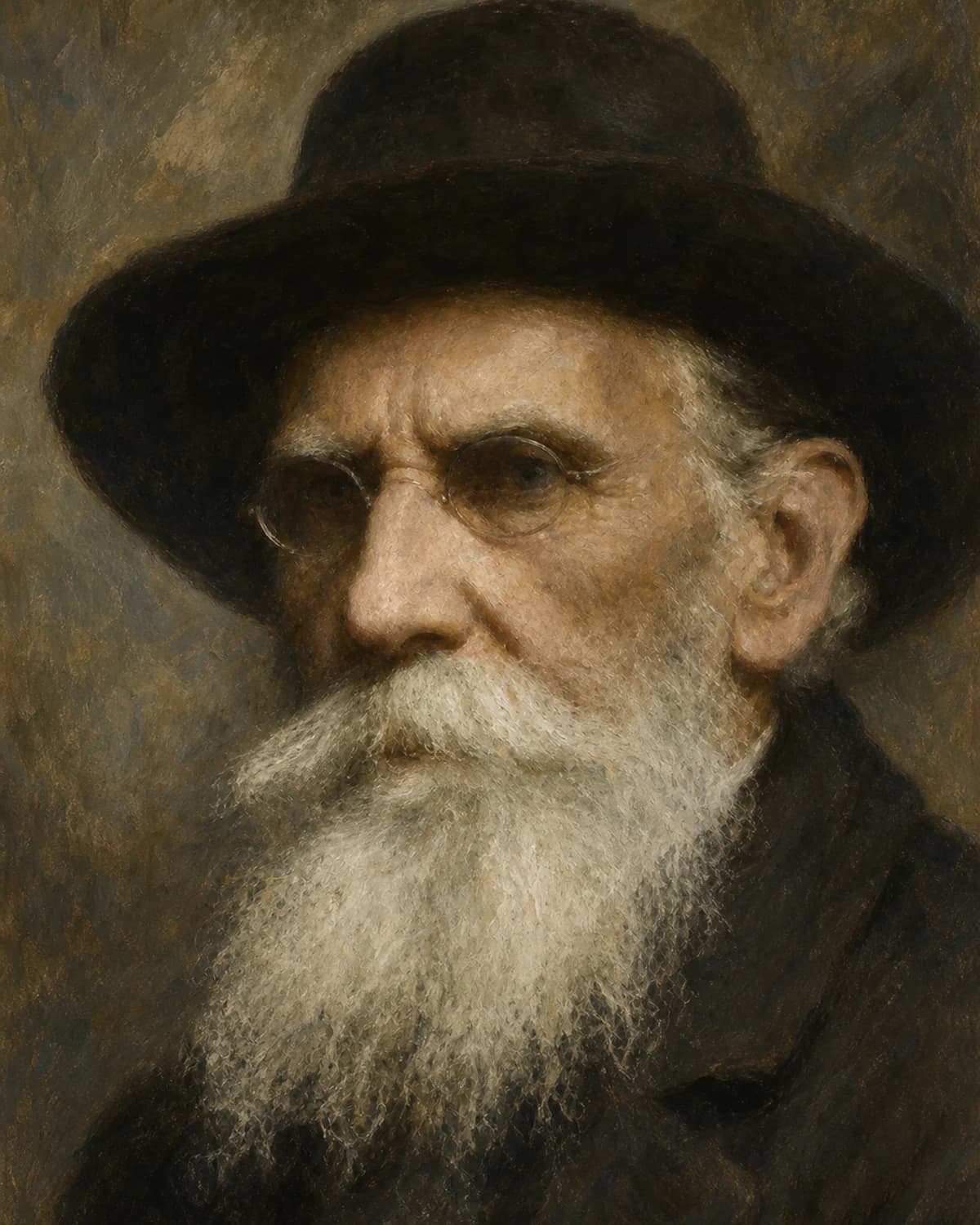
Biography
The museum in Buenos Aires that bears Sívori’s name opened in 1938, twenty years after his death. By then he had been written about both as the first Argentine realist and as one of the two leading figures of realism, together with Ernesto de la Cárcova.
He was born on 13 October 1847 in Buenos Aires. His parents were Genoese, and the family were merchants. He felt drawn to drawing in childhood, but for family reasons the inclination went undeveloped.
The change came in the first half of the 1870s. His father invited him on a business trip to Paris, and Sívori used the occasion to visit Parisian ateliers. The years are given differently: 1874, the early 1870s, a stay in Paris in 1873–1876. It seems to me that the safest way to put it is this: by the age of twenty-six or twenty-seven he had seen the European painting world from the inside for the first time.
Back in Buenos Aires, he began to study systematically with local artists; the names given are José Aguyari, Francesco Romero and Ernest Charton de Treville. Together with his brother Alejandro, Aguyari and Eduardo Schiaffino, Sívori took part in founding the Society for the Promotion of Fine Arts (Sociedad Estímulo de Bellas Artes). The sources give different founding years: 1875 or 1876. The Society became the direct predecessor of the National Academy of Fine Arts.
His reputation began with “Dolce far niente” (“Sweet Do Nothing”). For it Sívori received a gold medal at the Continental Art Salon in Buenos Aires in 1880. Another gold medal followed at the exposition in St. Louis in 1884.
In 1882 he returned to Paris. He studied with Jean-Paul Laurens and, according to some accounts, also with Louis-Joseph-Raphaël Collin and Pierre Puvis de Chavannes, and he attended the Académie Colarossi. In 1887, at the Paris Salon of French Artists, he showed “El despertar de la criada” (“Le lever de la bonne”), a large canvas with a nude female figure, 198 by 131 centimetres. The French and Argentine press responded to it with mixed opinions. In 1888 the picture was shown in Buenos Aires, at the Society for the Promotion of Fine Arts. Spanish-language tradition regards this event as the start of the naturalist phase in Argentine art.
He continued to exhibit at the Salon: in 1888 he showed “The Death of a Peasant” and “Without Family”, in 1889 “Dolce far niente” and “Women Doctors”, and in 1890 “By the Fire” and “The Lark”. In 1890 he took part in the Exposition Universelle in Paris. He returned to Argentina for good around 1892.
That same year Sívori helped found the Ateneo, an exhibition hall in Buenos Aires where he later showed his work. He taught, and he was one of the first in the country to work in etching.
Later, landscapes of the Argentine pampas became more prominent in his work, and they earned him the nickname “portraitist of the pampas”. He also painted portraits on commission. One of them, of the stockbreeder Godofredo Daireaux (1903), is well known. In 1905 Sívori arranged the transfer of the Society for the Promotion of Fine Arts to the Argentine government. Ernesto de la Cárcova became president of the new academy and Sívori took the post of deputy director, which he left in 1908 while continuing to teach some of the courses. According to other accounts, he was elected president of the guild in 1910. He also worked on organising the International Centennial Exhibition in Buenos Aires in 1910.
Eduardo Sívori died in Buenos Aires on 5 June 1918 and was buried in the Chacarita Cemetery. His works are held in the museum named after him, in the National Museum of Fine Arts in Buenos Aires and in the museum of fine arts in Rosario.
Related context
Associations
Works connected through artistic movements, cultural context and period. Priced works available in this market appear first.








Profile notes
Profile and sources
Image
Artist image
На основе открытого изображения: Unknown author Unknown author; Wikimedia Commons; Public domain.
