
08.11.1914–17.08.2007
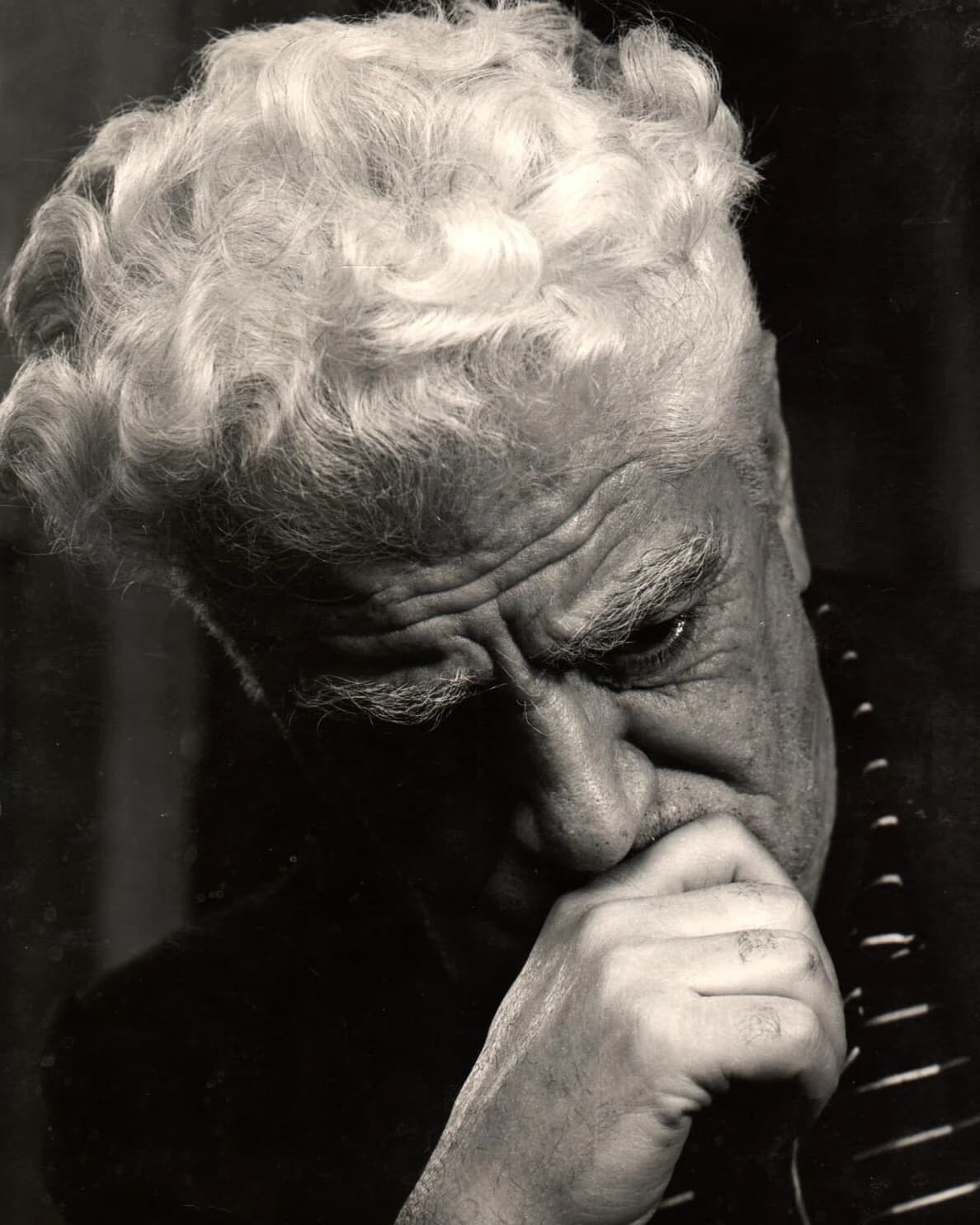
Eduard Isabekyan
Eduard Isabekyan grew up in Yerevan in a family of refugees from Iğdır, studied in Tbilisi and became the author of large multi-figure historical canvases: “The Battle of Avarayr”, “Reply to Hazkert”, “The Revolt of Haghpat Peasants in 1903”. From 1967 to 1987 he headed the National Gallery of Armenia and opened nine of its branches. His last painting, devoted to his native Iğdır, was left unfinished.
Biography
The last large painting of Isabekyan can be described in a few words: a group portrait of the people who brought fame to Iğdır, the town his family fled in 1918. He could not finish it, because his eyesight had worsened.
He was born on 21 November 1914 (8 November, Old Style) in Iğdır, in the Surmalu district of the Erivan Governorate. His father, Hmayak, farmed and traded; his mother, Satenik, kept house. In 1918, fleeing the advancing Turkish troops, the family went north-east, spent two months in Echmiadzin and settled in Yerevan.
From 1927 to 1931 Isabekyan studied at the Geghard technical school in Yerevan under Sedrak Arakelyan and Vahram Gayfejyan (painting) and Gohar Fermanyan (drawing and graphics); according to what is written about him, he owed his graphic skills to her. In 1931, at an exhibition of young artists, he showed a work titled “Pavlik Morozov” and received a voucher for a sanatorium at New Athos. Until 1935 he worked at the House of the Collective Farmer and drew for the newspapers Pioneer’s Call, Avant-garde and Soviet Armenia, designing the front pages of holiday issues.
In 1935–1941 he studied at the Academy of Fine Arts in Tbilisi: two years in the graphics department, then in the painting department under Kote Gzelishvili. His diploma work was the painting “The Uprising of the Batumi Workers in 1903”. In 1941 he was admitted to the Artists’ Union of Armenia. During the war he painted and drew war subjects; in 1943 he was sent to the 89th Armenian Division together with Nairi Zaryan and Sogomon Tarontsi, and the works he brought back were shown at an exhibition. In 1944 the Supreme Soviet of the Armenian SSR awarded him a certificate of honour for his war pictures. Among the early works of these years is “Mother’s Portrait” (1944), which Armenian art historians count among the best portraits of the Soviet period. I would add to it “David Bek” (1945), where the same theme of the struggle for freedom takes on a historical form.
From 1943 he taught at the Panos Terlemezian art school, and from 1945 at the Yerevan Institute of Fine Arts and Theatre, where he ran a creative studio. He was given the rank of docent in 1952 and confirmed as professor in 1967, both times in Moscow. In 1952 he joined the Communist Party of the Soviet Union; in 1953, 1956 and 1967 he was elected a deputy of the city council. In 1954–1956 he was secretary of the Artists’ Union of Armenia, and in 1965–1966 he headed a department at the Khachatur Abovian Pedagogical Institute.
In the 1950s he developed what is called in Armenia the thematic compositional genre, and he is considered the founder of this direction. “Young David” (1956), “The Revolt of Haghpat Peasants in 1903” (1957) and “Reply to Hazkert” (1960) are built on many figures and sharp movement. Beside them stand portraits of Aksel Bakunts, Derenik Demirchian, Sayat-Nova and Khachatur Abovian, landscapes such as “In the Canyon of Tatev” (1959) and “Khndzoresk” (1962), and the paintings “Horovel” and “Artavazd’s Death”. He illustrated Demirchian’s novel “Vardananq” and Sero Khanzadyan’s novel “Mkhitar Sparapet”. The series “Restless Horses” and “The Battle of Avarayr” were among the works honoured with the State Prize of the Armenian SSR in 1985, together with “Wedding Procession” and “Morning”.
When he took over the State Picture Gallery in 1967, it had no branches. Over twenty years he opened them in Echmiadzin (1970), Jermuk (1972), Hrazdan (1973), Kirovakan (1974), Leninakan and Martuni (1978) and Yeghegnadzor (1979), and two house-museums: that of Ara Sargsyan and Hakob Kojoyan in Yerevan (1973) and that of Minas Avetisyan in Jajur (1980). By some accounts one more branch, in Alaverdi, was opened in 1987; other accounts do not mention it, and the years of his directorship are also given differently.
He returned constantly to the theme of the Armenian genocide. For decades he kept a diary, wrote articles on art and a book about his childhood in Iğdır. His solo exhibitions were held in Yerevan (1947, 1965, 1985, 2004), Tbilisi, Rabat, Moscow at the Central House of Artists (1988), Aleppo and Los Angeles; he took part in Expo 67 in Montreal and in the Paris exhibition “From Urartu to Our Days”.
He received the Order of the Red Banner of Labour and the title of Honoured Art Worker (1956), the title of People’s Painter of the Armenian SSR (1963), and in 2001 became an honorary citizen of Yerevan and a holder of the Order of Mesrop Mashtots. From 2005 he lived in Ashtarak. He died on 17 August 2007 and was buried in the Komitas Pantheon in Yerevan. In 2013 a gallery bearing his name opened on Mashtots Avenue, in 2014 the Central Bank issued a coin for his centenary, and in 2023 a street in the Nork-Marash district was named after him.
Profile notes
Profile and sources
Image
Artist image
Irina Isabekyan; Wikimedia Commons; CC BY-SA 4.0.
