
11.11.1868–21.06.1940
Édouard Vuillard
Édouard Vuillard failed the entrance examinations of the École des Beaux-Arts three times, but was finally admitted and in 1890 joined the Nabis. He painted seamstresses, interiors with patterned wallpaper and decorative panels for his friends’ apartments, and designed sets for an avant-garde theatre. In the 1890s he worked in his seamstress mother’s workshop; later he became known for portraits of the Parisian elite.
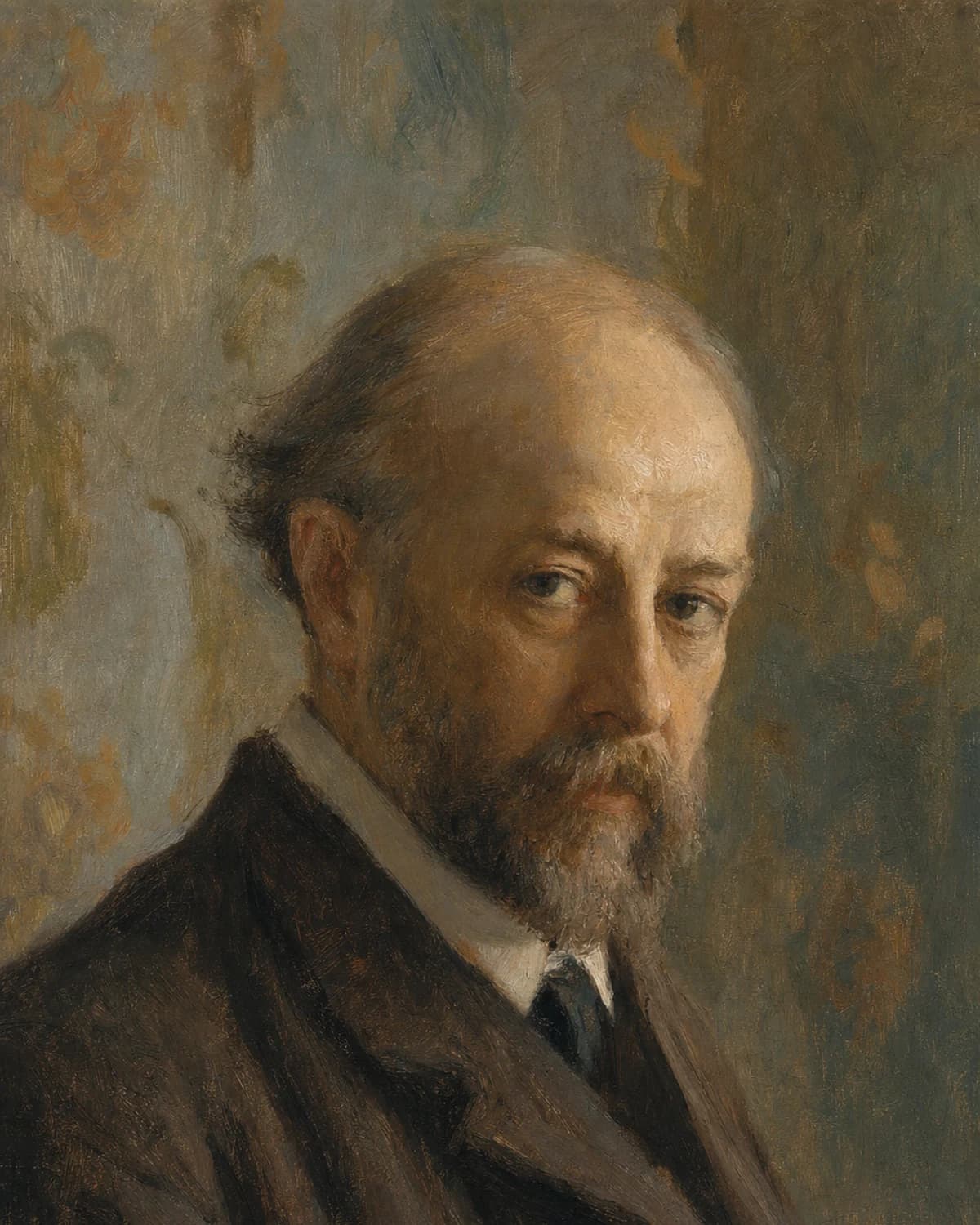
Biography
Vuillard tried three times to get into the École des Beaux-Arts, the state art school in Paris. In February and July 1886 and again in February 1887 he failed the entrance competition, and only in July 1887 was he accepted. Persistence, it seems, was part of his character.
He was born on 11 November 1868 in Cuiseaux, in the department of Saône-et-Loire, not far from the Swiss border. His father, a retired naval captain, worked as a tax collector; his mother, Marie Vuillard (née Michaud), was a seamstress. After his father retired in 1877 the family settled in Paris, and later moved to a building on Rue Daunou, where his mother had a sewing workshop. The boy was taught by the Marist Brothers, then won a scholarship to the Lycée Fontaine, later the Lycée Condorcet. There he made friends with Ker-Xavier Roussel, later his sister’s husband, with Maurice Denis and with the future theatre director Aurélien Lugné-Poe. In November 1885 Vuillard left the lycée and gave up the idea of a military career like his father’s. With Roussel he worked in the studio of Diogène Maillart, the former studio of Eugène Delacroix on Place Fürstenberg, attended the Académie Julian, and after entering the École des Beaux-Arts studied under Robert-Fleury and then Jean-Léon Gérôme. In 1889 a crayon portrait of his grandmother was accepted for the Salon.
In the autumn of that year he began attending meetings of the Nabis (“the prophets”), a semi-secret circle that included Denis, Pierre Bonnard, Paul Sérusier and Paul Ranson. In 1890 Denis brought him into the group; members had playful nicknames, and Vuillard was called “the Nabi Zouave” because of his military service. With Bonnard and Lugné-Poe he shared a studio on Rue Pigalle and designed sets for plays by Maurice Maeterlinck and other Symbolist writers. In 1891 he showed two paintings at the group’s first exhibition, at Saint-Germain-en-Laye.
In time he began keeping a journal. In an entry of 22 November 1888 he wrote that a form or a colour exists only in relation to another form or colour. He collected Japanese prints himself, which were shown at Siegfried Bing’s gallery and at the 1890 exhibition at the École des Beaux-Arts: he owned 180 sheets, some of them visible in the backgrounds of his paintings. From them come the flat patches of colour, the turned-away faces, and the patterns of wallpaper and dresses into which the figures almost dissolve.
His favourite subject in those years was women at work and at home. He painted seamstresses in a workshop modelled on his mother’s. In “The Flowered Dress” (1891) the figures include his grandmother and his sister Marie, and a mirror on the wall gives a second view of the scene. There is also “The Seamstress” (1893), now in Indianapolis. In his journal for 1894 he admitted that in men he saw only gross caricatures, while in women he always found something that satisfied him as a painter.
Through the theatre he met the brothers Alexandre and Thadée Natanson, founders of the review La Revue Blanche, where his graphic work appeared alongside that of Bonnard, Henri de Toulouse-Lautrec and Félix Vallotton. In 1892, on their commission, he painted his first decorative panels, for the house of Mme Desmarais. In 1894 Alexandre Natanson commissioned from him six panels, “The Public Gardens”, showing children in the parks of Paris. He received the commission on 24 August and finished it by the end of the year. He did not use oil here but painted in glue-based distemper, as for theatre sets: it demanded speed, but gave a matt surface that resembles fresco. Between 1892 and 1899 he made eight decorative cycles, about thirty panels in all. In 1895 the cardiologist Henri Vaquez commissioned four panels for his library, now in the Petit Palais in Paris. At about the same time Bing commissioned from Vuillard and other Nabis designs for stained-glass windows to be made by the firm of Louis Tiffany, but the windows themselves were never made.
After the exhibition of 1900 the Nabis went their separate ways; the Dreyfus Affair deepened the rift, as Vuillard and Bonnard supported Dreyfus, while Denis and Sérusier took the side of the army. His painting changed: rooms became lighter and deeper, faces clearer, and he did more work outdoors. In 1912 he, Bonnard and Roussel were offered the Légion d’honneur, and all three declined it. In the same year he painted Théodore Duret in his study: this commissioned portrait began a new phase, and from the 1920s portraits predominate. His sitters included the actor Sacha Guitry, the couturière Jeanne Lanvin and the inventor Marcel Kapferer, usually amid surroundings that he rendered in detail. In 1912 he received a commission for panels for the new Théâtre des Champs-Élysées, and from 1911 to 1914 he attended performances of the Ballets Russes.
I would point out that official recognition from the state came to him late. Only in 1936 was he commissioned to paint the mural “La Comédie” for the foyer of the Palais de Chaillot theatre, and in 1937, together with Denis and Roussel, panels for the Palace of the League of Nations in Geneva. In 1937 he became a member of the Institut de France, and in 1938 a major retrospective was held at the Musée des Arts Décoratifs. He finished his last two portraits in 1940 and went to La Baule to recover his health.
He died there on 21 June 1940, in the same month in which the French army was defeated in the Battle of France.
Related context
Associations
Works connected through artistic movements, cultural context and period. Priced works available in this market appear first.








Profile notes
Profile and sources
Image
Artist image
На основе открытого изображения: Rijksmuseum; Wikimedia Commons; CC0.
