
19.07.1834–27.09.1917
Edgar Degas
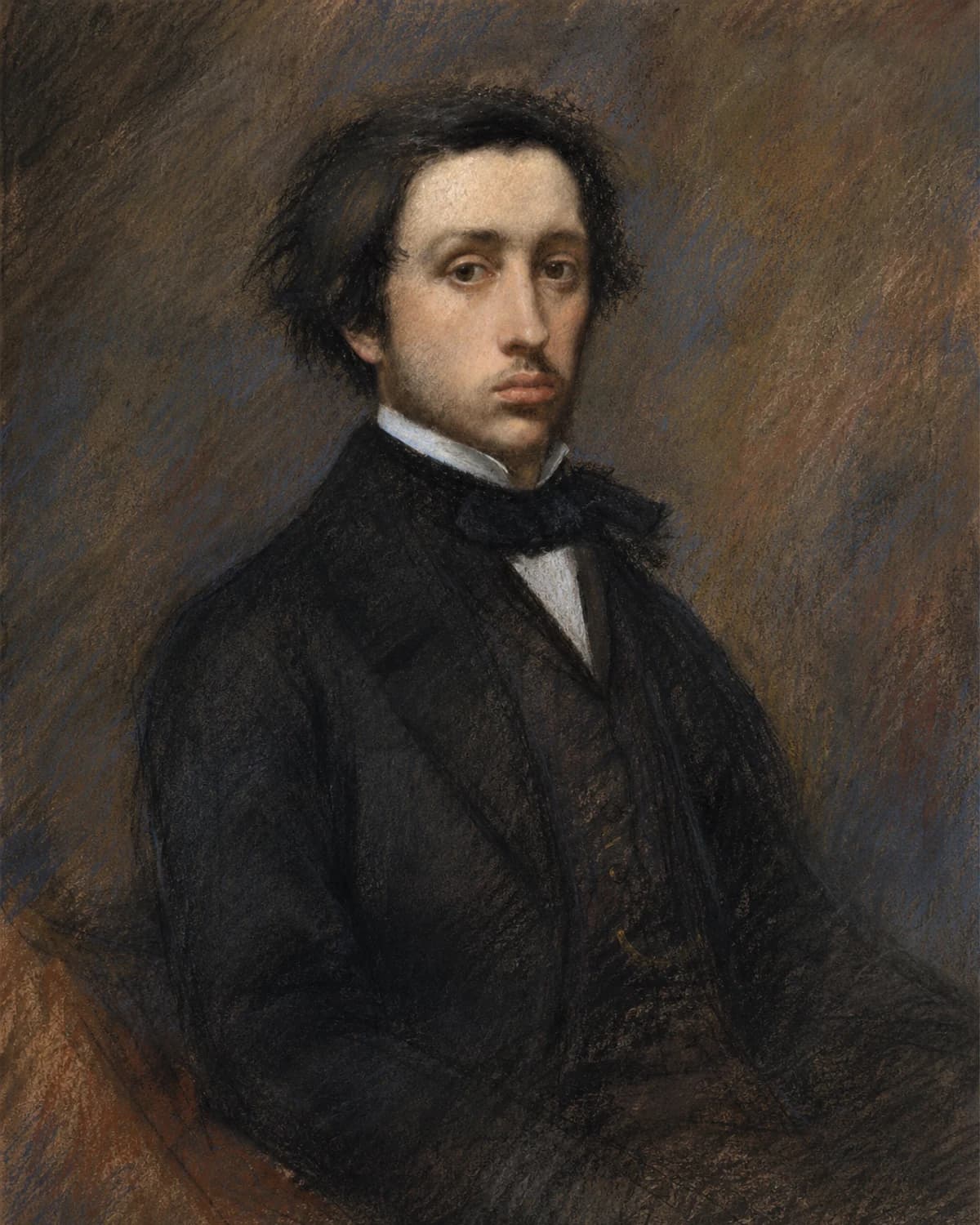
Edgar Degas (1834–1917) devoted more than half of his work to dancers: rehearsals, the wings, the orchestra pit of the Paris Opéra. He took part in seven of the eight Impressionist exhibitions, though he called himself a realist and laughed at plein-air painting. He worked in oil, pastel and monotype and modelled in wax; in his lifetime he showed the public only one sculpture, “Little Dancer Aged Fourteen”.
Biography
At the sixth Impressionist exhibition in 1881 the public saw a wax girl dancer, almost life-size, with real hair and a skirt of real fabric. She had been modelled on Marie van Goethem. Critics granted that the figure was extraordinarily lifelike, and almost all of them called it ugly; Huysmans wrote that with his very first attempt Degas had overturned the traditions of sculpture. He never showed the public another sculpture in his lifetime.
Hilaire-Germain-Edgar de Gas was born on 19 July 1834 in Paris, the eldest of five children in a banker’s family. His mother, Célestine Musson, a Creole from New Orleans, died when her son was thirteen. As an adult he began to sign himself more simply, Degas. After the Lycée Louis-le-Grand he registered as a copyist at the Louvre and, at his father’s wish, entered the law faculty, where he studied without much zeal. In 1855 he met Ingres and remembered his advice to draw lines, lots of lines, from life and from memory. The same year he was admitted to the École des Beaux-Arts, under Louis Lamothe, a pupil of Ingres. In the summer of 1856 he left for Italy for three years and copied Michelangelo, Raphael and Titian, picking some minor figure or head out of an altarpiece and turning it into a portrait. In 1858, while staying with his aunt, he began the studies for “The Bellelli Family”: Aunt Laura, her husband and their daughters, with a palpable chill between husband and wife. He finished the picture only in 1867.
Back in Paris, he meant to become a history painter. Around 1860 came “The Daughter of Jephthah”, “Semiramis Building Babylon” and “Young Spartans Exercising”, in which girls and boys of antiquity taunt one another while their faces are entirely Parisian. He first exhibited at the Salon in 1865 with “Scene of War in the Middle Ages”, and it went almost unnoticed. A year later the Salon hung “The Fallen Jockey”. His turn to modern life is usually linked with Manet. They met, according to a story that may be a legend, in the Louvre, when both were copying the same portrait by Velázquez.
In 1870, when the Franco-Prussian War broke out, Degas joined the National Guard and took part in the defence of Paris. At rifle practice it turned out that his eyesight was poor. Worry about his eyes never left him for the rest of his life.
In 1872 he went to New Orleans for a long stay with his mother’s family and lived with his uncle Michel Musson. From there came “A Cotton Office in New Orleans” (1873), with the uncle and the painter’s brothers among the clerks and the cotton samples; it is the only picture of his bought by a museum in his lifetime (the museum in Pau). Soon after his return, in 1874, his father died, and it emerged that his brother René had run up enormous debts. To save the family name Degas sold his house and the collection of pictures he had inherited, and for the first time began to live by selling his own work.
At the same time the group that the press dubbed the Impressionists took shape. Of the eight exhibitions of 1874–1886 he took part in seven and organised a good deal of them, but he could not stand the word “Impressionist”, called himself a realist, mocked his colleagues for working out of doors and insisted that Forain and Raffaëlli exhibit alongside them. “No art was ever less spontaneous than mine,” he said.
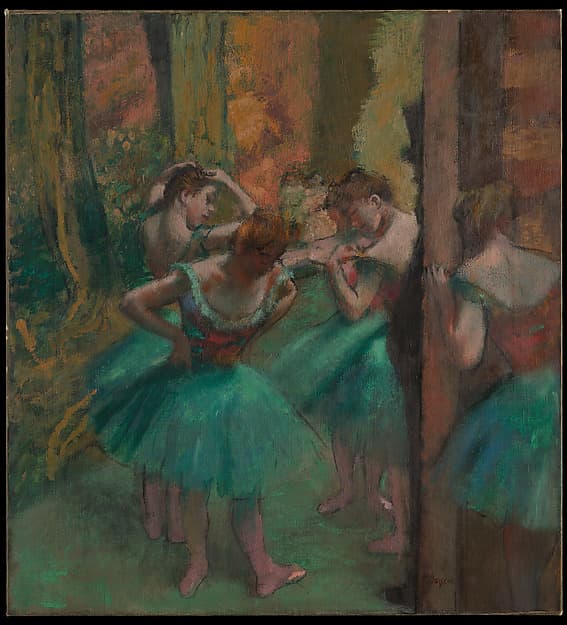
Dancers entered his work with “Mademoiselle Fiocre in the Ballet ‘La Source’” at the Salon of 1868 and never left it. He almost always shows the stage from an unexpected angle. In “The Orchestra at the Opera” (around 1870) his friend the bassoonist Désiré Dihau sits in the pit among the musicians, and of the ballerinas above them only legs and tutus remain, cut off by the edge of the canvas. Degas painted not the performance but the work: rehearsals, the wings, classes. Edmond de Goncourt noted in his diary on 13 February 1874 that Degas had chosen laundresses and dancers as his principal modern subjects. Degas himself explained that ballet was for him only a pretext for painting pretty fabrics and catching movement; besides, ballet pictures sold well, and after the business with the debts he needed money. In “Place de la Concorde” (1875, Hermitage) his friend Ludovic Lepic crosses the square with his daughters and a dog, and half the canvas is given over to empty roadway. It was Lepic, too, who in the mid-1870s brought him back to etching, after which Degas took up monotype and made some three hundred prints, often working over them in pastel. By the late 1870s he handled pastel as well as oil and had devised his own fixative for it.
In my view, his method shows best in the late bathers. Women dry themselves with towels, comb their hair, climb into a tin tub that stood right in the middle of the studio. The series of nudes at the last exhibition in 1886 drew more reviews than any other work of his lifetime, and mostly favourable ones. In the late 1880s he also took photographs, usually of friends by lamplight; the double portrait of Renoir and Mallarmé is well known.
The older he grew, the more withdrawn his life became. The Dreyfus affair made him an open antisemite; by the mid-1890s he had broken with all his Jewish friends, and Renoir recalled that his friends had to leave him one after another. After 1890 his sight grew noticeably worse. He worked in pastel until the end of 1907 and modelled, apparently, until 1910, but in 1912 the house on the rue Victor-Massé was marked for demolition, Degas moved to the boulevard de Clichy and gave up work. He never married. In his last years the almost blind old man wandered the streets of Paris.
He died on 27 September 1917 in Paris. He was buried, as he had wished, simply and without speeches; among the mourners were Monet and Forain.
In the studio his heirs found about a hundred and fifty wax figures, many of them half crumbled. The founder Adrien Hébrard judged seventy-four fit for casting, and all of Degas’s bronze dancers, bathers and horses that now stand in museums were cast after his death.
Artist works
Works by the artist
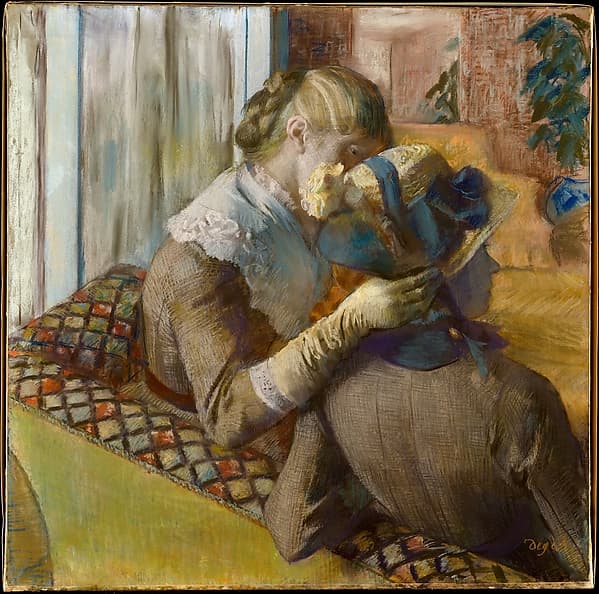
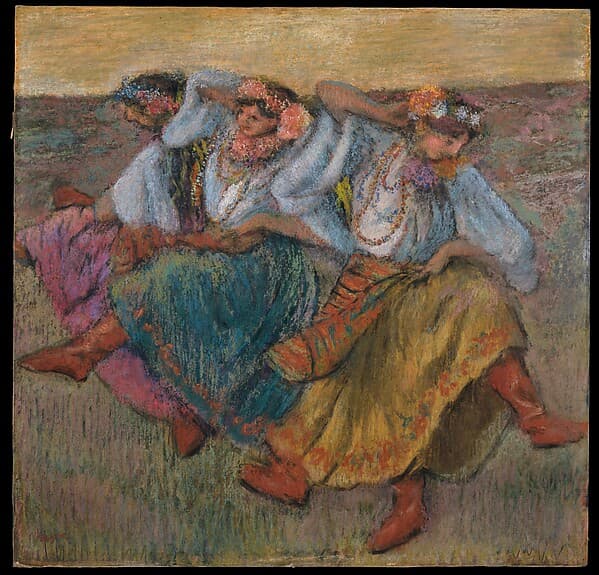
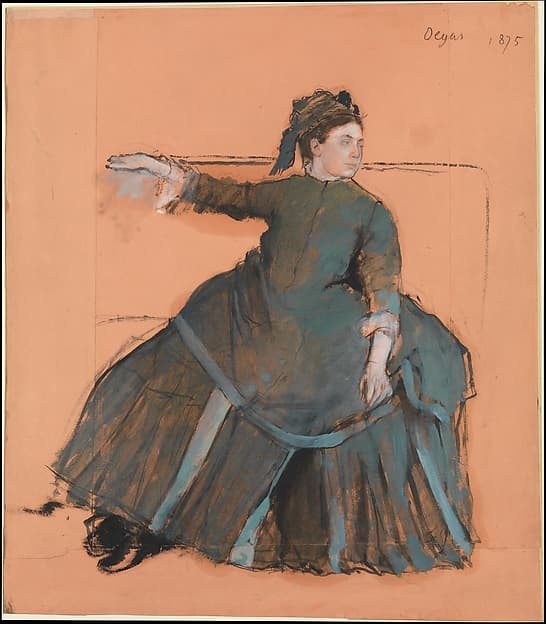
Works by Edgar Degas available in this edition of NEOARCA.


Related context
Associations
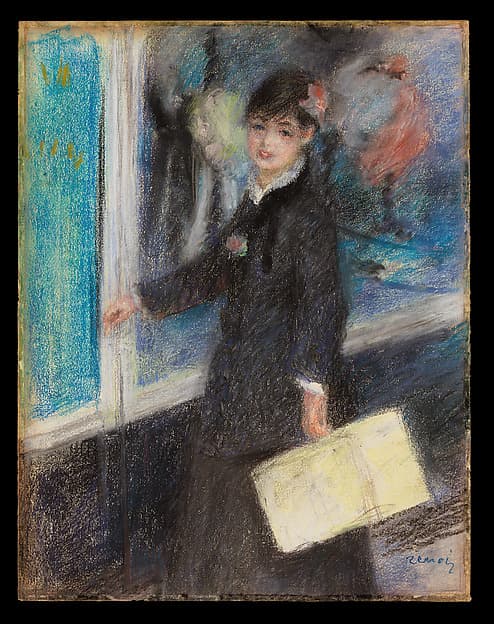
Works connected through artistic movements, cultural context and period. Priced works available in this market appear first.






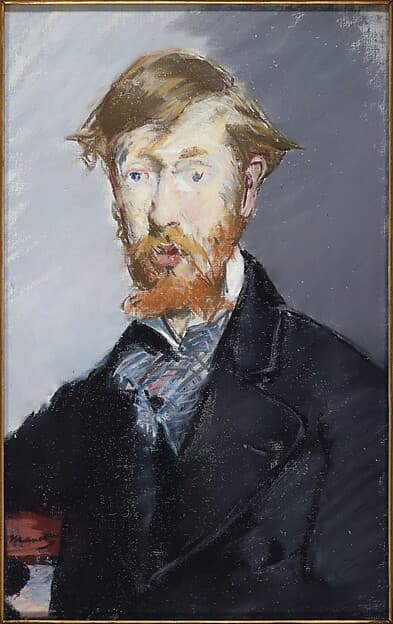
Profile notes
Profile and sources
Image
Artist image
На основе открытого изображения: Edgar Degas; Wikimedia Commons; Public domain.
