
21.05.1942–16.10.1991
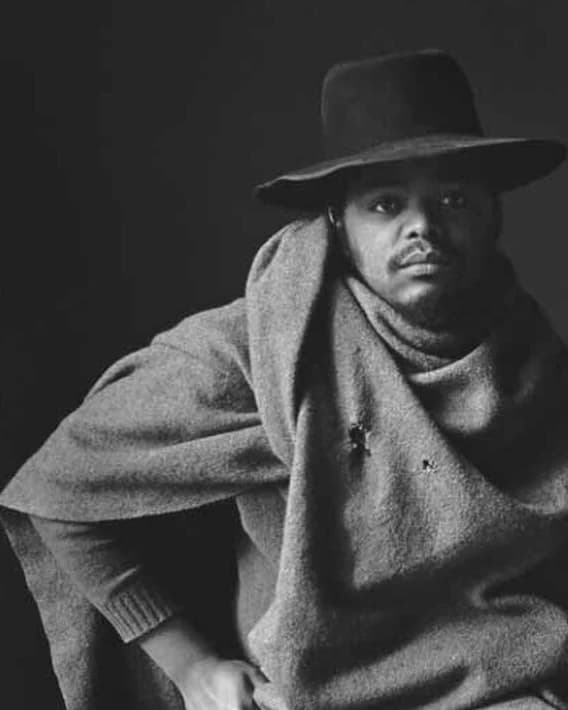
Dumile Feni
The South African artist Dumile Feni (1942–1991) drew in pencil and charcoal, painted pictures with sculptural elements and made sculptures, often about life under apartheid. From 1968 he lived in self-imposed exile in London, Los Angeles and New York, mostly in extreme poverty. His panel “African Guernica” was shown outside South Africa for the first time in 2026.
Biography
In 2026 Madrid’s Museo Reina Sofía hung a large panel in pencil and charcoal, made in South Africa in the apartheid years, next to Picasso’s “Guernica”. It is called “African Guernica”, and until then it had never left the country. The Guardian wrote of its unsettling juxtaposition of man and beast, light and dark, innocence and cruelty.
The artist did not see the exhibition: he had been dead for more than thirty years.
Dumile is short for Zwelidumile, a name meaning “a person known all over the country”; the artist’s full name is made up of several names. He was born on 21 May 1942 on the small farmstead of Withuis in Worcester, in the Cape Province. His father was a trader and an evangelist, his mother ran a business of her own. The family were Xhosa and, when the boy was still small, moved to Cape Town, to the Welcome Estate district.
Feni worked in three ways: drawing, painting with three-dimensional, sculptural elements, and sculpture proper. Most often he turned to the lives of people under apartheid and to the struggle against it. Recognition came quickly. In 1965 the Transvaal Academy in Johannesburg showed his work, and 1966 turned into an almost unbroken run of exhibitions for him: the Durban Art Gallery, Gallery 101 and the Civic Theatre in Johannesburg, the Pretoria Art Museum, the touring exhibition of the SA Breweries Art Prize. That same year he took part in a group show with the telling title “Artists of Fame and Promise”. In 1967 his work went to the São Paulo Biennial and was included in a survey of South African sculpture from 1900 to 1967. Judging by the list of exhibitions, in three years he went from his first showing in Johannesburg to an international biennial.
In 1968 he left the country and for more than twenty years lived between London, Los Angeles and New York. The exile was self-imposed, and life in it was, for the most part, destitute. In 1969 he was shown at the Grosvenor Gallery in London and at the Camden Arts Centre in an exhibition of contemporary African art. Meanwhile his work, including pieces from private collections, kept appearing in exhibitions at the Goodman Gallery. In 1978 Feni moved to the United States and worked as artist in residence at the Institute of African Humanities at the University of California in Los Angeles. In his American years he took part in exhibitions against apartheid: in 1983 at the United Nations for Namibia Freedom Day, and in 1988 in the touring exhibition “Voices from Exile” of seven South African artists, which traveled to Washington, Los Angeles, Houston and Philadelphia. In 1989 he painted a portrait of Nelson Mandela for the Pathfinder Mural in New York.
In 1991 his work was shown at the National Arts Festival in Grahamstown. On 16 October that year Dumile Feni died in New York.
Later Amitabh Mitra wrote that ordinary people in South Africa hardly know his work, while the contemporary South African art world calls him the “Goya of the Townships”. The nickname is, I think, convenient but too narrow, and Mitra himself added that Feni stood for much more. In 2003 he was posthumously awarded the Order of Ikhamanga in Gold for excellence in the arts. In 2004 the book “Dumile: Artist in Exile”, prepared by Bruce Smith, was published, and in 2010 the South African filmmaker Ramadan Suleman made a documentary about him, “Zwelidumile”.
Profile notes
Profile and sources
Image
Artist image
George Hallett; Wikimedia Commons; CC BY-SA 3.0.
