
03.10.1875–15.08.1964
Dr. Atl
Dr. Atl, the Mexican painter and writer Gerardo Murillo Coronado (1875–1964), called in 1906 for a monumental public art in Mexico and became one of the forerunners of muralism. All his life he painted the volcanoes Popocatépetl and Iztaccíhuatl, and from 1943 he watched the birth of the volcano Paricutín, making thousands of drawings and a book about it.
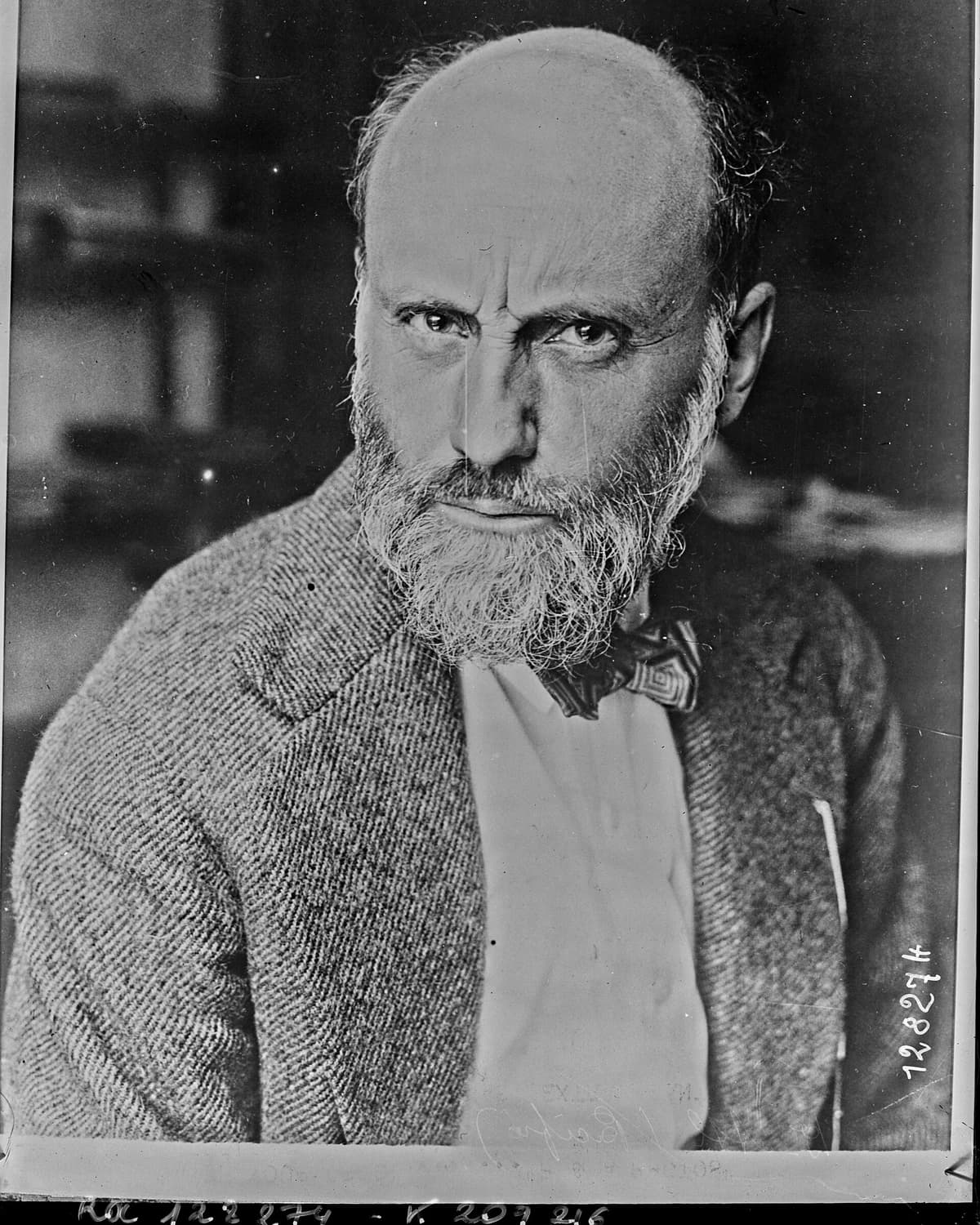
Biography
The glass curtain for the Palace of Fine Arts, then under construction in Mexico City, was commissioned under Porfirio Díaz from Gerardo Murillo and made by Tiffany’s of New York. It shows the two volcanoes that can be seen above the capital. At the same time Murillo was commissioned to paint a mural, but in 1910 the revolution against Díaz broke out, and the work was put off.
The volcanoes would stay with him to the end of his life.
Gerardo Murillo Coronado was born on 3 October 1875 in Guadalajara, the first child of a pharmacist. He began to study painting with the Guadalajara artist Felipe Castro; in 1895 he attended the preparatory school of the Institute of Sciences and Arts in Aguascalientes, then the studio of Félix Bernardelli and, finally, the Academy of San Carlos in the capital. In 1897 the Díaz government, together with the state of Jalisco, gave him a grant to study in Europe. He travelled to England, France, Germany, Italy and Spain, studied philosophy at the University of Rome, attended Henri Bergson’s lectures in Paris, joined the Socialist Party in Italy and worked for the newspaper Avanti. At the Paris Salon of 1900 his pastel self-portrait won a silver medal. In 1902 he took the signature “Atl”, which means “water” in Nahuatl, and Leopoldo Lugones added the “Dr.” to it.
On his return he worked at the Academy of San Carlos as a restorer, was given a studio there and taught. At the Academy he was nicknamed the Agitator; among his pupils and colleagues in those years was the young José Clemente Orozco. In 1906 he took part in an exhibition organised by the magazine Savia Moderna together with Diego Rivera, and issued a manifesto calling for a monumental public art bound up with the life and interests of the Mexican people. Mexican muralism would only begin in 1922, but this text is often seen as its forerunner.
In 1911 Atl left for Europe again and lived mostly in Paris, where he founded a journal, wrote about the situation in Mexico and spoke out against General Victoriano Huerta, who had helped overthrow the government of Francisco Madero. In 1913 his first book, “Les volcans du Mexique”, appeared. Back home, he joined Venustiano Carranza’s Constitutionalists and became director of the Academy of San Carlos; he persuaded the students Orozco and David Alfaro Siqueiros to join the Carrancistas and illustrated the newspaper La Vanguardia. In the summer of 1914 he met Emiliano Zapata on Carranza’s behalf. After Carranza was murdered in May 1920, Atl lost his post and from then on lived by his paintings and books.
After the revolution the country rediscovered its pre-colonial past and its folk arts. Atl organised exhibitions of folk crafts and performances by dancers and musicians, and in 1922 the government published his two-volume study “Folk Arts in Mexico”. He also wrote fiction: “Cuentos bárbaros” (1930) and “Cuentos de todos los colores” (1933–1941), about the years of the revolution. He gave the poet and painter Carmen Mondragón the Aztec name Nahui Olin. In the 1930s and 1940s he frequently published articles in support of European fascism; later his interest in politics faded.
Volcanoes had absorbed him since 1909. He painted Popocatépetl and Iztaccíhuatl in different seasons, at different times of day and from different viewpoints, and at one time lived for two years on the slopes of Popocatépetl. When Paricutín began to grow in 1943, Atl watched it from the very start, bought the land on which the volcano had appeared, and made more than eleven thousand drawings and about a thousand landscapes in oil. While observing the eruption he was injured and his leg had to be amputated, but even after that he went on climbing volcanoes. In 1950 his book “Cómo nace y crece un volcán: el Paricutín” (“How a Volcano Is Born and Grows: Paricutín”) was published, and volcanologists valued his records. Later he painted panoramic landscapes from a helicopter. I think that in these views from above his old dream of a monumental art found a fitting scale.
In 1950 he was elected a member of the Colegio Nacional, and in July 1951 he left it. He was an art and literary critic and for a time headed the National Institute of Fine Arts and Literature. In 1956 the Senate awarded him the Belisario Domínguez Medal, and in 1958 he received the National Prize for Arts.
Dr. Atl died on 15 August 1964 in Mexico City and is buried in the Rotunda of Illustrious Persons at the Dolores cemetery. In Guadalajara a statue of him stands in the Rotunda of Illustrious Jaliscans, and in 1996 his work was shown in Moscow by the All-Russian Museum of Decorative, Applied and Folk Art.
Related context
Associations
Works connected through artistic movements, cultural context and period. Priced works available in this market appear first.








Profile notes
Profile and sources
Image
Artist image
Pacific and Atlantic (Agence photographique). Agence photographique pour le document reproduit (commanditaire) Agence Rol. Agence photographique (commanditaire); Wikimedia Commons; Public domain.
