
1828–1899
Dmitry Strukov
Dmitry Strukov (1828–1899) studied at a drawing school in Moscow and made his name through copying and restoring antiquities. At the Kremlin Armoury he restored 13 old banners, and in 1864 he painted watercolours of monuments in the Northwestern Krai, many of which are now known only from his sheets. He published the magazine “Drawing School”, opened icon-painting schools and went on archaeological expeditions to Crimea and the Caucasus.
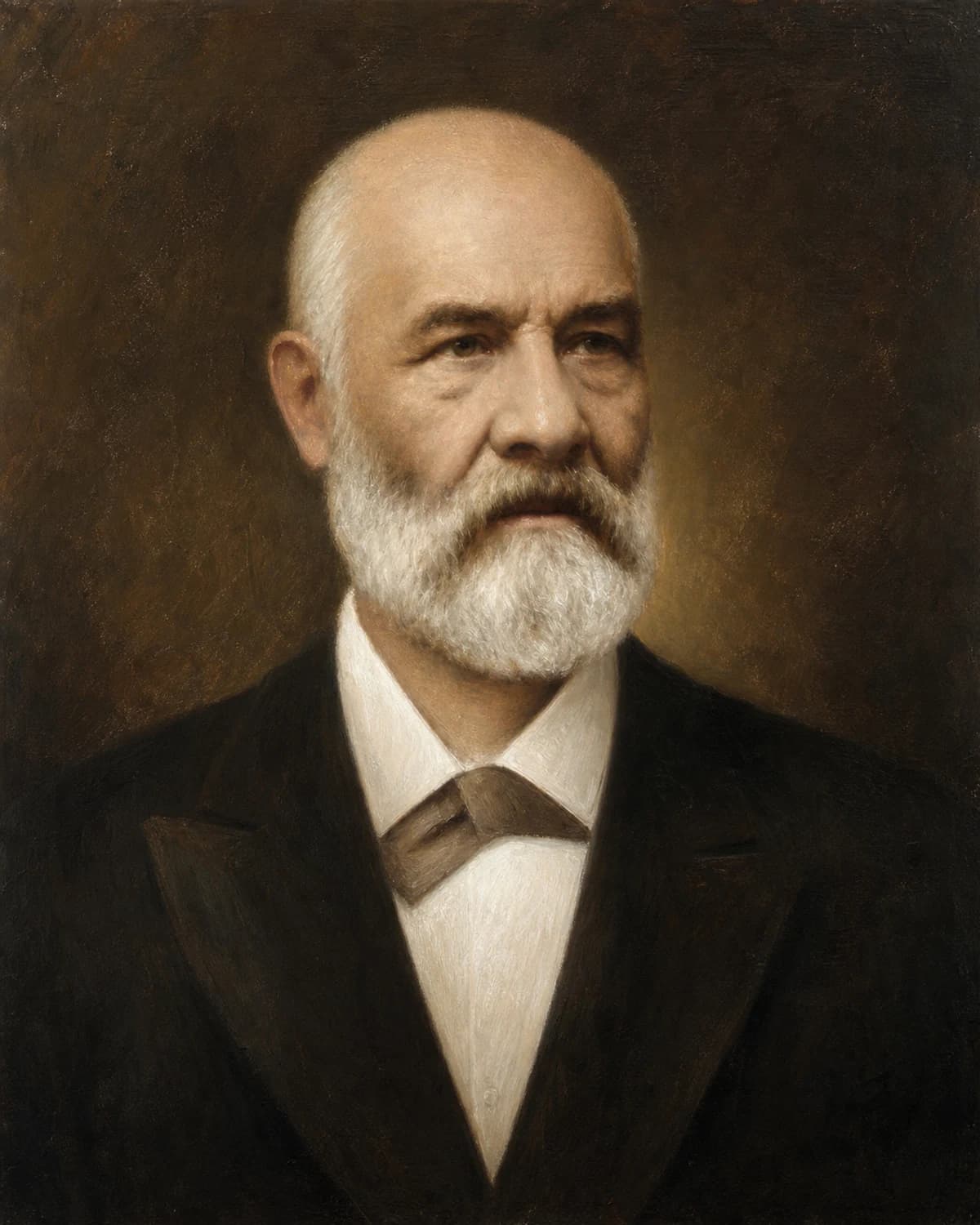
Biography
Strukov’s album of views of the Northwestern Krai, made in 1864–1867, is sometimes the only evidence of how some churches and monasteries in Belarus looked. The buildings themselves did not survive.
He was born in Moscow into the family of Mikhail Strukov, a tailor. During a cholera epidemic the family left the city: first for Nizhny Novgorod, then for Verkhoturye and Nizhny Tagil. They returned to Moscow in 1840, and Dmitry entered a drawing school, from which the Stroganov School later grew. While still in the fourth class he was invited by the headman of the village of Lyubertsy to paint the icons for the iconostasis of the local church, and he also made a pencil portrait of the headman himself. He drew a great deal from life.
In 1849 he helped to open a drawing school at the Trinity Lavra of St Sergius, later known as an icon-painting school. That same year he compiled “A Guide to the Shrines of Moscow”, a handbook to Orthodox Moscow with a list of its miracle-working icons. In 1850 the abbot of the Sarov Hermitage invited him to draw the monuments of the monastery, and he helped to open a drawing school at the Diveyevo convent. From then on Strukov travelled widely, sketching the churches and monasteries of Nizhny Novgorod, Vladimir, Murom and the western provinces, and he visited the Caucasus and Crimea. In 1853 (according to other accounts, in 1855), on finishing his course, he received the title of “unclassed artist” in portrait watercolour. At about that time he made a copy of the Grebnevo icon of the Mother of God from the church on Myasnitskaya Street; the copy was presented to the emperor, and its maker received a diamond ring and an open certificate permitting him to draw antiquities in monasteries and churches.
From 1858 he published the magazine “Drawing School”: drawings of medieval initials, headpieces and other monuments, with short articles on early Russian art. It appeared until 1863, and Strukov spent almost 25 years paying off the debt it left.
In 1859 he was invited to the Kremlin Armoury to copy museum pieces, and from 1860 he was the Armoury’s resident artist, restoring 13 old banners. At the same time he sorted the collection of Pyotr Sevastyanov that was being transferred to the Rumyantsev Museum. He taught a great deal, out of necessity: at the Sergius School attached to the Moscow committee of the Imperial Philanthropic Society, at Moscow University (1873), at the Third Women’s Gymnasium and at a commercial school. He worked out a method which, as he believed, could teach anyone to draw quickly; as a trial he taught 200 soldiers of the Pernovsky Regiment in a short time. For this method he received a silver medal at the All-Russian Exhibition in Moscow and was elected a member of the French Academy of Fine Arts. In 1860 he took part in the restoration of the cathedral of the New Jerusalem Monastery, and in 1861, at the invitation of the church authorities, he drew the ceremony at which the relics of St Tikhon were uncovered in Zadonsk.
In 1864 the Governor-General of Vilnius, Count Mikhail Muravyov, invited Strukov to join an artistic expedition to the Northwestern Krai. Its task was to search the region for medieval Russian monuments, or for traces of those that had been destroyed. Strukov painted the surviving buildings in coloured watercolour, in Polotsk, Mogilev, Nesvizh, Orsha, Vitebsk, Minsk and other places. According to some accounts, the result was an album of 199 sketches. His diaries, field notes and drawings are kept at Vilnius University, at the State Historical Museum in Moscow and at the St Petersburg branch of the Institute of Archaeology.
In 1869, on his initiative, a department of icon studies was created at the Moscow Society of Lovers of Spiritual Enlightenment: the Holy Synod, the church’s governing body, ordered abbots to send it worn-out icons. A place for the collection was set aside in the Chudov Monastery and consecrated on 23 December 1870, and in time more than 300 old icons were gathered. He meant them to be used in an icon-painting school. In 1870 drawing classes opened, on his initiative, at the Zaikonospassky Theological School, and in September 1873 an icon-painting school began work on Bolshaya Ordynka Street, in a house donated by the merchant Dmitry Khludov. Later most of the icons were given to poor village churches.
In 1871 he was entrusted with restoring the paintings in Saint Basil’s Cathedral. In those same years he carried out a commission for the Church of the Nativity of the Virgin in Old Simonovo. In 1873 he was called in, as an expert on pre-Petrine antiquity, to help renovate the Church of St John Climacus on the second tier of the Ivan the Great Bell Tower: the iconostasis was made to his drawings, and the walls were painted under his supervision.
In the 1860s to 1880s, as a member of the Imperial Russian Archaeological Society, he travelled repeatedly to Crimea and the North Caucasus. One of his finds was the Zelenchuk Inscription; its discovery is dated to 1888. In 1868 he excavated in the citadel of Mangup, including the site of a monastery on Cape Teshkli-burun. He wrote “The Lives of the Tauric Saints” (1886). In 1883 he became one of the founders of the Russian Gymnastic Society. When in the 1880s his son Nikolai was commissioned to rebuild Kutuzov’s Hut, which had burned down in 1867, Dmitry took charge of its interiors. At about that time he opened a workshop making icons and church plate in the old Russian style. He was awarded the Orders of St Anna, 2nd and 3rd class, of St Stanislaus, 2nd class, and of St Vladimir, 4th class.
Strukov died in Moscow in 1899 and was buried in the cemetery of the Donskoy Monastery. The grave is lost.
Related context
Associations
Works connected through artistic movements, cultural context and period. Priced works available in this market appear first.








Profile notes
Profile and sources
Image
Artist image
На основе открытого изображения: Unknown author Unknown author; Wikimedia Commons; Public domain.
