
10.10.1954–present
Dmitry Krymov
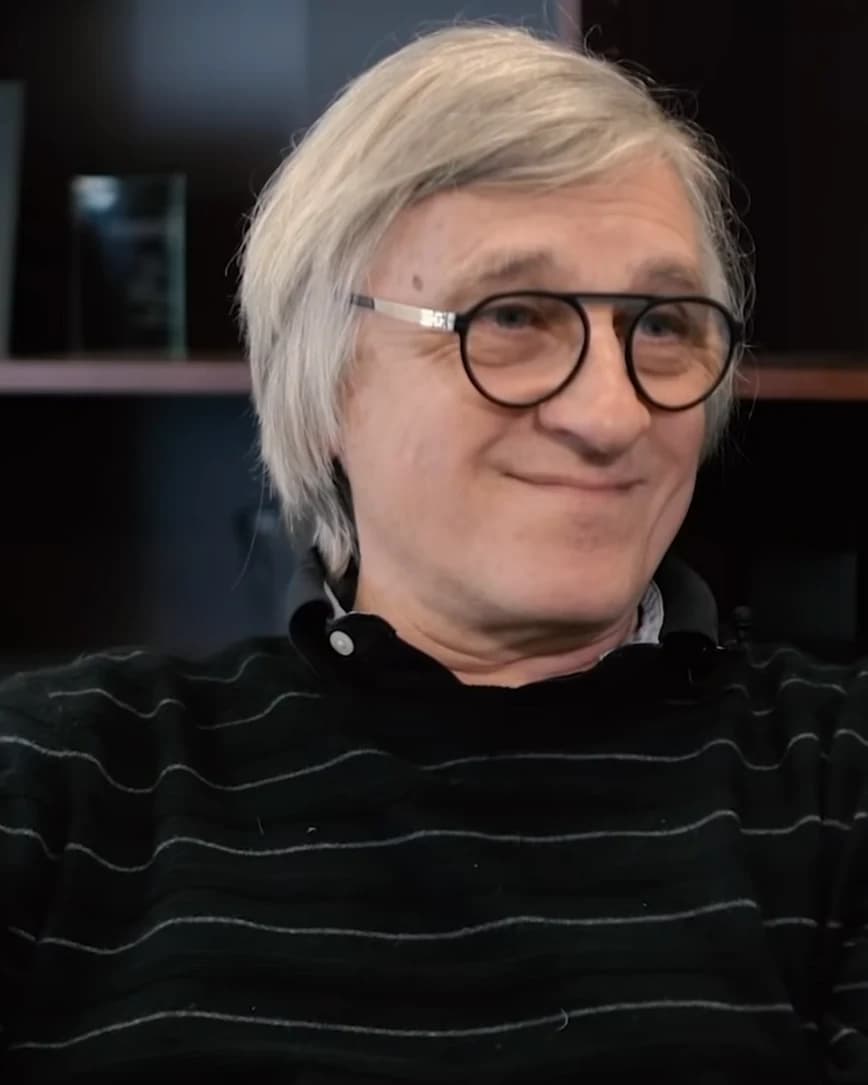
Dmitry Krymov (b. 1954) began as a stage designer: he designed his father Anatoly Efros’s productions at the Malaya Bronnaya Theatre, then worked at the Taganka, and in all created sets for more than a hundred productions. In the 1990s he turned to painting, graphic art and installation, and since the 2000s he has directed his own productions. A five-time Golden Mask winner, since 2022 he has run a theatre laboratory in New York.
Biography
Dmitry Krymov painted his portrait of Pope John Paul II from a photograph, as a birthday present for the pontiff. His manner was later compared to Modigliani and Soutine, and witnesses recalled that when the cover was lifted from the stretcher, the cardinals froze. The silence was broken by John Paul II himself: “Do not be afraid, it is I.”
This was in the 1990s, when Krymov left the theatre for painting for several years.
He was born on 10 October 1954 in Moscow, the son of the director Anatoly Efros and the theatre critic Natalia Krymova. In 1976 he graduated from the production department of the Moscow Art Theatre School, in the class of E. P. Freze. His diploma work was the set design for his father’s “Othello” at the Malaya Bronnaya Theatre, and it was this theatre that Krymov joined. There followed Turgenev’s “A Month in the Country”, Tennessee Williams’s “Summer and Smoke” (1981), Arbuzov’s “Recollection”, Bruckner’s “Napoleon the First” and Dvoretsky’s “The Theatre Director”, all directed by Efros. For his father he also designed two productions at the Gorky Moscow Art Theatre: “Tartuffe” (1981) and “The Living Corpse” (1982).
In 1985 he moved to the Taganka Theatre, where he designed “The Unwomanly Face of War” after Svetlana Alexievich, “A Square Metre and a Half” after Boris Mozhayev’s novella (together with Sergei Artsybashev) and Molière’s “The Misanthrope”. In all, he has designed more than a hundred productions in Russia, Japan, Bulgaria, France and the United States.
In the early 1990s Krymov left the theatre. He painted, illustrated books, made installations and exhibited in Russia and abroad, and today his works are in the Tretyakov Gallery, the Russian Museum, the Pushkin Museum and the Vatican Museums. It seems to me that without this decade at the easel there would have been none of his later theatre, which critics call “the theatre of an artist”.
The return was not easy. In 2002 Krymov began teaching on the stage design course at the Russian Academy of Theatre Arts, and that same year he released his first work as a director, “Hamlet”, staged for Valery Garkalin. The press received it coldly, and reviewers advised the author to go back to set design. His next attempt, “Nedoskazki” (2004), was a movement piece based on Russian fairy tales. That same year Krymov was given his own laboratory at the School of Dramatic Art and began working with his stage design students and young actors. “Sir Vantes. Donkey Hot” (2005), “Demon: The View from Above” (2006), “Opus No. 7” (2008), “Death of a Giraffe” (2009) and “Gorki-10” (2012) bore little resemblance to ordinary dramatic theatre. The press called them “art actions” and “surrealist illusions”: the story in them is told through a chain of metaphors, objects, transformations and spoken turns. In 2007 Krymov and his students won the Golden Triga at the Prague Quadrennial, the main award of that stage design exhibition.
He has five Golden Masks: for “Demon” (2008), “Opus No. 7” (2010), “O-y. Late Love” (2016), “Seryozha” (2020) and “Mozart ‘Don Giovanni’. Dress Rehearsal” (2022). In 2014 he was elected an honorary member of the Russian Academy of Arts.
He has also worked beyond Moscow. In 2011 came “In Paris”, after Bunin, with Mikhail Baryshnikov; in 2012 his production based on “A Midsummer Night’s Dream” won an award at the Edinburgh Festival; in 2016 at Yale University he staged “The Square Root of Three Sisters” with drama students. In 2018 he left the School of Dramatic Art, where fifteen of his productions were then in the repertoire, and began working on other Moscow stages: “Mumu” at the Theatre of Nations, “Seryozha”, after “Anna Karenina”, at the Chekhov Moscow Art Theatre, “Boris”, after Pushkin, at the Museum of Moscow (2019), “Mozart” at the Pyotr Fomenko Workshop and “Kostik”, after “The Seagull”, at the Pushkin Theatre (both 2021).
In February 2022 he went to Philadelphia to stage “The Cherry Orchard” at the Wilma Theater and decided not to return to Russia. In September of that year his productions were removed from the repertoire of Moscow theatres. In October Krymov opened a theatre laboratory in New York, which later settled at La MaMa; there he has staged “Metamorphoses” (2025) and “Uncle Vanya” (2026). In 2026 he directed a production based on Schiller’s “Mary Stuart” at the Gesher Theatre in Israel. He has published his directorial plans and his conversations with students in the books “In Our Own Words” (2022), “The Course” (2023) and “The New Course” (2025).
Profile notes
Profile and sources
Image
Artist image
Голос Америки (Voice of America, Russian-language); Wikimedia Commons; Public domain.
