
02.01.1937–12.08.2023
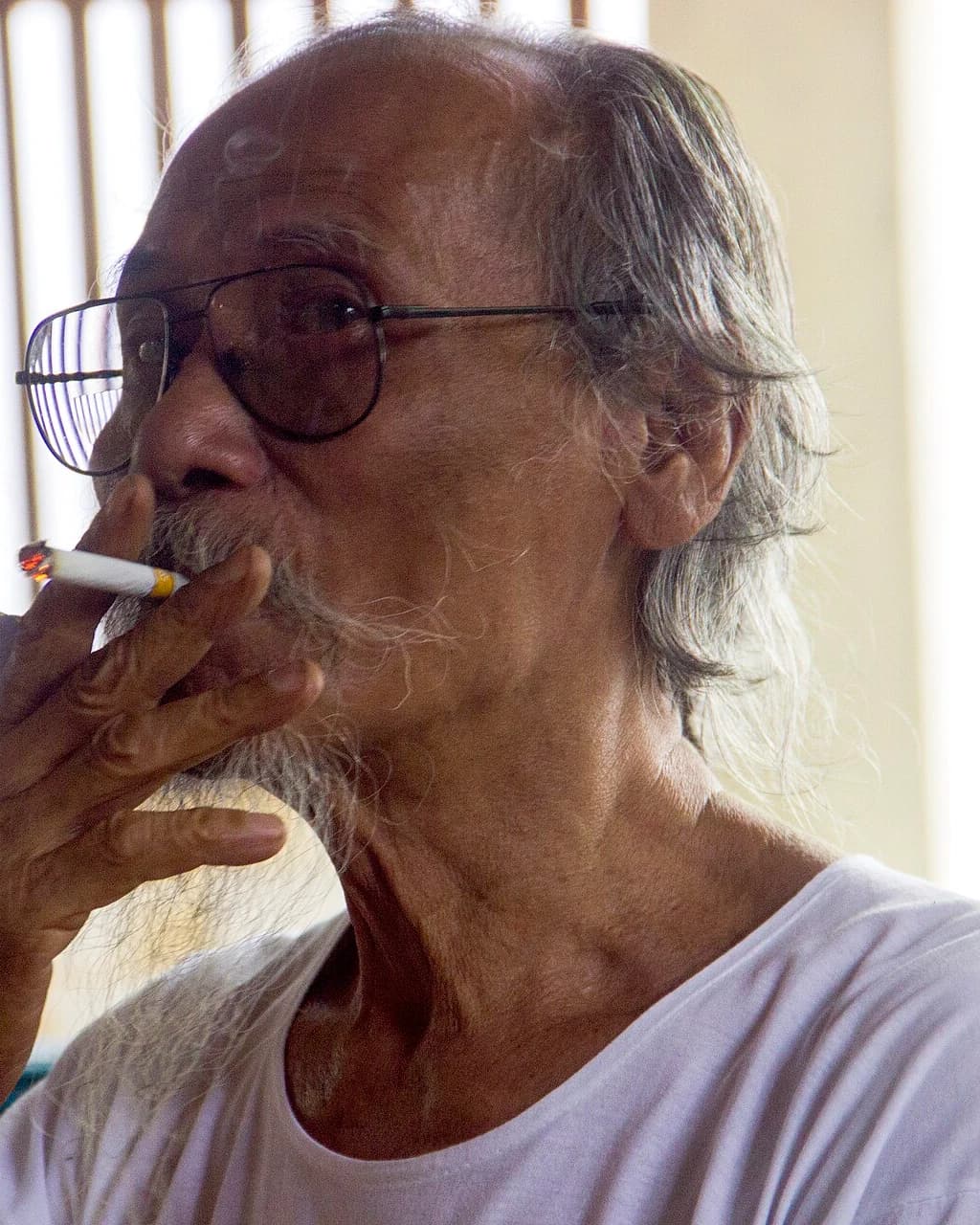
Djoko Pekik
Djoko Pekik (1937–2023) studied at the Academy of Fine Arts in Yogyakarta and belonged to the Bumi Tarung studio. From late 1965 until 1972 he was held in prison because of his link with Lekra, and he returned to exhibiting only in the late 1980s. His best-known painting, “Berburu Celeng” (1998), is connected with the end of President Suharto’s rule.
Biography
In the autumn of 1964 one of Djoko Pekik’s paintings was ranked among the five best canvases in the country at an exhibition organised by Lekra, the People’s Cultural Institute, a leftist cultural organisation. A year later this turned against him.
He was born on 2 January 1937 in Grobogan, near Purwodadi, in Central Java. In 1957 he entered the Indonesian Academy of Fine Arts (ASRI) in Yogyakarta and graduated in 1962. While still a student he became a member of the Bumi Tarung studio (“Land of Struggle”); among his companions there were Amrus Natalsya, Kuslan Budiman, Adrianus Gumelar and Isa Hasanda. He regarded the painter Affandi as his teacher and model. The Bumi Tarung artists travelled to poor neighbourhoods and villages under the principle of “Turba”, that is, “going down” to the people. These trips supplied his subjects: hard labour, poverty, peasants and townspeople living without means. His manner is usually described as a combination of realism and expressionism drawing on popular culture. Before 1965 he managed to hold three or four exhibitions in Jakarta. He was active in Lekra, which operated under the auspices of the Communist Party of Indonesia. After the events of 30 September 1965, arrests began, and on 8 November 1965 the police detained Pekik as someone connected with Lekra. He spent time in prison until 1972, where, it is reported, he was beaten, including with a rifle butt, and his hearing deteriorated as a result. His painting “Obsessive Pursuit”, dated 1965, is held by the State Museum of Oriental Art in Moscow.
After his release he could not paint seriously and earned his living as a tailor. In 1970 he married Tini Purwaningsih.
He returned to exhibiting in the late 1980s: in 1989 he showed work in the United States, and in 1990 at Edwin’s Gallery in Jakarta. After that, one work determined everything. “Berburu Celeng” (“Hunting the Wild Boar”, 1998) is linked with the end of Suharto’s rule in the Reformasi era. In 1998, at the Bentara Budaya cultural centre in Yogyakarta, he held an unusual exhibition: for one day and night he showed a single painting. It seems to me that this gesture says more about his attitude to his own work than any statement could.
Pekik’s paintings are held in the National Gallery of Indonesia and in private collections. In 2013 a solo exhibition of his work was held at the National Gallery, and in 2015 another opened at the National Museum in Yogyakarta. In 2019 the Indonesian president, Joko Widodo, bought his painting “Petruk Becomes King, and Semar His Coachman”.
Djoko Pekik died on 12 August 2023 at Panti Rapih Hospital in Yogyakarta. A little over two months earlier, on 29 May 2023, a sculpture of the artist himself by Dunadi was unveiled at Omah Petroek in the Pakem district (Sleman), beside a sculptural version of “Berburu Celeng” by Pramono.
Profile notes
Profile and sources
Image
Artist image
Rokok Indonesia; Wikimedia Commons; CC BY 2.0.
