
1415–06.05.1475
Dieric Bouts
Dieric Bouts (about 1415–1475), a native of Haarlem according to Karel van Mander, worked in Leuven for nearly all of his known life and became the city painter there. His “Last Supper” in St Peter’s Church was the first depiction of the subject on a Flemish panel and one of the first northern pictures in which the lines of a room meet at a single point.
Biography
The receipt for the Altarpiece of the Holy Sacrament begins with the words “I, Dieric Bouts…”, written in the artist’s own hand. Hence the form of the name Dieric, which many museums and scholars prefer today. The documents of the time also have other spellings, from Dirk to Diericke.
Little is known of his life. In 1604 Karel van Mander, in his “Book of Painters”, called him a native of Haarlem who lived and worked in Leuven. His year of birth is fixed only approximately, at around 1410–1415. Rogier van der Weyden influenced him so strongly that Bouts probably studied with him around 1440; he also knew the work of Jan van Eyck and Albert van Ouwater.
He married in Leuven, according to different accounts around 1447 or in 1448, Catharina van der Brugghen, the daughter of a wealthy patrician; he was working there from 1457 at the latest. He owned a large stone house with a garden and a vineyard in the Minderbroedersstraat. The early works include the triptych of the Life of the Virgin in the Prado, the Deposition triptych in the Capilla Real in Granada, “Christ in the House of Simon the Pharisee” in the Berlin Gemäldegalerie and the “Lamentation” in the Louvre. Four of his paintings on canvas, from about 1450–1455, also survive: the “Calvary” in Brussels, the “Annunciation” in the Getty Museum, the “Entombment” in the National Gallery in London and the “Resurrection” in the Norton Simon Museum in Pasadena.
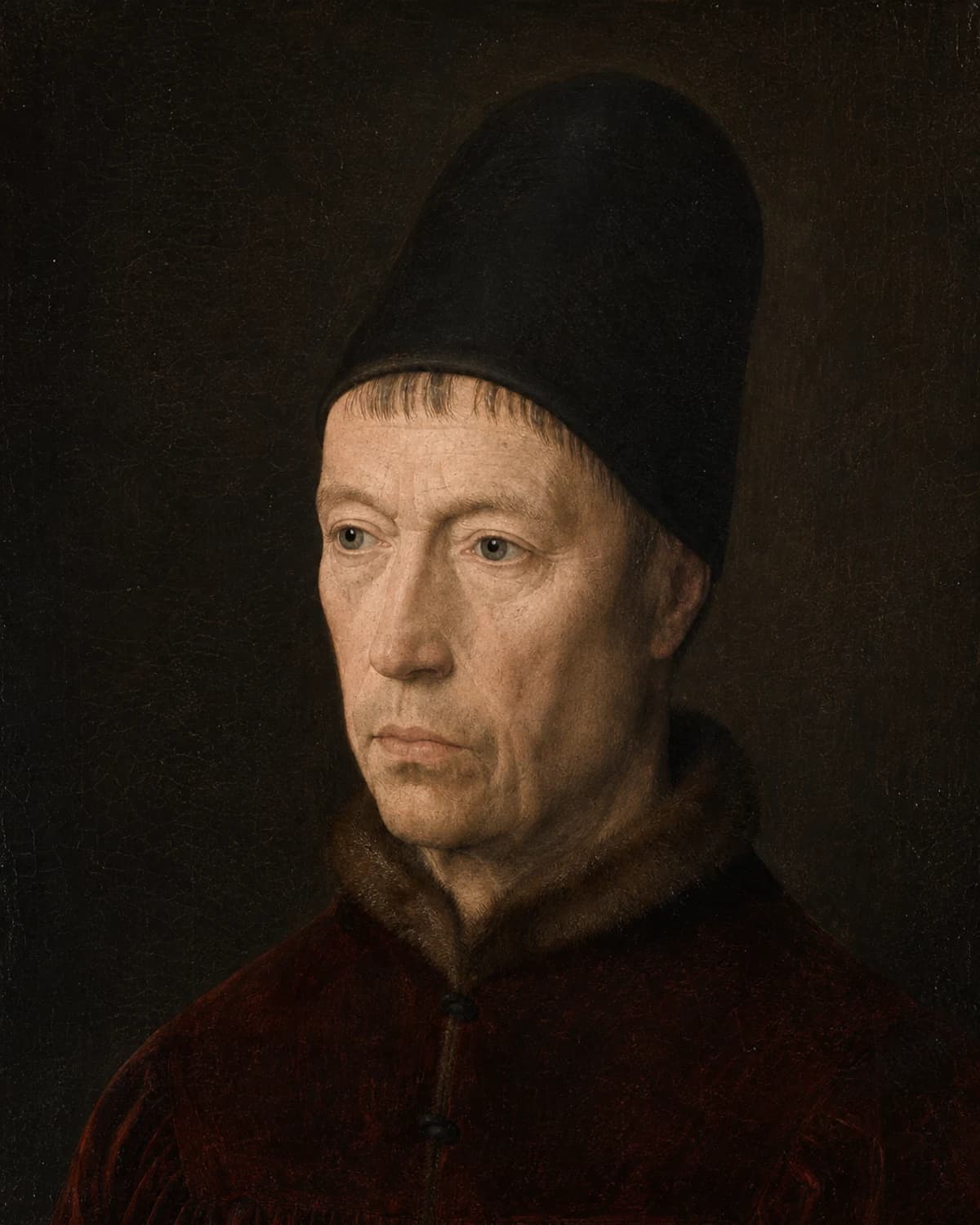
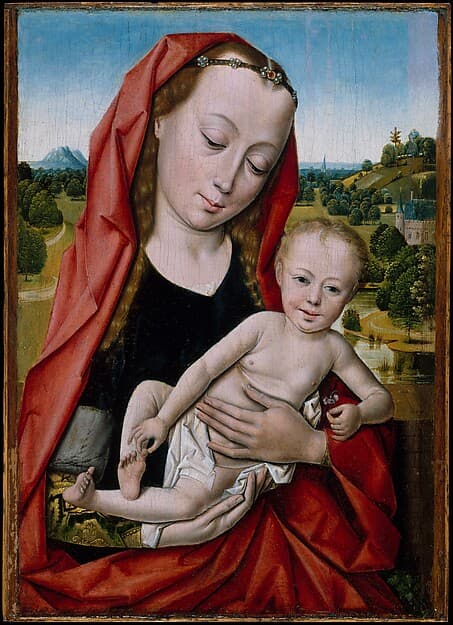
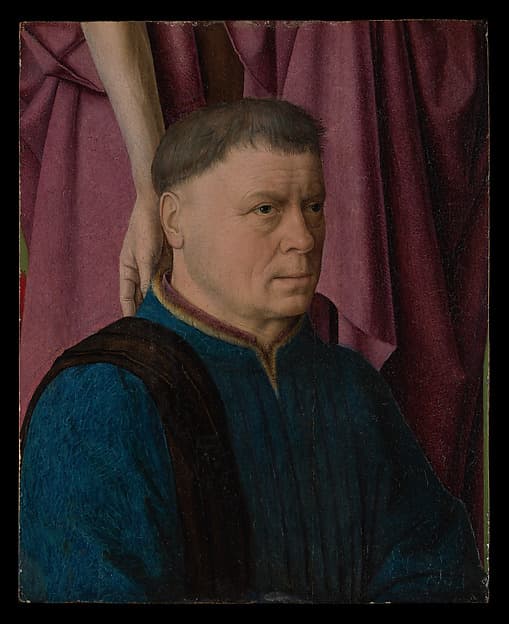
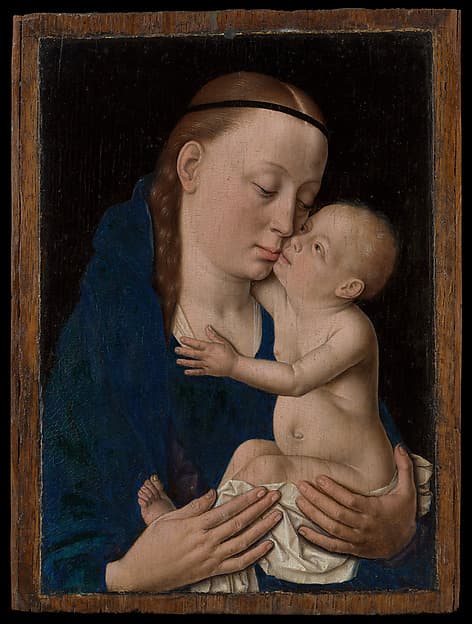
In 1462 he painted the “Portrait of a Man” now in the National Gallery in London: for the first time the sitter is turned three-quarters before a recognisable room, with a landscape visible through the window behind him. Many of his authentic works are small and made for prayer, most often the Virgin and Child; the so-called Davis Madonna in the Metropolitan Museum follows the scheme of the miraculous icon of Notre-Dame-de-Grâce installed in Cambrai Cathedral in 1454.
In 1464 the Leuven Confraternity of the Holy Sacrament commissioned an altarpiece from him for St Peter’s Church. At its centre is the “Last Supper”, the first known Flemish panel painting of the subject. Bouts chose neither the betrayal by Judas nor Christ comforting John, but the moment when Christ, like a priest at Mass, consecrates the host. The four servants in Flemish dress, two at the window and two standing, were long taken for a self-portrait of the artist with his sons, but they are more likely members of the confraternity who commissioned the altarpiece. The lines of the main room meet at one point, on the mantelpiece above Christ’s head. The small side room, though, has a vanishing point of its own, and neither lies on the horizon of the landscape beyond the windows. Among dated northern pictures, only Petrus Christus’s “Virgin” of 1457 in Frankfurt shows an understanding of Italian linear perspective earlier. The wings with the Old Testament prefigurations of the Eucharist (“Abraham and Melchizedek”, “The Passover Meal”, “The Gathering of the Manna”, “Elijah and the Angel”) were taken to Berlin and Munich in the nineteenth century, and reconstructing their original arrangement proved difficult.
He became city painter of Leuven in 1468 (according to other sources in 1472). For the town hall he first painted an altarpiece of the Last Judgement (1468–1470), of which the wings “The Road to Paradise” and “The Fall of the Damned” survive in Lille and a fragment with the head of Christ in Stockholm.
Then came the largest commission from the same town hall, the panels of “The Justice of Emperor Otto III”. Bouts finished “The Ordeal by Fire” and began “The Execution of the Innocent Count”, which others completed after his death; two further panels never came into being. Both panels are now in the Royal Museums of Fine Arts in Brussels. In 1998 the Leuven historian Maurits Smeyers called his book on him “Painter of Silence”, and, in my view, it could not be put better: Bouts’s figures barely move, his compositions are balanced and symmetrical, and people are absorbed into the interior or the landscape. Questions of attribution are still not all settled. The Alte Pinakothek in Munich holds the triptych known as the Pearl of Brabant, which writers tried to separate from the authentic Bouts as early as 1902, and the wings with the Betrayal of Christ and the Resurrection; these were long thought early, until dendrochronology placed them around the time of his death.
Bouts died in Leuven on 6 May 1475 and was buried near his house, in the church of the Friars Minor; at least until the beginning of the seventeenth century portraits of him and of his son Aelbrecht hung there. His sons carried on the workshop: the elder, Dieric the Younger, died in 1491, while the younger, Aelbrecht, painted in a recognisable manner of his own and carried his father’s imagery into the sixteenth century. Bouts was long confused with his Leuven contemporary Hubrecht Stuerbout. In 2023 the M Leuven museum mounted a retrospective, “Dieric Bouts, Creator of Images”.
Artist works
Works by the artist
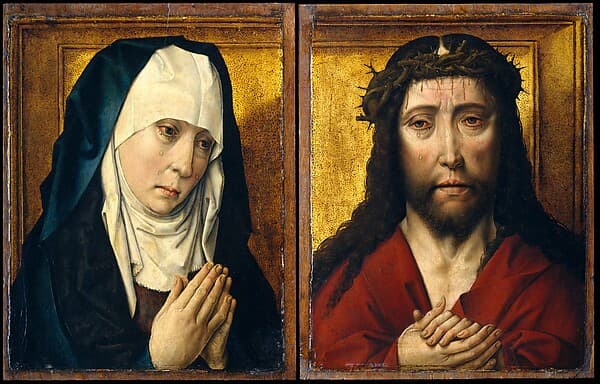
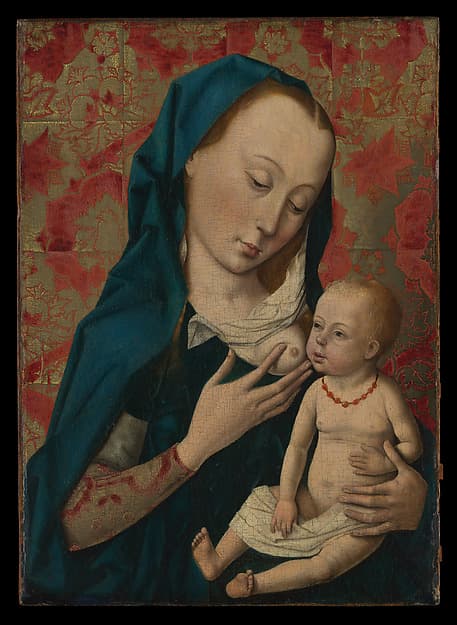
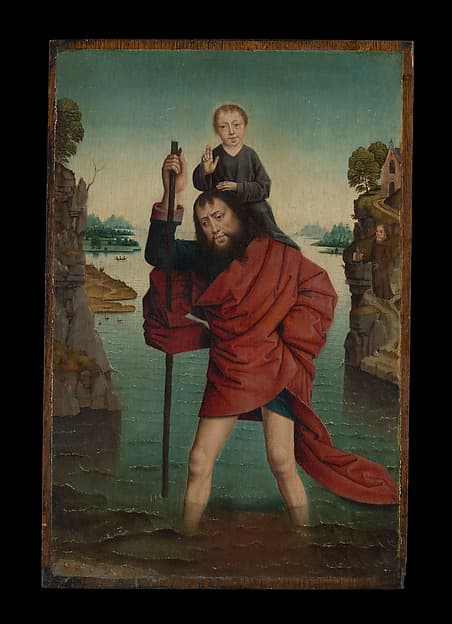
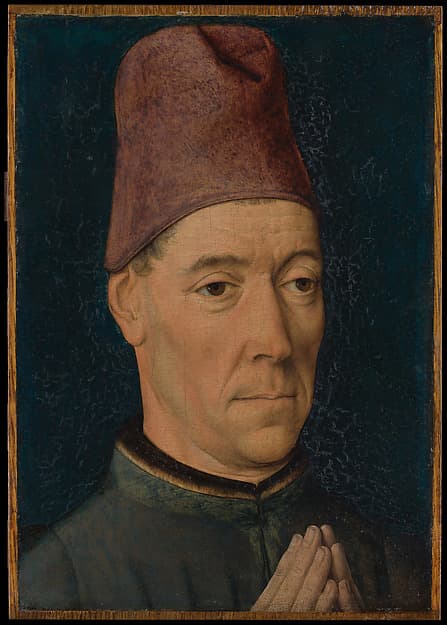
Works by Dieric Bouts available in this edition of NEOARCA.
Related context
Associations
Works connected through artistic movements, cultural context and period. Priced works available in this market appear first.
Profile notes
Profile and sources
Image
Artist image
На основе открытого изображения: Unknown; Wikimedia Commons; Public domain.
