
08.12.1886–24.11.1957
Diego Rivera
Diego Rivera (1886–1957) came back from Paris a Cubist and became the leading master of Mexican muralism: the Ministry of Education, Chapingo, the National Palace in Mexico City. In the United States he painted the twenty-seven frescoes of “Detroit Industry”, and his mural with Lenin at Rockefeller Center was destroyed. A communist who gave Trotsky a home, and the husband of Frida Kahlo.
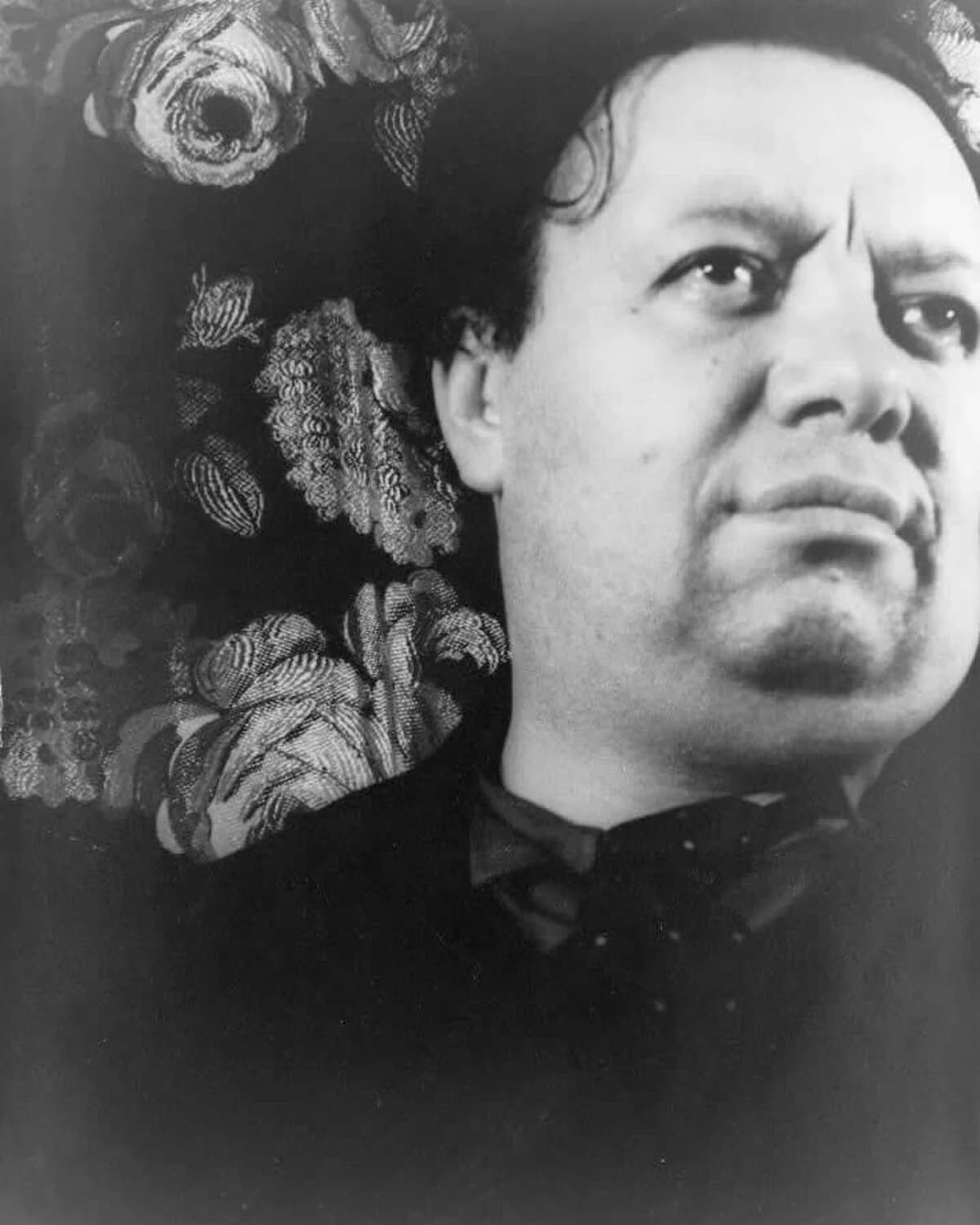
Biography
In 1933, at Rockefeller Center in New York, Rivera was painting the fresco “Man at the Crossroads”. At its centre, as it turned out, was Lenin, joining the hands of workers. The patrons demanded that Lenin be replaced by the face of an unknown man; Rivera refused, the work was halted, and in 1934 the fresco was destroyed. One of his assistants had managed to photograph it.
Rivera told the newspapers that with the money left over from his fee he would paint the fresco again and again, wherever he was asked, until the money ran out.
He was born on 8 December 1886 in Guanajuato, into a well-off family; his father worked for a liberal newspaper. His twin brother Carlos died at the age of two. Soon afterwards little Diego began drawing on the walls, and his parents, instead of scolding him, hung blackboards and canvas on them. From the age of ten he studied at the Academy of San Carlos in Mexico City. Rivera later took liberties with his ancestry: Spanish nobility, an Italian grandfather in the diplomatic service in Russia, an Indigenous grandmother, a mother descended from converted Jews. Almost all of this is known from his own words, and I would treat such stories with caution.
A grant to study in Europe came from the governor of the state of Veracruz, Teodoro Dehesa. In 1907 Rivera arrived in Madrid to work with the painter Eduardo Chicharro, and from 1909 he lived in Paris, in Montparnasse. His circle was La Ruche and the people who lived there: Modigliani, who painted his portrait in 1914, Chaim Soutine, Ilya Ehrenburg, Max Jacob, Moïse Kisling, the dealer Léopold Zborowski. In 1911 he married Angelina Beloff, an artist from Russia. From 1913 to 1917 Rivera painted with enthusiasm in a Cubist manner; then, under the impression of Cézanne, he moved to simple forms and large patches of bright colour. In 1920 the Mexican ambassador to France, Alberto Pani, persuaded him to go to Italy to look at Renaissance frescoes.
He came home in 1921, when the minister of education José Vasconcelos was launching a state programme of murals. In January 1922 Rivera painted his first large mural, “Creation”, in the Bolívar Auditorium of the National Preparatory School; he worked in encaustic and, so they say, kept a pistol by him in case of right-wing students. In the autumn of that year he took part in founding the union of technical workers, painters and sculptors and joined the Communist Party; it was then too that he married Guadalupe Marín. From September 1922 until 1928 he painted the Ministry of Education: 124 frescoes were planned. His style took shape quickly: large simplified figures, open colour, Aztec motifs, and each wall telling a story, like a Maya stela. For the chapel of the agricultural school at Chapingo he painted “Fertile Land”: Emiliano Zapata and Otilio Montaño lie in their graves, their bodies feeding the maize field above them, and a sunflower grows in the middle. Then came the Palace of Cortés in Cuernavaca (1929–1930) and the National Palace in Mexico City with “The History of Mexico” (1929–1930, 1935).
In the autumn of 1927 he was invited to Moscow for the tenth anniversary of the October Revolution. He stood on the stand of the Mausoleum during the parade, drew the marchers, received a commission for a mural for the Red Army Club and met Alfred Barr, the future director of the Museum of Modern Art in New York. In 1928 the authorities told him to leave. In 1929 he was expelled from the Mexican Communist Party on suspicion of Trotskyism, and on 21 August of that year he married Frida Kahlo: she was twenty-two, he was forty-two.
His American years began in November 1930 in San Francisco, where the architect Timothy Pflueger had invited him: a mural for the Stock Exchange club and a fresco for the California School of Fine Arts. In November 1931 the Museum of Modern Art put on a retrospective of his work. In 1932–1933 he painted the twenty-seven fresco panels of “Detroit Industry” in the inner courtyard of the Detroit Institute of Arts; part of the money came from Edsel Ford. Assembly line, blast furnaces, workers and machines fill the walls entirely. Straight after Detroit came Rockefeller Center, and after the scandal Chicago cancelled a commission for a mural for the World’s Fair. In 1934 Rivera repeated the destroyed fresco in the Palacio de Bellas Artes in Mexico City and called it “Man, Controller of the Universe”.
He persuaded President Lázaro Cárdenas to grant asylum to Leon Trotsky, who lived for several months in the house of Rivera and Kahlo until they fell out. In 1939 Rivera divorced Kahlo, and on 8 December 1940, his own birthday, he married her again in San Francisco. There too, in 1940, he painted the ten-panel “Pan American Unity” in full view of visitors to the Golden Gate Exposition.
In 1946–1947 came “Dream of a Sunday Afternoon in the Alameda Park”. It includes the Catrina, a skeleton lady of fashion in a large hat, once invented by the printmaker José Guadalupe Posada; Rivera gave her Indigenous features, and since then she has become a national symbol and the chief image of the Day of the Dead. Another detail caused a scandal: Ignacio Ramírez, known as El Nigromante (the Necromancer), holds a placard reading “God does not exist”. Rivera, a convinced atheist, refused to remove the inscription, and the fresco was kept from view for nine years, until he gave in.
After Frida Kahlo’s death he married, in 1955, Emma Hurtado, who had been his agent since 1946, and in 1955–1956 he made one more trip to the USSR. Diego Rivera died in Mexico City on 24 November 1957 and was buried in the Dolores Cemetery, in the Rotunda of Illustrious Persons. In 1960 his autobiography “My Life, My Art” came out; the journalist Gladys March had been taking it down from his words since 1944 and had filled some two thousand pages.
Related context
Associations
Works connected through artistic movements, cultural context and period. Priced works available in this market appear first.








Profile notes
Profile and sources
Image
Artist image
Carl Van Vechten; Wikimedia Commons; Public domain.
