
09.07.1937–11.06.2026
David Hockney
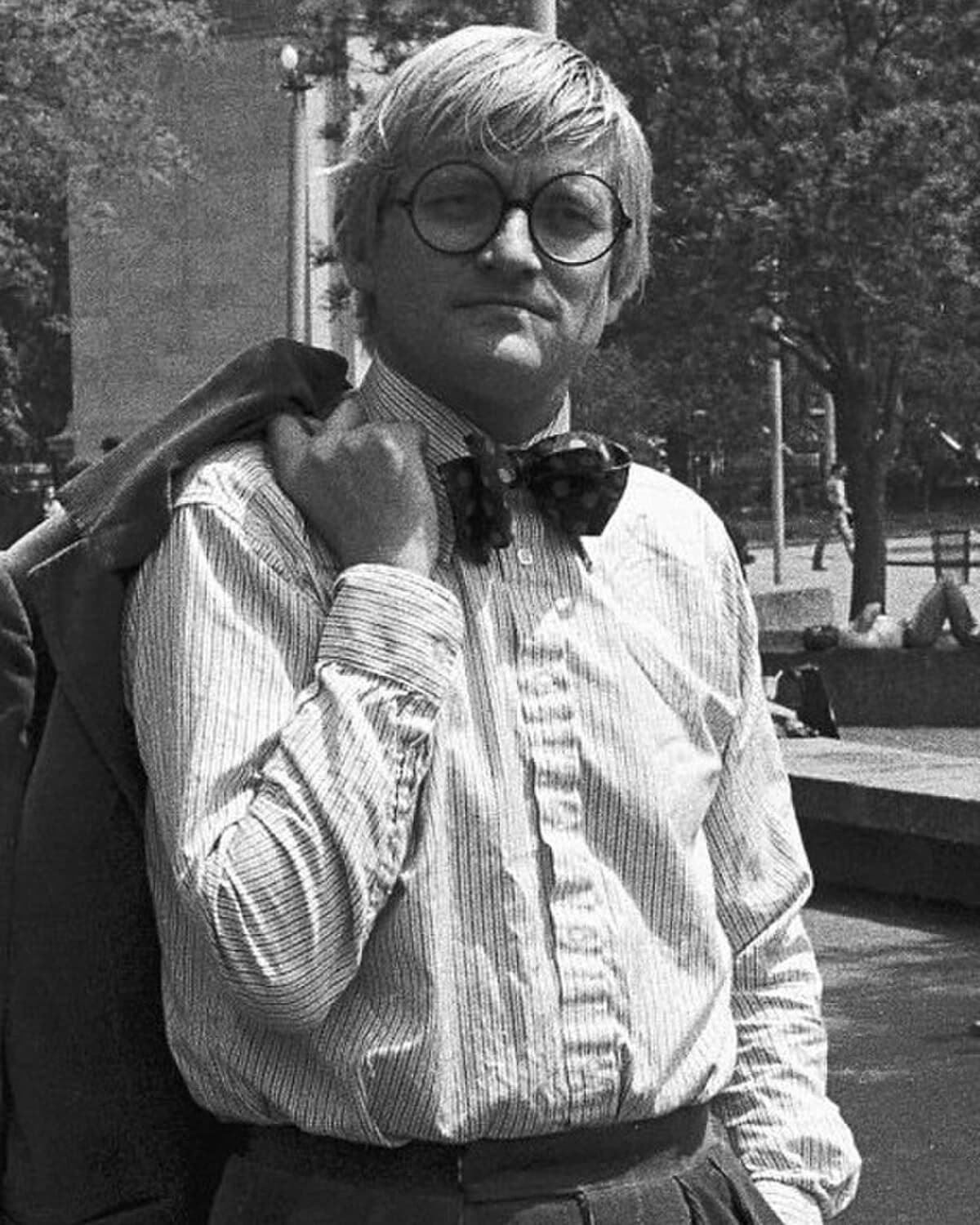
David Hockney grew up in Bradford, studied at the Royal College of Art in London and in 1964 moved to Los Angeles, where he painted his swimming pools, including “A Bigger Splash” (1967). Later he assembled “joiners” from Polaroid photographs, designed operas at Glyndebourne and the Metropolitan Opera, drew on a tablet and painted the landscapes of his native Yorkshire outdoors. He died in London in 2026.
Biography
In 1962 the Royal College of Art threatened not to let David Hockney graduate. He refused to write the compulsory examination essay, holding that he should be judged by his work, and when he was also required to produce a student study from the life model, he painted a picture and called it “Life Painting for a Diploma”. The college changed its rules and awarded him the diploma.
He was born on 9 July 1937 in Bradford, West Yorkshire, the fourth of five children. His father, Kenneth Hockney, worked as a clerk for an accountant, later set up an office of his own, and in the Second World War refused to fight on grounds of conscience. His mother, Laura, was a devout Methodist and a vegetarian. David studied at Bradford Grammar School and at the local art college. He became a conscientious objector himself, like his father, during his National Service of 1957–1959, and served it out as an orderly in hospitals.
At the Royal College he became friends with R. B. Kitaj, and at the “Young Contemporaries” exhibition his work hung next to Peter Blake’s; that show later came to be regarded as the birth of British Pop Art. In 1961 came the painting “We Two Boys Together Clinging”, titled after a line by Walt Whitman. Hockney spoke openly about his homosexuality from the age of twenty-three, several years before sex between men ceased to be a crime in England and Wales in 1967.
His first solo exhibition was held in 1963 with the London dealer Kasmin. Then came short teaching contracts in Maidstone, Iowa, Colorado, Los Angeles and Berkeley. In 1964 he settled in Los Angeles, and the Californian light, together with acrylic paint, then still a new medium, gave him a subject for years: swimming pools. Almost nothing happens in “A Bigger Splash”. A yellow diving board, smooth blue water, a low house with a wide window, two palm trees and a white burst of spray where the diver has just vanished. In 1967 Hockney won the John Moores Prize for “Peter Getting Out of Nick’s Pool”, and in 1974 Jack Hazan made a film about him and called it, after the painting, “A Bigger Splash”.
From 1968 he painted his friends almost life-size, often in pairs: the fashion designer Ossie Clark and the textile designer Celia Birtwell (“Mr and Mrs Clark and Percy”, 1970–1971), the curator Henry Geldzahler, the collectors Fred and Marcia Weisman. In 1972 he finished “Portrait of an Artist (Pool with Two Figures)”. Over his lifetime he made more than three hundred self-portraits. Printmaking ran alongside the painting. In 1961–1963 he produced a series of etchings, “A Rake’s Progress”, after Hogarth, then illustrated poems by Cavafy (1966) and fairy tales by the Brothers Grimm (1969). From 1973 he worked with Aldo Crommelynck, Picasso’s printer, and in 1976–1977 made twenty etchings with him for “The Blue Guitar”, after the poem by Wallace Stevens. In the summer of 1978, at the workshop of the New York printer Ken Tyler, he tried painting directly with coloured paper pulp and in six weeks made 29 sheets of pools and sunflowers.
His work for the theatre began in 1966 with “Ubu Roi” at the Royal Court in London. Then came Stravinsky’s “The Rake’s Progress” (1975) and “The Magic Flute” (1978) at Glyndebourne, two triple bills at the Metropolitan Opera in the early 1980s, “Tristan und Isolde” in Los Angeles, “Turandot” in Chicago and “Die Frau ohne Schatten” at Covent Garden (1992). He built the sets in his own studio as 1:8 scale models.
In the early 1980s he began gluing Polaroids and ordinary prints into composite pictures, which he called “joiners”: “My Mother, Bolton Abbey, 1982”, “Pearblossom Highway”. The shots are taken from different points and at different seconds, and the image comes out almost Cubist. Later he lost faith in “one-eyed” photography and went back to painting. In 1985 he drew directly on the screen of a Quantel Paintbox system for the BBC, and later printed drawings on a fax machine and an inkjet printer. In 2001 came the book “Secret Knowledge”, in which Hockney, together with the physicist Charles Falco, argued that the old masters had used lenses and the camera obscura. Art historians disputed it; I would read it as the notes of a practitioner who had himself spent two years drawing with a camera lucida.
In the 1990s he went more and more often to Yorkshire to see his mother, and his dying friend Jonathan Silver persuaded him to paint the local landscape. In 1998 came “Garrowby Hill”, then a studio in the seaside town of Bridlington and work outdoors in oil and watercolour. “Bigger Trees Near Warter” (2007) is painted on fifty canvases measuring 4.6 by 12 metres overall; in 2008 Hockney gave the painting to the Tate. From 2009 he drew on a smartphone and a tablet, and in 2012 the Royal Academy showed these drawings beside huge landscapes in the exhibition “A Bigger Picture”. That same year he received the Order of Merit, and in 2018 Westminster Abbey unveiled “The Queen’s Window”, with flowering hawthorn, which he had designed on a tablet.
In 2017 the retrospective marking his eightieth birthday became the most visited exhibition in the history of Tate Britain. In 2019 he set up a studio on a farm near Beuvron-en-Auge in Normandy and spent a year there drawing the changing seasons on a tablet (an iPad); the series “The Arrival of Spring, Normandy, 2020” was included in exhibitions at the Royal Academy and the Art Institute of Chicago. In 2025 the Fondation Louis Vuitton in Paris showed “David Hockney 25”, with works from 1955 to 2025. From 2023 he was living in London again.
Hockney died at his home in London on 11 June 2026, aged 88. At his wish, the funeral was private.
Profile notes
Profile and sources
Image
Artist image
United Press International; Wikimedia Commons; Public domain.
