
09.07.1882–15.01.1967
David Burliuk
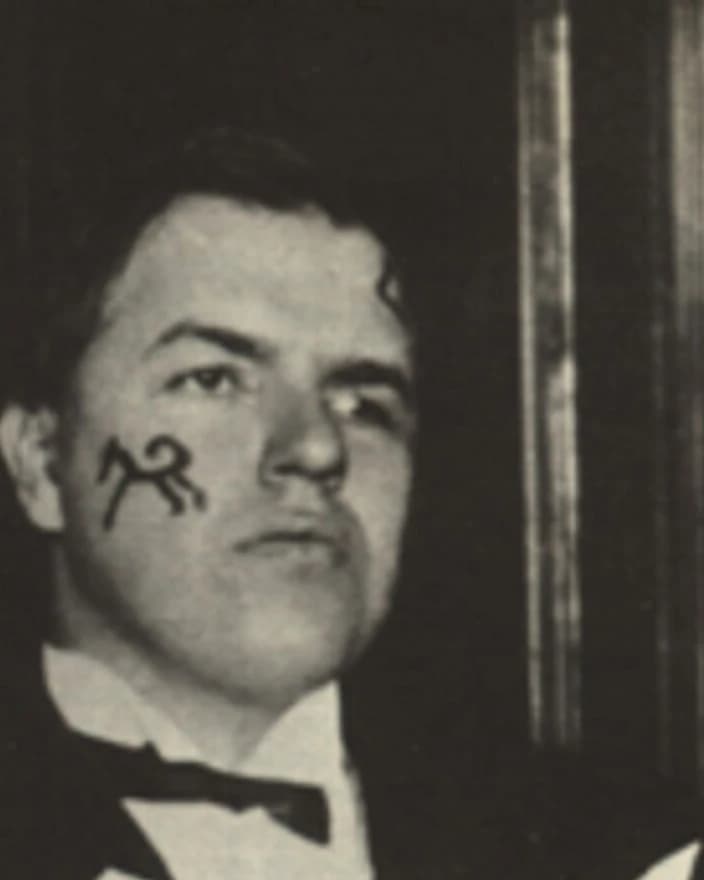
David Burliuk (1882–1967), painter and poet, gathered the Hylaea group around him and signed the manifesto “A Slap in the Face of Public Taste”; he called himself “the father of Russian Futurism”, and Mayakovsky considered him his teacher. From 1920 he lived in Japan and from 1922 in the United States, where he painted, published the journal “Color and Rhyme” and exhibited to the end of his life.
Biography
In December 1912 David Burliuk, together with Mayakovsky, Khlebnikov and Kruchenykh, signed a manifesto that proposed to “throw Pushkin, Dostoevsky, Tolstoy, etc., etc. overboard from the Steamship of Modernity”. The manifesto was called “A Slap in the Face of Public Taste”.
Forty-four years later he came to Yasnaya Polyana.
Burliuk was born on 9 (21) July 1882 near the village of Riabushky in the Lebedin district of the Kharkov Governorate. His father, David Fyodorovich, a self-taught agronomist from a Cossack family, managed the estates of Count Mordvinov; his mother, Lyudmila Iosifovna, née Mikhnevich, grew up in Nizhyn and Romny. Of the six children, Vladimir and Lyudmila also became painters and Nikolai a poet, and all three later ended up among the Futurists. As a child David lost an eye when his brother accidentally hit him while playing with a toy cannon; the glass eye later became part of his image. He attended grammar schools in Sumy, Tambov and Kazan, first appeared in print in 1899, and studied painting at the art schools of Kazan and Odesa (in Odesa under Kiriak Kostandi and Gennady Ladyzhensky), at the Royal Academy in Munich under Wilhelm von Diez and privately under Anton Ažbe, who called him a “wonderful wild steppe horse”, and in Paris under Cormon. Once he brought back 350 studies of the Kherson steppe from a summer of practice, and his teachers dubbed it “factory production”. By then the family was living in the south, and from 1907 it settled in Chernyanka near Kherson, where his father managed estates for the same Mordvinov.
Chernyanka became a meeting place. From 1907 to 1913 painters and poets came there, and in 1910–1911 the Hylaea group took shape: the three Burliuks, Benedikt Livshits, Vasily Kamensky, Velimir Khlebnikov, Elena Guro, Mayakovsky and Aleksei Kruchenykh. Burliuk saw to the group’s printing: the first Futurist publications came out in Kherson and Kakhovka. Back in 1907 he had become friends with Mikhail Larionov and one of the leaders of the group Venok–Stefanos (The Wreath), and in 1908, with his brother Vladimir, Aleksandra Ekster, Alexander Bogomazov and Vladimir Baranoff-Rossiné, he organised the exhibition “Zveno” (The Link) in Kiev. From 1910 he belonged to the Jack of Diamonds, took part in the Blue Rider exhibition in Munich and wrote an article for its almanac. From 1911 he studied with Mayakovsky at the Moscow School of Painting, Sculpture and Architecture, and in 1913 they were both expelled. Around the same time Burliuk, Mayakovsky and Kamensky toured towns giving performances, and audiences often met them with hostility. Mayakovsky later wrote of him briefly: “Burliuk made me a poet.”
He was not called up for the war because he had lost an eye. In the spring of 1915 he found himself in the Ufa Governorate, near Iglino station, where his wife Maria Nikiforovna had an estate, and in two years he painted about two hundred pictures there; thirty-seven of them are now in the Nesterov Bashkir Art Museum. In 1918, when the anarchists were being crushed in Moscow, he barely escaped with his life and left again for Ufa, then toured the Urals, Siberia and the Far East with Kamensky and in June 1919 reached Vladivostok.
In 1920 Burliuk left for Japan, lived there for two years and painted about three hundred pictures on Japanese motifs; their sale paid for the move to America. From 1922 he lived in the United States. He knew no English, but he made friends with the artist and patron Katherine Dreier, and in 1926 his huge canvas “Advent of the Mechanical Man” hung in the International Exhibition of Modern Art at the Brooklyn Museum. In New York he joined pro-Soviet circles, wrote a poem for the tenth anniversary of the October Revolution and was a regular contributor to the newspaper “Russian Voice”. With his wife he published his own collections and pamphlets and, for many years, the journal “Color and Rhyme”, partly in English and partly in Russian. In 1925–1930 he painted “Lenin and Tolstoy” (Lenin harnessed to the plough, Tolstoy striding ahead), and in 1944 “Children of Stalingrad”. In 1949 the couple travelled through the south of France in the footsteps of Van Gogh, and in 1962 they visited Australia, where his only Australian exhibition was held in Brisbane, and Italy.
In 1956 the Burliuks came to the USSR for the first time since emigrating: Leningrad, Moscow, the Crimea, Spasskoye-Lutovinovo, and Yasnaya Polyana, where they were met by Tolstoy’s last secretary, Valentin Bulgakov. Burliuk admired Tolstoy all his life and was proud that his drawings had been printed in the same collection as drawings by Tolstoy and Dostoevsky. To my mind, that is the best commentary on the manifesto of 1912. In 1965 they came again, hoping to get Soviet museums to take his works, but he never managed to have a single line of his poetry printed in the USSR.
He worked without a break all his life and said with pride that he had painted more than twenty thousand pictures.
For about the last twenty years of his life Burliuk lived in Hampton Bays on Long Island, where his house and studio still stand. He died on 15 January 1967 in Southampton, New York. In accordance with his will his body was cremated, and his family scattered the ashes over the Atlantic from a ferry. On 24 May 1967 he was posthumously elected a member of the American Academy of Arts and Letters.
Related context
Associations
Works connected through artistic movements, cultural context and period. Priced works available in this market appear first.








Profile notes
Profile and sources
Image
Artist image
Unknown author Unknown author; Wikimedia Commons; Public domain.
