
29.12.1896–06.01.1974
David Alfaro Siqueiros
David Alfaro Siqueiros (1896–1974), with Diego Rivera and José Clemente Orozco one of the best-known Mexican muralists, painted murals with spray guns, from projections and on aluminium, designing them for a moving viewer. A communist who fought in two wars, he worked in Mexico City, Los Angeles, New York, Chile and Cuba; his last major work is the Polyforum in Mexico City (1971).
Biography
On 9 October 2012 in Los Angeles, on the outside wall of the former Plaza Art Center above Olvera Street, the mural “Tropical America” was shown to the public again. Siqueiros had painted it in 1932 together with his students; in 1934 it was partly covered, and in 1938 whitewashed entirely. No colour photographs survived, and the conservators of the Getty Conservation Institute reconstructed his intentions from analysis of the paint layer.
The wall faced the street, and that made him think about the viewer walking past.
He was born on 29 December 1896 in the city of Chihuahua; for a long time Camargo was believed to be his birthplace, until his birth certificate turned up in 2003. He was baptised José de Jesús Alfaro Siqueiros; the artist took his mother’s surname, and the name David came later. His mother died when he was four, the children were sent to their paternal grandparents, and from 1902 he went to school in Irapuato. In September 1910, at the centenary celebrations of independence in Mexico City, the boy shouted “Die!” at the dictator Porfirio Díaz and was struck with a whip by the coachman. In 1911 he entered the Academy of San Carlos and took part in a student strike, after which an open-air painting school was opened at Santa Anita. His teacher Dr. Atl urged artists to look for a national art in the ancient indigenous cultures. In 1913 Siqueiros and some of his friends enlisted in Venustiano Carranza’s Constitutionalist Army, and after Huerta’s fall he fought against the forces of Villa and Zapata.
In 1919–1922 he lived in Europe: in Paris he looked at the Cubists and Cézanne and met Diego Rivera, he travelled to Italy to study Renaissance frescoes, and in 1921 in Barcelona he brought out the magazine “Vida Americana” with a manifesto to the artists of America: to create a public art with new technical means. Back home, he painted the walls of the National Preparatory School with Rivera and Orozco, commissioned by the education minister José Vasconcelos. From 1922 he was a member of the Communist Party, and in 1923 he helped to found the Syndicate of Revolutionary Painters, Sculptors and Engravers, with its newspaper El Machete. His fresco “Burial of a Worker” (1923) remained unfinished; students damaged it, and later a new minister had it painted over.
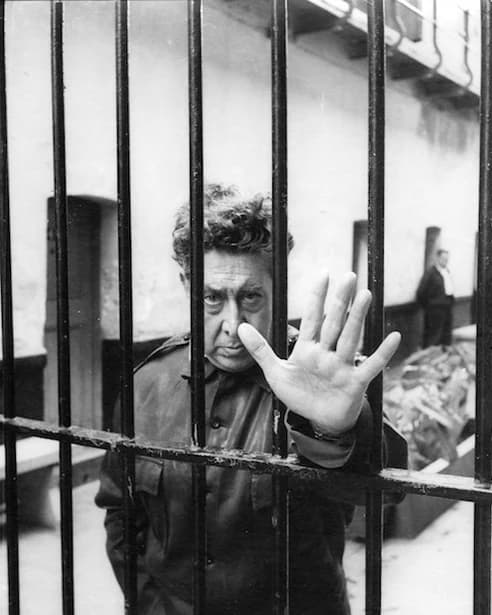
In 1930 Siqueiros was arrested and sent into internal exile in Taxco, where he painted several dozen works; in Lecumberri prison he made lithographs that were later exhibited in the United States. In 1932, in six months in Los Angeles, he and his team painted three murals: “Street Meeting” for the Chouinard School, “Tropical America” and “Portrait of Mexico Today” on the patio of the film director Dudley Murphy. They worked with an airbrush and a spray gun, transferred the drawing to the wall with a projector, and photographed the sketches to correct the perspective. A mural, he concluded then, must follow the ordinary path of the viewer. That same year he was deported from the United States.
In 1936 in New York he set up the Experimental Workshop, which made posters and floats for the May Day parades. The young Jackson Pollock came to it, and Siqueiros is credited with showing Pollock the technique of dripping and pouring paint. To my mind, this is the most unexpected legacy of Mexican muralism. From the same years come “Echo of a Scream” (1937) and “The Sob” (1939), both now in the Museum of Modern Art in New York.
In 1937–1938 Siqueiros fought in Spain in the Republican army and rose to lieutenant colonel; he later called his memoirs “They Called Me El Coronelazo”. In 1939, with the Spaniard Josep Renau and an international team, he began “Portrait of the Bourgeoisie” on the stairwell of the electricians’ union in Mexico City, using photomontage and stencils. On 24 May 1940 an armed group under his command attacked Leon Trotsky’s house in Coyoacán; Trotsky was unhurt, and his grandson was wounded. Siqueiros went into hiding and was arrested in October 1940, but the case never came to trial: in 1941 he left for Chile, where, with the help of Pablo Neruda, he painted a school library in Chillán (“Death to the Invader”), and then for Cuba.
In 1950, together with Orozco, Rivera and Tamayo, he represented Mexico at the 25th Venice Biennale and received the second prize. In 1952 came the relief mural with mosaic on the rectorate building of the National Autonomous University, and from 1957 he worked on his largest fresco, “From the Dictatorship of Porfirio Díaz to the Revolution”, in Chapultepec Castle. In 1960 he was imprisoned for his political activity; under international pressure he was released in 1964. In 1967 he received the International Lenin Peace Prize.
The Polyforum in Mexico City, completed in 1971, was conceived as a building that is itself a mural: outside, twelve panels of painting and sculpture; inside, the walls and ceiling are covered by “The March of Humanity on Earth and Toward the Cosmos”. It is said to be the largest mural ever made. Siqueiros died on 6 January 1974 in Cuernavaca and was buried in the Rotunda of Illustrious Persons in Mexico City. A few days before his death he gave the state his house in Polanco, where the Public Art Room had been operating since 1969.
Related context
Associations
Works connected through artistic movements, cultural context and period. Priced works available in this market appear first.








Profile notes
Profile and sources
Image
Artist image
Galería Fundación Héctor García; Wikimedia Commons; CC BY-SA 3.0.
