
01.08.1856–23.10.1932
Daniel Hernández Morillo
Daniel Hernández Morillo (1856–1932) was born in the Andean village of Salcabamba, painted “The Death of Socrates” at sixteen, won a scholarship for it and left for Europe for forty-four years: ten in Italy beside Fortuny, then Paris, the Salon, medals in 1899 and 1900 and the Legion of Honour. In 1919 he returned to Lima to open the National School of Fine Arts and ran it until his death.
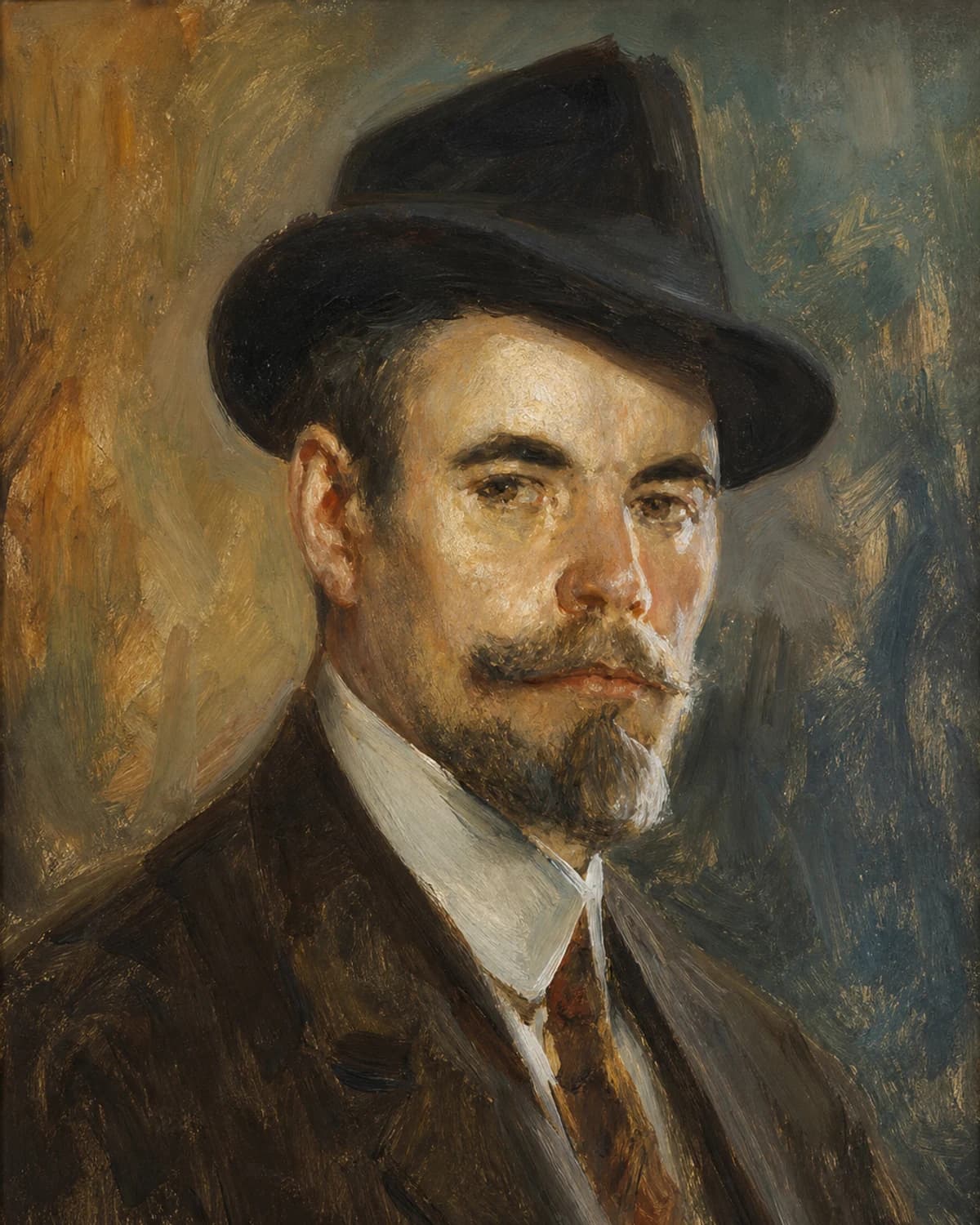
Biography
The picture is called “The Idle Woman” (La Perezosa): a woman doing nothing, and Daniel Hernández painted a whole series of such idle women. For this one, shown at the Paris Salon of 1899, he received a second-class medal, and two years later the Legion of Honour.
He was born on 1 August 1856 in Salcabamba, a mountain village in the province of Tayacaja in the department of Huancavelica; his father, Leocadio Hernández, was Spanish, his mother, Basilia Morillo, Peruvian. At four he was brought to Lima. He began drawing at fourteen, in the studio of the Italian Leonardo Barbieri in the Calle San Pedro; Barbieri had painted portraits and taken daguerreotypes in California in the Gold Rush years, and when he left Lima his class passed to the pupil. In 1872 the sixteen-year-old Hernández painted “The Death of Socrates”, and the government of President Manuel Pardo gave him a scholarship to Europe, promising an allowance that was later paid only in part. By early 1874 he was in Paris, where his compatriot Ignacio Merino advised him to study in Rome.
He spent about ten years in Italy, working beside Mariano Fortuny, and in 1883 returned to Paris, where he lived until 1918. He was elected president of the Society of Spanish Painters, which brought together the Spanish-speaking painters of Paris; he was friends with Francisco Pradilla and José Villegas Cordero, belonged to the Société des Artistes Français and exhibited year after year at its Salon, eventually gaining the right to show without passing the jury. At the Exposition Universelle of 1900 his “Cruel Love” received a gold medal; later his “Francisco Pizarro” was awarded a prize at the Ibero-American Exposition in Seville. He illustrated Balzac: “The Country Parson”, “Lost Illusions”, “The Country Doctor”. In 1912 he exhibited in Montevideo, Buenos Aires and Rome and returned once more to Paris.
He painted portraits, genre and history scenes, battle compositions and, with particular readiness, the female nude, with measured drawing and even, decorative colour. Critics at home later reproached him for giving Peruvian painting breadth but not feeling, and for pictures that repeated what he had learned abroad, while granting that it was he who taught the Lima public to buy painting of the European kind. I would not judge him harshly: he lived forty-four years outside Peru, and the Salon was his element. For the government of Augusto Leguía he painted “The Salute to President Leguía”; he also painted President Eduardo López de Romaña, the conquistador Francisco Pizarro and the capitulation of the Spaniards at Ayacucho.
In 1918 his younger brother Inocencio rose to a high position in the Dominican Order in Peru, and, possibly not without his help, President José Pardo y Barreda called on the painter to create a new art school. The National School of Fine Arts in Lima opened in 1919, Hernández became its first director and remained so to the end.
He died in Lima on 23 October 1932 and was buried in the Presbítero Maestro cemetery. A district next to the town of Pampas, not far from his birthplace, is named after him.
Related context
Associations
Works connected through artistic movements, cultural context and period. Priced works available in this market appear first.








Profile notes
Profile and sources
Image
Artist image
На основе открытого изображения: Daniel Hernández Morillo; Wikimedia Commons; Public domain.
