
15.12.1857–08.11.1890
Cristóbal Rojas
Cristóbal Rojas (1857–1890) went to work in a tobacco factory in Cúa at thirteen, and in 1883 received a scholarship to Paris from the Venezuelan government for the painting “The Death of Girardot at Bárbula”. At the Académie Julian, under Jean-Paul Laurens, he painted poverty: a sick violinist, a tavern, a first and last communion. He died in Caracas three months after his return, aged thirty-two.
Biography
In 1883 Caracas was celebrating the centenary of Bolívar, and at the centenary exhibition a young painter from the Tuy valley showed “The Death of Girardot at Bárbula”. The state bought the picture; it is now in the Bolivarian Museum.
The medal was silver, and he shared second place with Arturo Michelena. With the medal came a scholarship to study in Europe, fifty pesos a month.
Rojas was born on 15 December 1857 (or, by other accounts, 1858) in Cúa, in the Tuy valley in what is now the state of Miranda, the son of a physician, Cristóbal Rojas Acosta, and Alejandra Poleo. His childhood fell in the Federal War of 1859–1863, which hit Cúa especially hard; from 1860 to 1864 the family lived in the Dominican Republic, where his father served as Venezuelan consul. His first lessons came from his grandfather, the carver José Luis Rojas, who encouraged the boy to draw. When he was thirteen his father died, and he went to work in a tobacco factory in Cúa to feed the family. In 1878 an earthquake laid waste the Tuy valley; the Rojas family moved to Caracas almost penniless. There he studied at the Academy of Drawing and Painting under José Manuel Maucó and worked once more in a tobacco shop. His first oil paintings, of 1880–1882, were of what he saw: the ruins of Cúa after the earthquake and the ruins of the church of La Merced. In 1881 Antonio Herrera Toro, back from Rome, took him on as an assistant for the decoration of Caracas Cathedral.
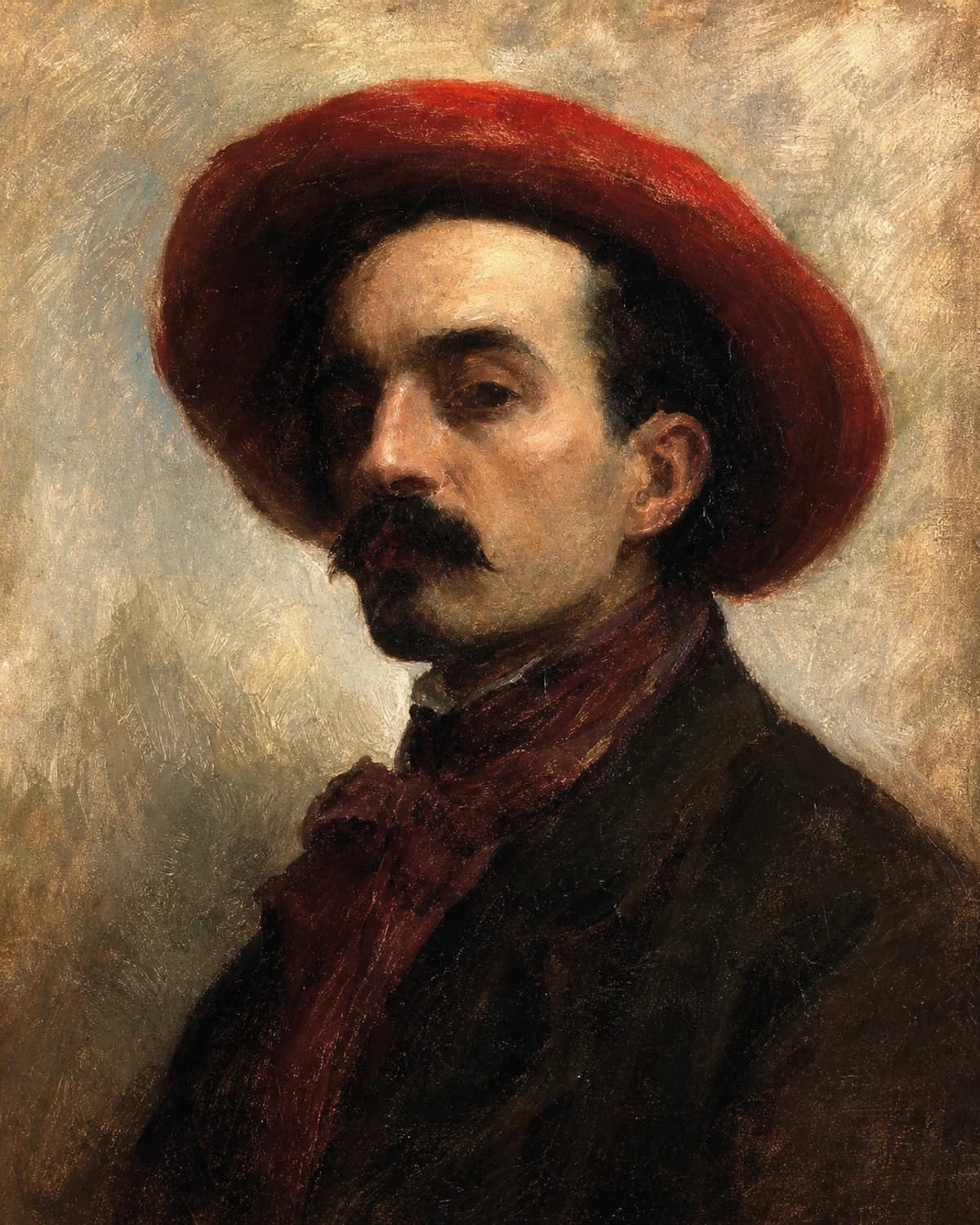
He reached Paris at the end of 1883 and entered the Académie Julian, where he studied under Jean-Paul Laurens until 1888; he shared a studio with Michelena, who arrived soon after, was friends with Emilio Boggio and went constantly to the Louvre. In 1885 he exhibited for the first time at the Salon des Artistes Français, and in 1886 received a distinction there for “Poverty”; the journalist Ermelindo Rivodó, who visited him in 1885, remembered a pale man with a small moustache and black hair that set off the softness of his melancholy eyes. In April 1886 he called on General Guzmán Blanco in Paris, and the general warned him that, once back in the presidential chair, he would cut off the scholarship unless the painter moved to Rome, where, in the general's view, study was more profitable. Rojas stayed and sent “The Tavern” to the Salon. The Paris years produced “The Sick Violinist” (1886), “The Expired Term” (1887), “First and Last Communion” (1888), “The Baptism” (1889), in which a Dutch feeling for air was noticed, and “Dante and Beatrice on the Banks of the Lethe” (1889). In 1888 he spent a season at Villeneuve-Saint-Georges outside Paris, still sending pictures to the salons. By the end of 1889 he had moved away from dramatic scenes and was painting portraits and genre scenes with attention to colour and light, closer to the Impressionists; most of his work, however, stays within Salon realism with an eye on Courbet and Daumier. Contemporaries were unanimous in calling him a melancholic, withdrawn and with few friends. Few paintings remain from the seven Paris years, and almost all of them are about the poor, the sick and the dying; it seems to me he painted what he had known from childhood in Cúa, and in this he was more honest than many Salon realists.
The scholarship was running out. In August 1890 he returned to Caracas with his last works: a portrait of President Juan Pablo Rojas Paúl and “Purgatory”, his only religious picture, painted on commission from Fray Olegario de Barcelona for the church of La Pastora. He died on 8 November 1890 in Caracas, aged thirty-two. Since 27 December 1958 his remains have rested in the National Pantheon of Venezuela; a municipality in the state of Miranda and the Caracas school of visual arts bear his name.
Related context
Associations
Works connected through artistic movements, cultural context and period. Priced works available in this market appear first.








Profile notes
Profile and sources
Image
Artist image
На основе открытого изображения: Cristóbal Rojas; Wikimedia Commons; Public domain.
