
1820–23.07.1851
Constantin Daniel Rosenthal
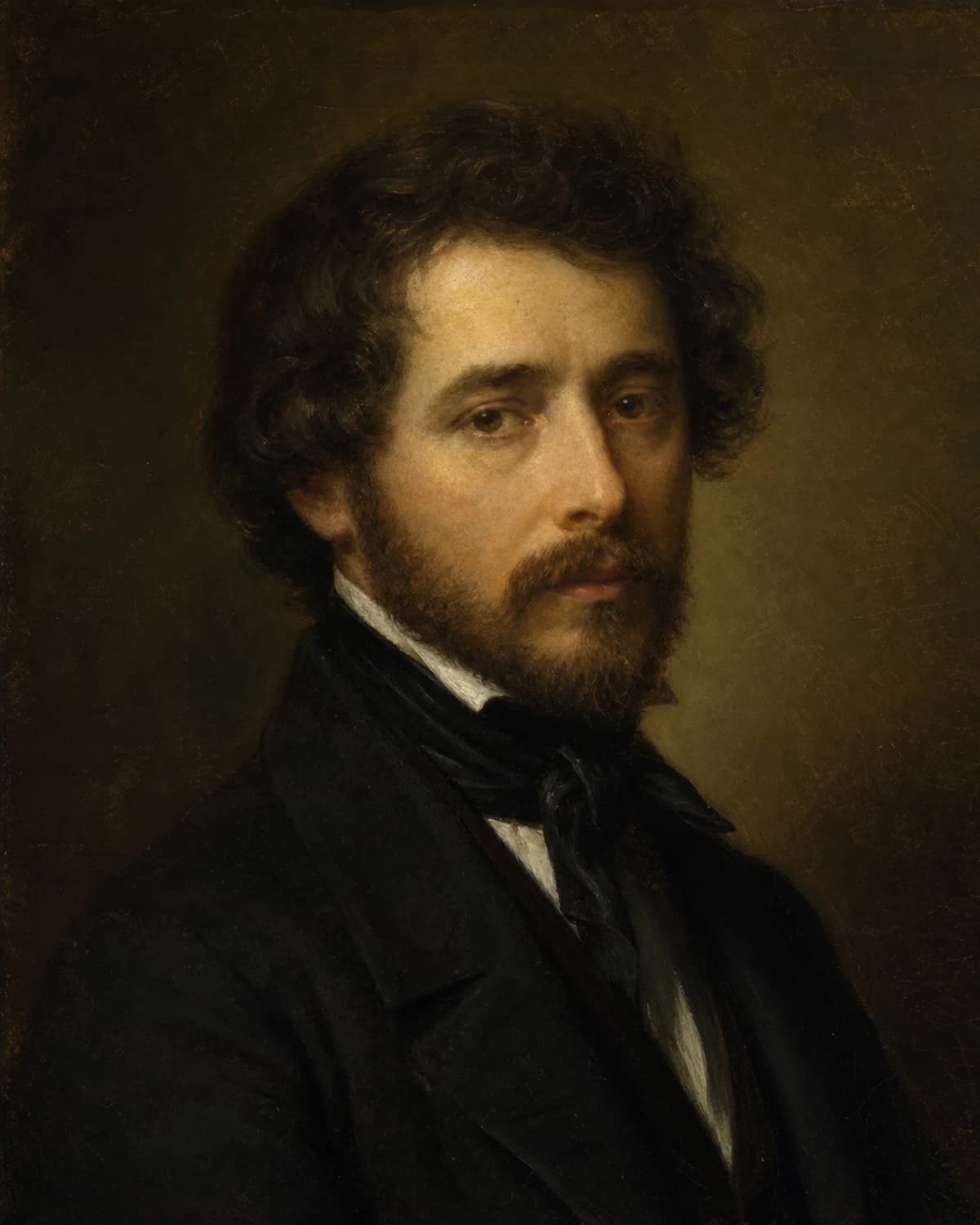
Constantin Daniel Rosenthal (1820–1851) was born in Pest into a Jewish merchant family, studied in Vienna, and worked chiefly in Bucharest and Paris. He painted portraits of Wallachian nobility, took part in the 1848 revolution in Wallachia and was granted Wallachian citizenship. His best-known pictures are two allegories of Romania, painted in exile. He died in Pest after his arrest by the Austrian authorities.
Biography
Rosenthal applied for Wallachian citizenship on 18 June 1848, a few days after the Provisional Government had taken hold in Bucharest. Until then his Austrian passport had protected him from repression, and now he wanted to be a Wallachian. The document of naturalization spoke of his talent and his active part in the revolution. He later wrote to a friend that he had never thought he could be as Wallachian as he now was.
He was born in Pest in 1820. His family were Jewish merchants; at birth, according to some accounts, he bore the name Rosenthal David. At seventeen he went to Vienna, to the Academy of Fine Arts, where he studied archaeological drawing and completed the course in 1839. There he met the first Romanian of his life, the painter Ioan Negulici. Whether he actually graduated from the academy is hard to say for certain: the information is incomplete.
Around 1842 Rosenthal arrived in Bucharest, the capital of Wallachia. It was probably then that he received a commission for the first of many portraits of boyars, the Wallachian landed nobility. Negulici introduced him to liberal-radical circles, and there he became close to Constantin Alexandru Rosetti. In late 1844, dissatisfied with his oil painting technique, he left for France. Rosetti went with him. In Paris Rosenthal attended art courses and went to meetings of Wallachian and Moldavian students, who spoke of national and radical ideals. Rosetti wrote of him with respect: none of the Romanians in Paris, he said, had to bear the cold that Rosenthal bore in his lodging. A group portrait in which Rosetti embraces Rosenthal himself and a third, unknown person is dated approximately to this time; it survives only as a lithograph. The artist painted himself wearing a Phrygian cap.
In 1846 the income from his works allowed him a trip to England. On his return to Paris he learned of his family’s hardship and in early 1847 left for Pest and Buda. In the summer he went to Mehadia, and in August he came back to Bucharest. There he joined the secret society Frăţia (“The Brotherhood”), which at the time disguised itself as a literary circle presided over by Iancu Văcărescu. Vasile Alecsandri commissioned from him a portrait of the late Elena Negri, to be painted from a daguerreotype. He also painted a portrait of Anica Manu, the wife of Aga Iancu Manu.
When the revolution broke out, Prince Gheorghe Bibescu left him alone: he carried an Austrian passport. The Provisional Government commissioned him to design a triumphal arch in Bucharest to mark the success of the revolution, and probably a Statue of Liberty as well. According to some accounts, the statue stood in Vorniciei Square from 23 to 29 June 1848; the project is also known from a watercolour by Theodor Aman, “The Freeing of the Gypsies”.
In late September 1848 Ottoman troops intervened against the revolution, and most of the radicals were arrested and carried off on small vessels down the Danube into exile. Rosenthal publicly asked to be sent with them, but was told that Austrian protection still applied to him, and he was refused permission to board. He then followed the ships on shore with Maria Rosetti, the wife of his friend, from Giurgiu to Sviniţa. There they persuaded the Austrian mayor to disarm the Ottoman guards, and the prisoners were set free.
He returned to Pest and Buda, where the Hungarian revolution was still going on, and in May 1850 left for Paris and took up propaganda work with Romanian exiles. His best-known paintings date from this period, two national allegories: “Revolutionary Romania”, for which Maria Rosetti posed, and “Romania Breaking Her Chains on the Field of Liberty”.
The money soon ran out. He went to Switzerland, lived in Porrentruy in late 1850, and in the first days of 1851 moved on to Fribourg and then Chur. Until July he lived in Graz, where critics began to take notice of him. He then decided to return to Wallachia and try to revive the radical movement.
His plan was betrayed by spies of the Second French Republic, who had read his correspondence in Paris. The Austrians arrested the painter in Pest, citing his “imprudent political statements”. They demanded that he name his contacts; he refused, and under interrogation he was tortured to death, though these circumstances are not fully documented. His body was not returned to his family, and the place of burial is unknown. In 1878 Maria Rosetti wrote about him in the magazine Mama şi Copilul: he had died for Romania and for his Romanian friends, and this martyr of Romania was an Israelite.
Related context
Associations
Works connected through artistic movements, cultural context and period. Priced works available in this market appear first.








Profile notes
Profile and sources
Image
Artist image
На основе открытого изображения: Constantin Daniel Rosenthal; Wikimedia Commons; Public domain.
