
14.11.1840–05.12.1926
Claude Monet
Claude Monet grew up in Le Havre, where Eugène Boudin first took him out to paint in the open air. His “Impression, Sunrise”, shown at the 1874 exhibition, gave Impressionism its name. From 1883 Monet lived at Giverny, painting series of a single motif in changing light (haystacks, poplars, Rouen Cathedral, the Thames), and he gave the last decades of his life to the water lilies in his own pond.
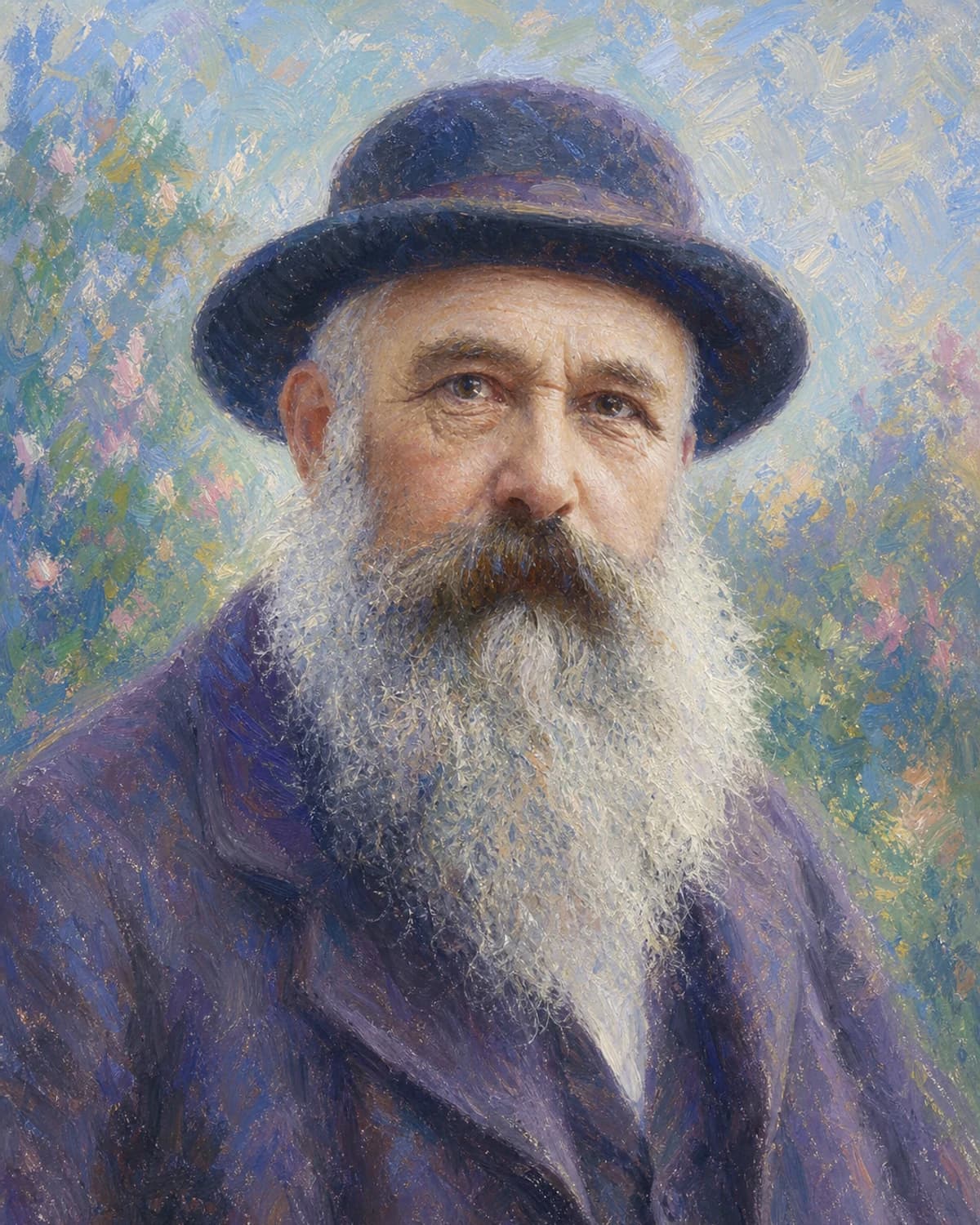
Biography
In 1879 Camille, Monet’s first wife, died at Vétheuil, and he painted her on her deathbed. Many years later he confessed to Georges Clemenceau that he had caught himself doing something dreadful: looking at the dead face of the woman he loved, he was automatically working out which colours it was made of. The study is almost entirely white, grey and mauve. I think this small work says more about the way his eye worked than many famous canvases.
Oscar-Claude Monet was born on 14 November 1840 in Paris, on the fifth floor of 45 rue Laffitte. At home he was called Oscar. In 1845 the family moved to Le Havre. His father dealt in ship’s chandlery and groceries and wanted his son in the business; his mother, a singer, encouraged his leaning towards art, but she died in January 1857. His aunt, Marie-Jeanne Lecadre, became his support. Oscar was a reluctant pupil, but by fifteen he was drawing caricatures of people he knew and charging money for them, and a shop selling artists’ materials displayed them in its window.
Above the caricatures in the same window hung seascapes by Eugène Boudin, which the young Monet could not stand. The owner of the shop introduced them, and Boudin, after praising the caricatures, began urging him to paint from nature. Monet refused for a long time, and when he gave in, he recalled, it was as if his eyes had been opened. Boudin remained for him the teacher to whom, in his own words, he owed everything.
In April 1859 he came to Paris, went to the Salon, early in 1860 enrolled at the Académie Suisse, where he met Camille Pissarro, and spent a great deal of time at the Brasserie des Martyrs among painters and writers. In 1861 he was called up and found himself in a regiment of the Chasseurs d’Afrique in Algeria. In the spring of 1862 he fell ill with typhoid and was sent home to recover, and his aunt bought him out of the army. He later called the light and colour of North Africa the seed of all his later experiments. That same summer, near Le Havre, he became friends with the Dutchman Johan Jongkind.
From the end of 1862 Monet studied in the studio of Charles Gleyre, where he met Renoir and Bazille, but he parted company with his teacher over how nature should be seen. The Salon of 1865 accepted two of his seascapes, and that of 1866 “The Woman in the Green Dress”, a portrait of Camille Doncieux. He never finished the huge “Luncheon on the Grass”, while “Women in the Garden” became his first success on a large scale. In 1867 his and Camille’s son Jean was born, his father stopped giving him money, and he was kept going by buyers such as the Le Havre collector Louis-Joachim Gaudibert. On 28 June 1870 Monet married Camille, and when the Franco-Prussian War broke out he left with his family for London. There he looked at Turner and Constable, painted the Thames and the parks, and met Paul Durand-Ruel, his first and most important dealer. The Royal Academy turned his work down. After several months in Zaandam in Holland, at the end of 1871 Monet settled at Argenteuil on the Seine and painted the river there from a boat converted into a floating studio.
At the first exhibition of the Anonymous Society of Painters, Sculptors and Engravers in 1874 he showed “Impression, Sunrise” (1872), a misty view of the port of Le Havre. The critic Louis Leroy mockingly called the whole group Impressionists, and the word stuck. At the second exhibition, in 1876, Monet had eighteen paintings, and at the third, in 1877, seven views of the Gare Saint-Lazare, where he studied how smoke and steam change colour. He showed with the Impressionists for the last time in 1882, and in 1906 he wrote that the word “Impressionist” meant very little.
In 1878 his second son, Michel, was born, and the family moved to Vétheuil, into a house shared with the family of the collector Ernest Hoschedé, a department-store owner who was soon ruined.
In April 1883 Monet rented a house at Giverny near Vernon, where he lived for the rest of his life; in 1890 he bought it. In 1892 he married Alice Hoschedé. He laid out the garden and the pond himself: he gave his gardeners instructions every day, ordered water lilies from South America and Egypt and put a Japanese bridge across the pond. For the sake of light he worked in series: “Haystacks” (1890–1891), “Poplars”, “Rouen Cathedral” (1892–1894), around a hundred views of the Thames painted from the Savoy Hotel and from St Thomas’ Hospital (1899–1901), thirty-seven views of Venice (1908). London, he said, would not be a beautiful city without its fog. From 1899 water lilies became his main subject; the first large series, 48 paintings, was shown in 1909, and in all there are more than two hundred and fifty of them.
After the deaths of Alice in 1911 and Jean in 1914, he was looked after by Blanche, who was both his stepdaughter and his daughter-in-law. His sight was failing; for a long time he refused a cataract operation and agreed to it only in 1923; by 1925 his late water lilies had turned bluer again. On Clemenceau’s advice he built a large new studio for a decorative cycle of panels, and during the war years he painted a series of weeping willows in memory of the soldiers who had died.
Claude Monet died on 5 December 1926 at Giverny, aged eighty-six, and was buried in the churchyard. In keeping with his wishes, about fifty people came to the funeral; Clemenceau took the black pall off the coffin with the words “No black for Monet!” and replaced it with a flowered cloth. In May 1927 his large water-lily panels were opened in two oval rooms of the Orangerie in Paris.
Related context
Associations
Works connected through artistic movements, cultural context and period. Priced works available in this market appear first.








Profile notes
Profile and sources
Image
Artist image
На основе открытого изображения: Nadar; Wikimedia Commons; Public domain.
