
1600–23.11.1682
Claude Lorrain
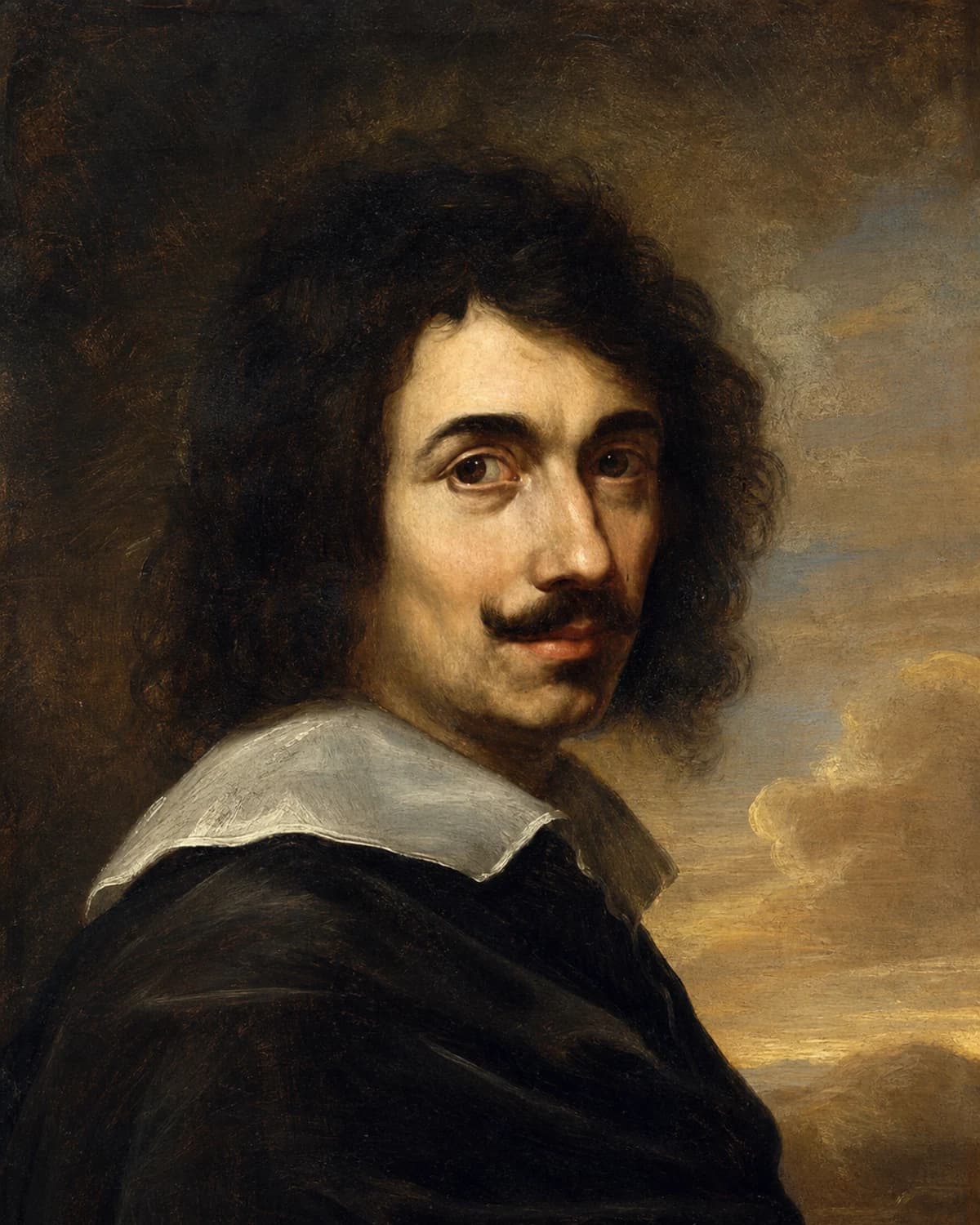
Claude Gellée, called Lorrain, a native of the Lorraine village of Chamagne, worked almost all his life in Rome and by the end of the 1630s had become the leading landscape painter in Italy. He was one of the first to bring the sun itself, and the stream of its light, into the picture; his harbours, ruins and pastorals with small figures from the Bible and myth were painted for popes, cardinals and the King of Spain, and later found particular favour in England.
Biography
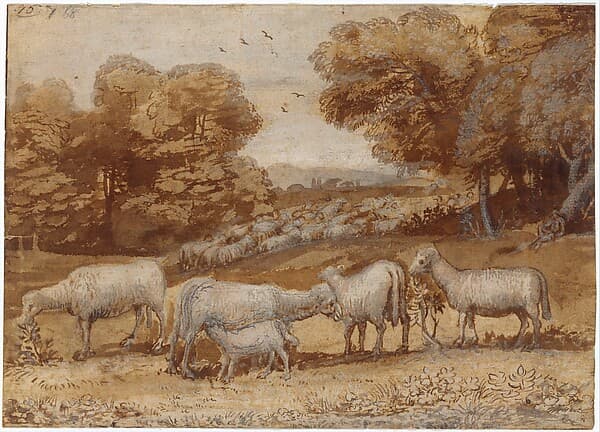
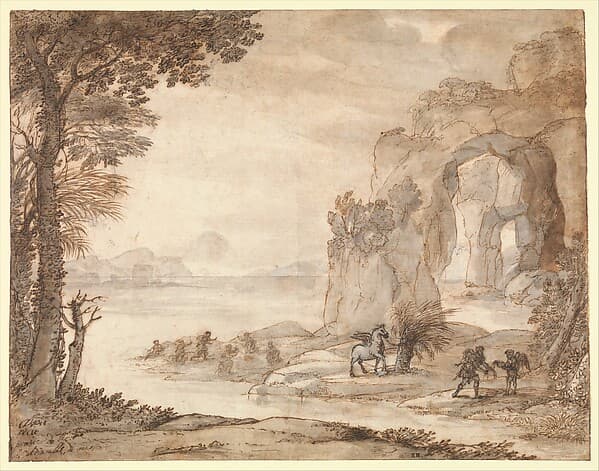
Around 1636 Claude began keeping an album in which he drew, in pen and wash, almost every painting as it was finished, writing the buyer’s name on the back, not always legibly. He called it the “Book of Truth” (Liber Veritatis). It now contains 195 drawings and is kept in the British Museum.
He kept little for himself: at his death he owned only four of his own paintings, but almost all his drawings.
His tombstone gives 1600 as the year of his birth, but contemporary documents point rather to 1604 or 1605. Claude Gellée was born in the village of Chamagne in the Vosges, then in the independent Duchy of Lorraine, the third of five sons of Jean Gellée and Anne Padose. His youth is described by his two earliest biographers, and they describe it differently. Joachim von Sandrart knew Claude as a young man and lived with him for a time; Filippo Baldinucci met him as an old man and took down much of his information from a nephew who lived in the painter’s house. According to Baldinucci, the boy was orphaned at twelve, lived in Freiburg with his elder brother Jean, an inlay craftsman who taught him the rudiments of drawing, and then went to Italy, to Goffredo Wals in Naples and to Agostino Tassi in Rome. According to Sandrart, he did badly at the village school, was apprenticed to a pastry cook, reached Rome with a company of cooks and bakers (Lorraine pastry was famous) and entered Tassi’s service as a servant and cook, and in time Tassi made him his pupil. Present-day scholars usually prefer Sandrart or combine the two versions. They agree that around 1620–1622 Claude studied with Wals, and from about 1622/23 to 1625 with Tassi; both were landscape painters, and Tassi ran a large workshop of palace frescoes.
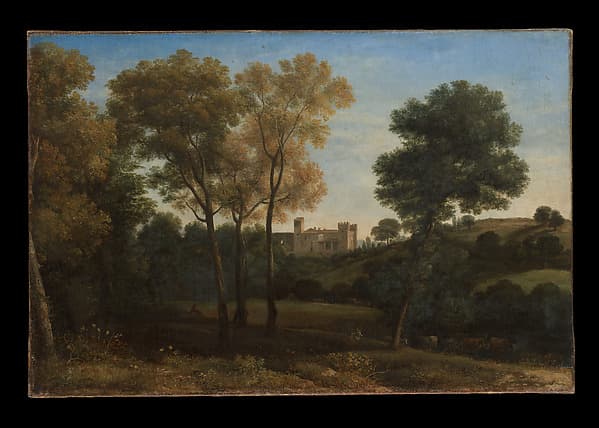
In 1625 he travelled home to Nancy and helped the court painter Claude Deruet with the backgrounds of frescoes now lost, but as early as 1626 or 1627 he returned to Rome and settled in the Via Margutta, near the Spanish Steps and the church of Trinità dei Monti. He lived in this neighbourhood to the end, moving in 1650 only to the house next door in the Via Paolina, today’s Via del Babuino. Sandrart recalled that already in the late 1620s Claude drew from nature, especially at dawn and at dusk, and made oil sketches on the spot. His first dated painting, “Landscape with Cattle and Peasants” (1629), shows a fully formed master.
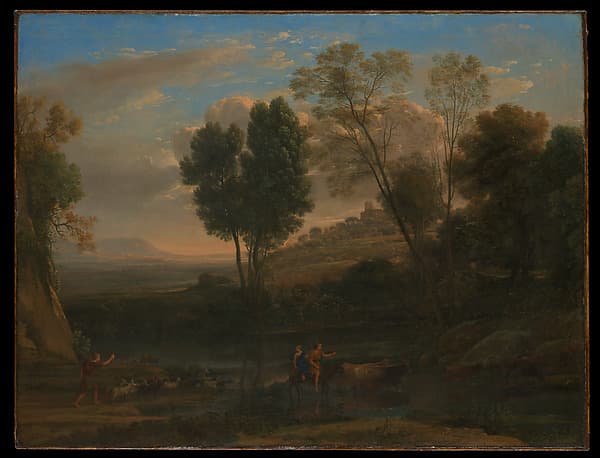
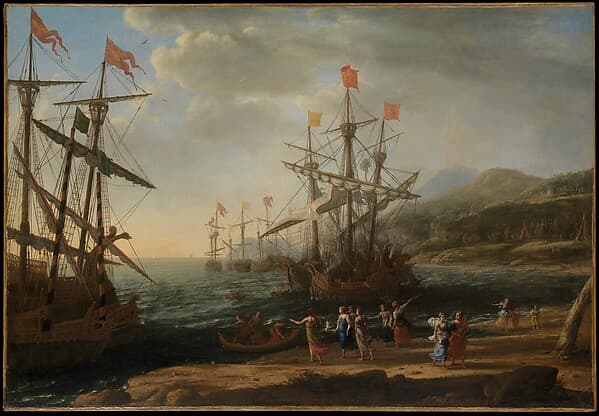
After that the commissions came one after another: the French ambassador in Rome (1633), King Philip IV of Spain (1634–1635), Cardinal Guido Bentivoglio, who recommended him to Pope Urban VIII; four pictures were painted for the pope in 1635–1638, two large and two small on copper. In 1634 he was admitted to the Accademia di San Luca. By the end of the 1630s he was the leading landscape painter in Italy. These were the years of “The Finding of Moses” (1638), “Village Fête” and “Seaport at Sunset” (both 1639), “Seaport with the Embarkation of Saint Ursula” (1641), “The Disembarkation of Cleopatra at Tarsus” (1642) and “Seaport with the Embarkation of the Queen of Sheba” (1648): imaginary harbours with ancient porticoes and thoroughly up-to-date merchant ships, and above the water the sun itself as the source of light, which had been rare in painting before. He made more than forty etchings, mostly before 1642; his early frescoes, which first made his name, have almost all perished.
Figures did not come easily to him, and he knew it. According to Baldinucci, he joked that he charged for the landscape and gave the figures away for free. It was long believed that others painted the figures for him, but few such cases are now accepted. After 1670 he worked less; among the late works are “Coast View with Perseus and the Origin of Coral” (1674) for Cardinal Camillo Massimo and his last painting, “Ascanius Shooting the Stag of Sylvia”, for the chief patron of his last years, Prince Lorenzo Onofrio Colonna. The hunters in it are stretched almost to absurdity. To my mind, this is no weakness of the hand: by then the landscape had become his true protagonist, and the people had turned into its scale.
The Hermitage in Saint Petersburg holds four of his late canvases united by the theme of the times of day; they were bought in 1815 from the collection of the Empress Josephine at Malmaison.
After his death Claude was loved most of all in England. Constable called him the most perfect landscape painter the world ever saw, and Turner bequeathed two of his own pictures to the National Gallery in London on condition that they hang between two paintings by Claude, “The Embarkation of the Queen of Sheba” and “The Marriage of Isaac and Rebekah”. The English even named the “Claude glass” after him, a small dark-tinted glass in a frame in which travellers looked at views, although he himself, it seems, knew nothing of the kind.
Claude Lorrain died in his house in Rome on 23 November 1682. He was buried in the church of Trinità dei Monti; his will asked for masses to be said for him in his native Chamagne. In 1840 his remains were moved to the church of San Luigi dei Francesi, beneath a monument by Paul Lemoyne.
Artist works
Works by the artist
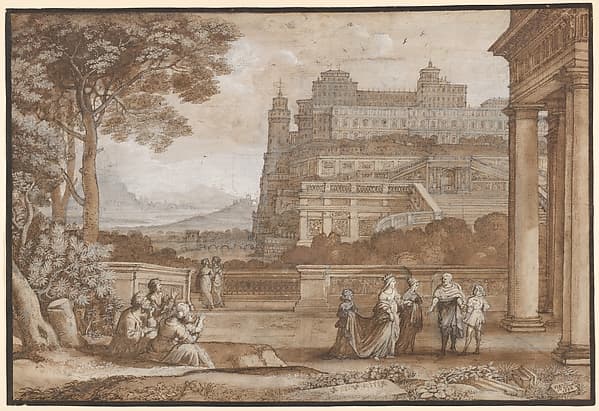
Works by Claude Lorrain available in this edition of NEOARCA.
Related context
Associations
Works connected through artistic movements, cultural context and period. Priced works available in this market appear first.
Profile notes
Profile and sources
Image
Artist image
На основе открытого изображения: Claude Lorrain; Wikimedia Commons; Public domain.
