
02.01.1783–22.07.1853
Christoffer Wilhelm Eckersberg
Eckersberg was born in southern Jutland to a carpenter and painter, studied under Jacques-Louis David in Paris and spent three years in Rome among the friends of Thorvaldsen. From 1818 he was a professor at the Copenhagen academy, where he took students outdoors to paint from nature. His pupils Købke, Rørbye and Bendz became the leading painters of the Danish Golden Age.
Biography
In the spring of 1803 a twenty-year-old journeyman from Flensburg arrived in Copenhagen and on 23 May stepped out at the city toll booth with his savings and the support of his fellow countrymen. A few weeks later he was admitted to the Royal Danish Academy of Art without paying fees.
Christoffer Wilhelm Eckersberg was born on 2 January 1783 in Blåkrog, in the Duchy of Schleswig, in southern Jutland. His father, Henrik Vilhelm Eckersberg, was a carpenter and painter; his mother was called Ingeborg. In 1786 the family moved to Blans, a village by the Alssund, where the boy drew the surrounding countryside and sailed in his father’s boat. After confirmation he trained as a craftsman under the church and portrait painter Jes Jessen in Aabenraa (1797–1800), then under Johann Jacob Jessen in Flensburg, where in May 1800 he became a journeyman.
At the academy one of his teachers was Nikolaj Abraham Abildgaard. Eckersberg painted history pictures, portraits and landscapes but did not get on with Abildgaard: according to the artist’s son, Abildgaard advised him to give up his studies and become a porcelain painter. In 1805 he won both silver medals and the small gold medal; in 1807 he came away with nothing. The large gold medal was awarded to him in 1809, after Abildgaard’s death. He earned extra money by making drawings for copperplate engravings; in September 1807, during the bombardment of Copenhagen, he made some of the best images of those events for the engraver Gerhard Ludvig Lahde. To my mind, these prints are more often remembered for the anecdote about the bomb that fell into the house than for the drawings themselves.
The promised travel stipend was paid only in 1812. On 1 July 1810 Eckersberg married Christine Rebekka Hyssing in order to legitimize her son Erling; two days after the wedding he left the country. He travelled through Germany with the writer and art lover Tønnes Christian Bruun de Neergaard, who supported him financially. In Paris in 1811–1812 he studied under Jacques-Louis David, following his advice to paint from nature and from the antique. There he formed friendships with his roommate Jens Peter Møller and the engraver Johan Frederik Clemens. The marriage was dissolved in 1816, while he was still abroad.
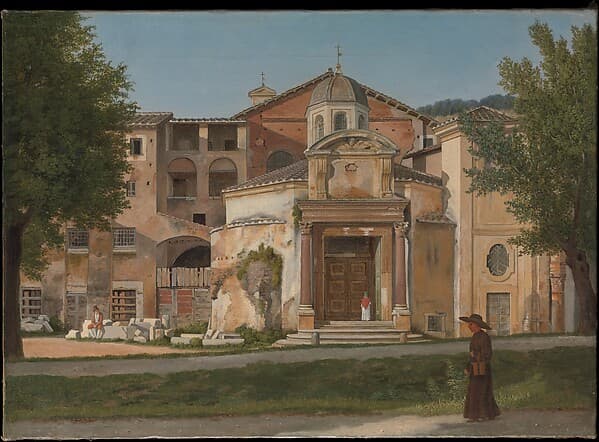
From Paris he went on via Florence to Rome and lived there in 1813–1816 among a large colony of artists whose centre was Bertel Thorvaldsen. Eckersberg grew close to him for good; in 1814 he painted his portrait, one of his best, and gave it to the academy. The Roman light affected him strongly. He worked a great deal, including landscape studies, among them views of the Colosseum and of the Tiber at Ponte Rotto.
He returned home on 2 August 1816.
In 1817 he was admitted as a member of the academy, with the Norse legend “The Death of Baldur” as his admission painting. In the same year he married Elisabeth Cathrine Julie Juel, daughter of the portrait painter Jens Juel. In 1818 Eckersberg became a professor, in a post that had stood vacant since 1809; the academy had not hurried to fill it, waiting for his return, although there were other candidates, pupils of Abildgaard. In the end both he and Johan Ludwig Lund were made professors. In 1827–1829 he was director of the academy.
He is known for his portraits of the Copenhagen middle class, above all “The Nathanson Family” (1818), and for the official portrait of Frederick VI. His career as a portraitist was short because of competition from Christian Albrecht Jensen. Later he painted “A Woman before a Mirror” (1841). Ships fascinated him most: from 1819 the Admiralty allowed him access to the naval station at Holmen, and there in summer he watched sailors swimming and chose models for his pictures on classical subjects. He sailed around the Skagerrak, the Kattegat and the North Sea, and at fifty-six reached the English Channel. After these voyages his marine paintings, previously calm, gained movement and waves: “A Russian Ship of the Line on the Roads” (1828), “The Corvette Galathea in a Storm” (1839).
His main contribution was through teaching. Eckersberg took students out into the open air and introduced direct study from nature into Danish art, while encouraging each of them to develop his own manner. His pupils included Christen Købke, Martinus Rørbye, Wilhelm Bendz, Constantin Hansen, Wilhelm Marstrand and Jørgen Roed. From an interest in perspective that grew out of his marine subjects, he wrote a treatise, “Linear Perspective Applied to the Art of Painting” (1841), and lectured on it at the academy. He also made a few small etchings in which observations of everyday life are combined with classical composition.
In old age his eyesight weakened and he stopped painting. Eckersberg died in Copenhagen on 22 July 1853 and is buried in Assistens Cemetery.
Artist works
Works by the artist
Works by Christoffer Wilhelm Eckersberg available in this edition of NEOARCA.
Profile notes