
06.08.1857–19.10.1915
Christian Wilhelm Allers
Christian Wilhelm Allers (1857–1915) began as a lithographer in Hamburg and became famous in 1888 with the portfolio “Club Eintracht”, followed by a series of books of drawings about Bismarck, the navy and travel. The income from them paid for a house in Karlsruhe and a villa on Capri. After the scandal of 1902 he left Italy and spent more than ten years earning his living from portraits.
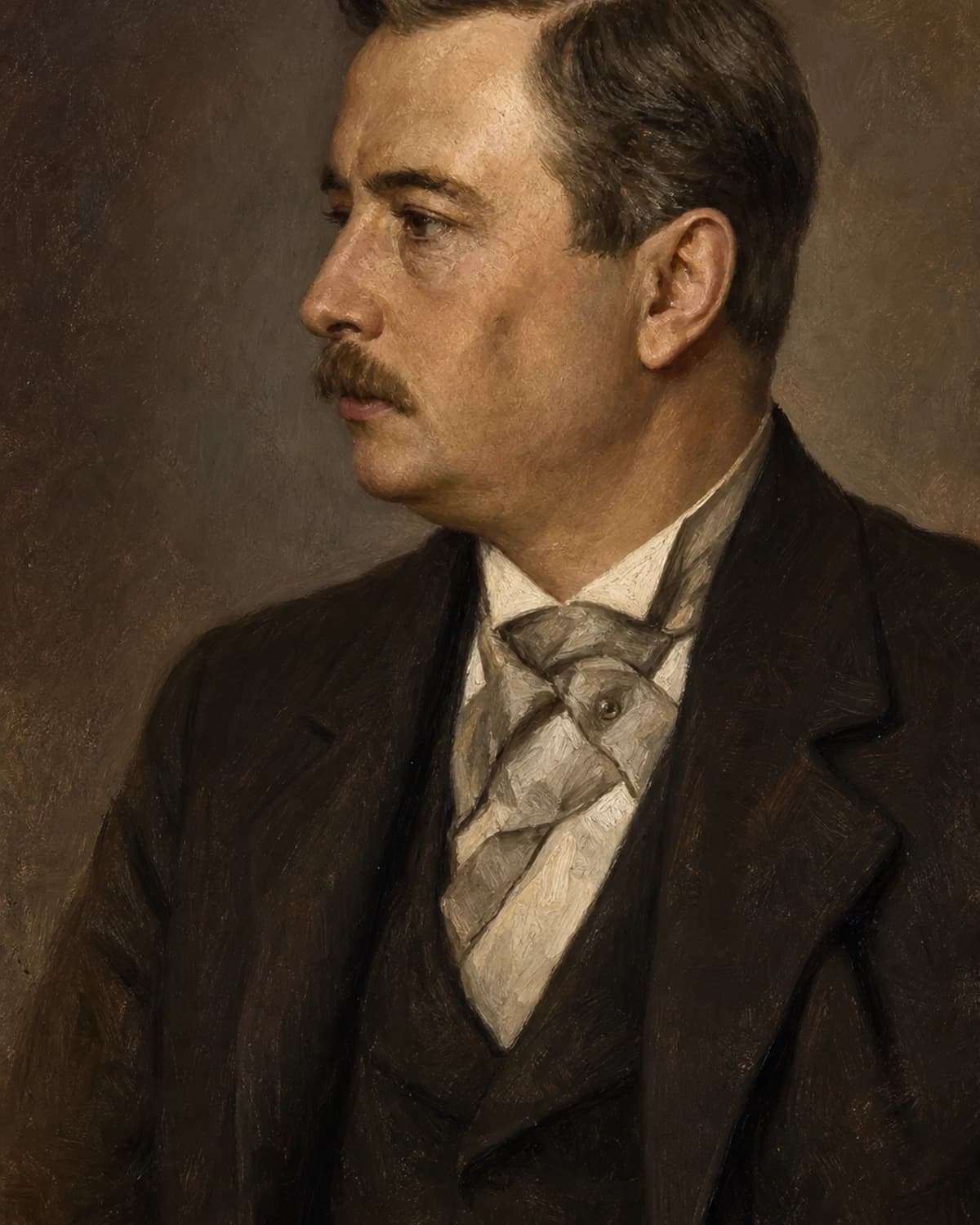
Biography
In 1888 a portfolio of drawings called “Club Eintracht” (subtitled “A Summer Trip”) was published, and a Hamburg lithographer, until then unknown, became famous across Germany. The author was thirty.
Allers was born on 6 August 1857 in Hamburg, the son of a merchant. He began as a lithographer in his home city, and in 1877 he moved to Karlsruhe, where for a time he went on working as a lithographer. At the same time he studied at the art academy, and among his teachers was Ferdinand Keller.
In 1880–81 Allers served in the Imperial Navy in Kiel. His patron there was Anton von Werner. In Kiel he got to know the poet Klaus Groth, whom he later met often and occasionally portrayed. The navy remained one of his main subjects: in 1891 he published the album “Unsere Marine” (“Our Navy”).
After “Club Eintracht”, portfolios and books of drawings followed one after another. By subject they fall into three groups: scenes of everyday life (“Spreeathener”, “Berlin Pictures”, “Hamburger Bilder”), travel narratives (“La bella Napoli”, 1893; “Rund um die Erde”, 1898; “Unter deutscher Flagge”, 1900) and portrayals of famous people. The last group includes the Bismarck books: “Fürst Bismarck in Friedrichsruh” (1892), “Unser Bismarck” (1895) and the memorial edition of 1898. In 1897, with Ludwig Ganghofer, Allers brought out “Das deutsche Jägerbuch” (“The German Hunters’ Book”). He also illustrated other people’s texts, for example Anna Lindau’s “Neue Märchen” (1887) and Ernst von Wolzogen’s verse story “Er photographirt!” (1890). His earnings were enough for a house in Karlsruhe around 1890 and for a villa on Capri, built in 1892. He lived there for many years, visiting Hamburg and Karlsruhe and travelling in various countries. Many German and foreign celebrities came to the villa. In 1894 Alexander Olinda devoted a biographical book to him, “Freund Allers” (“Friend Allers”).
He drew in detail and with fidelity to what he saw, but there is almost no emotion in the drawings. He worked a great deal in pencil and chalk, and his coloured sheets were usually made over a pencil drawing and coloured later in pastel or oil. He cannot be called a realist in the strict sense: into other people’s scenes he put the faces of acquaintances who had not been there.
In the autumn of 1902, after the scandal around Friedrich Alfred Krupp, who lived on Capri, the Italian press accused Allers himself of homosexual relations. In 1903 an Italian court sentenced him in absentia to four and a half years in prison: he had managed to flee before the trial began. Krupp died a few weeks after the scandal broke; he is generally thought to have taken his own life.
From Italy Allers set off on a journey around the world that lasted more than ten years. He visited, among other places, New Zealand, Samoa and Australia. He often signed with the pseudonym “W. Andresen” and lived on commissioned portraits of wealthy people.
He returned to Germany shortly before his death and died in Karlsruhe on 19 October 1915. In September 1916 his estate was shown at the Kunsthaus Louis Bock & Sohn, an art dealer in Hamburg, and in 1919 more than nine hundred original drawings for seven books were sold at auction in Aachen. In 1958 a street in the Hamburg district of Steilshoop, Allerskehre, was named after him.
Related context
Associations
Works connected through artistic movements, cultural context and period. Priced works available in this market appear first.








Profile notes
Profile and sources
Image
Artist image
На основе открытого изображения: Christian Wilhelm Allers; Wikimedia Commons; Public domain.
