
1676–1759
Chŏng Sŏn
Chŏng Sŏn (1676–1759), who painted under the art name Gyeomjae, turned away from the idealised Chinese landscape to views of the real Korea: the Diamond Mountains, the capital Hanyang, the Han River. His “General View of the Diamond Mountains” (1734) and “Clearing after Rain on Mount Inwang” (1751) are listed as National Treasures of Korea. He served both in the state painting bureau and as a county magistrate.
Biography
At the end of May 1751, after rain, the seventy-five-year-old Chŏng Sŏn painted Mount Inwang, at whose foot he lived. He laid in the wet rocks with heavy, repeated downward strokes of the brush and left the mist in the valley as white paper, its edges lightly touched with diluted ink; the mist hides a few roofs of the neighbourhood, and below are the houses of the painter and of his old friend, the poet Yi Byeong-yeon. The picture is connected with the death of this friend, which fell in the same days. “Inwangjesaekdo” (“Clearing after Rain on Mount Inwang”) is now listed as National Treasure of Korea no. 216.
The painter was by then in his seventies, and he was still painting every day.
He was born in 1676 in Hanyang, present-day Seoul, in the Cheongun-dong neighbourhood, the eldest son of Jeong Si-ik (1638–1689). The family, which traced its origins to Gwangju, was counted as gentry, but it had grown so poor that the position of a scholar-official painting for leisure was out of the question. His gifts were noticed early; it is said that he drew every day and kept up the pace into deep old age. Powerful neighbours brought him into their circle, and on their recommendation (Korean authors name the high official Kim Chang-jip) he entered the Dohwaseo, the state bureau of painting, at about twenty, while also painting landscapes for private patrons. He chose the art name Gyeomjae, “humble study”, for himself, and it seems to reflect the unequal relationship between a poor nobleman and those who protected him. He is known by other names as well: the art name Nangok and the courtesy name Wonbaek.
His fame came from the Diamond Mountains, Geumgangsan. In 1711 he toured them with the local governor Pak Tae-yu and made an album of thirteen leaves, and the next year, after a second journey, came an album of thirty views of mountains and sea; his patrons added their poems to both. By the age of thirty-seven his name was known, and in all he is thought to have painted these mountains about a hundred times. The largest sheet, “Geumgang jeondo” (“General View of the Diamond Mountains”, 1734, National Treasure no. 217), shows the range from the Inner Geumgang side: behind rises the highest peak, Birobong, and a river runs along the floor of the gorge. In the upper right corner the painter wrote the title, the date, his signature and a question: even if you walk the mountain yourself, how can that compare with the joy of looking at the picture at your own desk? To my mind, it would be hard to explain better what the “true view” is for.
His service was not limited to painting. In 1716 Chŏng Sŏn, who was versed in the Book of Changes and in astronomy, was appointed an extraordinary professor at the Gwansanggam, the office for the observation of celestial phenomena. Later he governed counties: Hayang in 1721–1726, Cheongha around 1733, Yangcheon in 1740–1745. In his old age King Yeongjo granted him honorary ranks, the fourth in 1754 and the second in 1756.
Korean painting at the time was dominated by the Chinese model of the scholar’s landscape, idealised and abstract, painted after the old masters. Chŏng Sŏn went out of his studio and painted what he saw: the capital, the Han River, the seacoast, the mountains. The genre is called jingyeong sansu, “true-view landscape”, and Chŏng Sŏn is regarded as its first master; he may have been influenced by the Silhak movement of practical learning. Formally his work is assigned to the Southern School, and he learned from its examples, above all from the Song painters Mi Fu and Mi Youren, whose foliage and vegetation are built up of dots. But for the strange rocks of the Diamond Mountains he found thin, angular lines and sharp parallel strokes, and he built up the masses of the mountains in layers of dark and light ink wash, broken by forest, mist and waterfalls. By one estimate, he painted more than four hundred pictures in all.
Opinions differ about the heirs to his manner. Some write that generations of Korean painters followed him, others that he found no successor and the manner remained one man’s affair. Sim Sa-jeong is named as his pupil; together with him and Jo Yeong-seok, Chŏng Sŏn was grouped among the “three Jae”, Samjae, after the last syllable their art names shared. His grandson, Jeong Hwang (born 1737), painted both true views and genre scenes. The painter and critic Kang Se-hwang acknowledged that Chŏng Sŏn rendered real places well, but judged his landscapes strictly: for each view, he believed, one had to find its own technique.
Chŏng Sŏn spent his last years at the foot of Mount Inwang. He died in 1759, in his eighties.
Related context
Associations
Works connected through artistic movements, cultural context and period. Priced works available in this market appear first.
Profile notes
Profile and sources
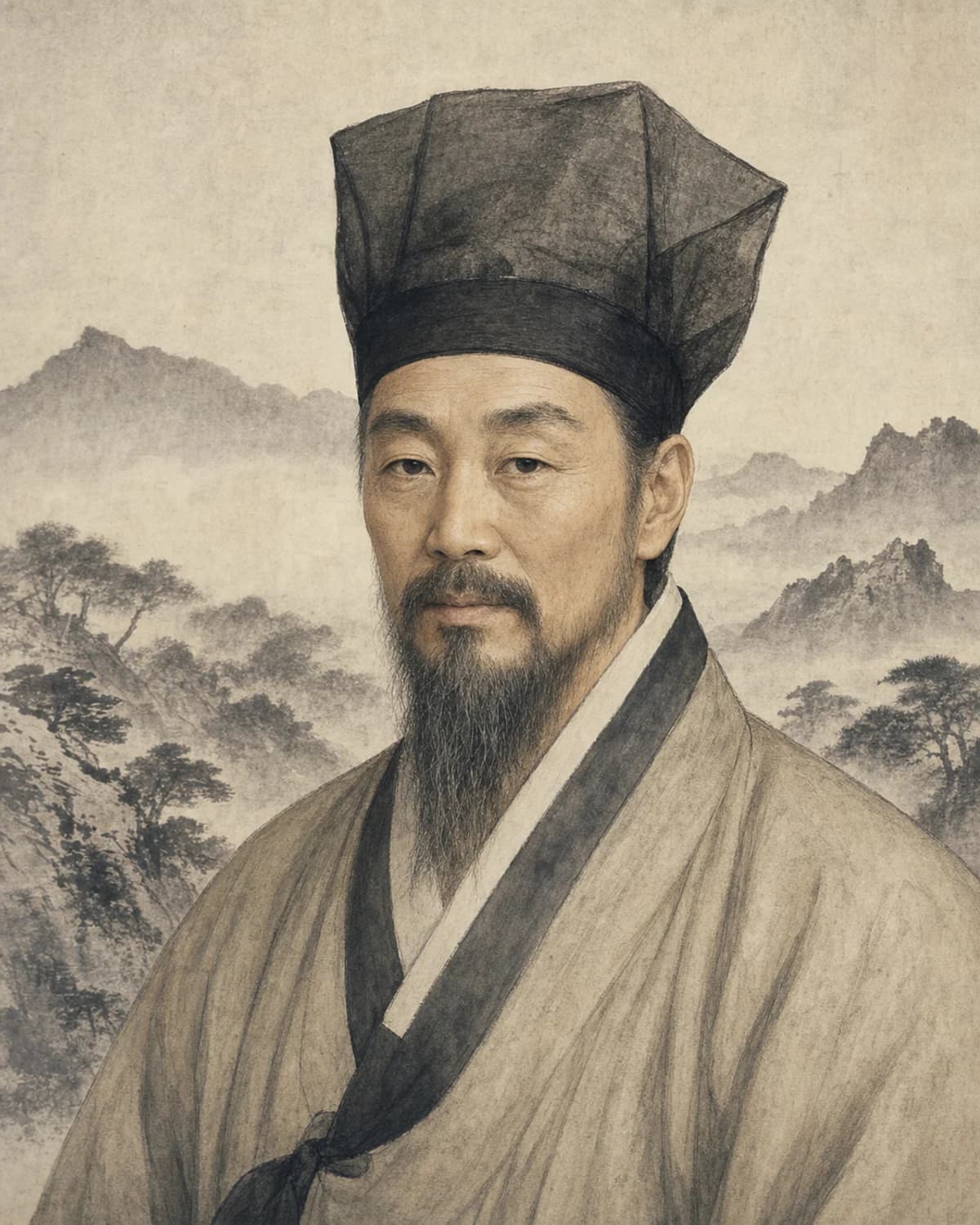
Image
Artist image
На основе открытого изображения: Korea.net / Korean Culture and Information Service (Jeon Han); Wikimedia Commons; CC BY-SA 2.0.
