
28.07.1800–12.10.1875
Charles Pellegrini
Charles Henri Pellegrini (1800–1875), an engineer from Chambéry, came to Buenos Aires in November 1828 on a contract and stayed as a portrait painter and lithographer: in a little over a year he made about two hundred portraits. Later he built the first Colón Theatre, opened in 1857, and founded the journal Revista del Plata. His eldest son, Carlos, became president of Argentina.
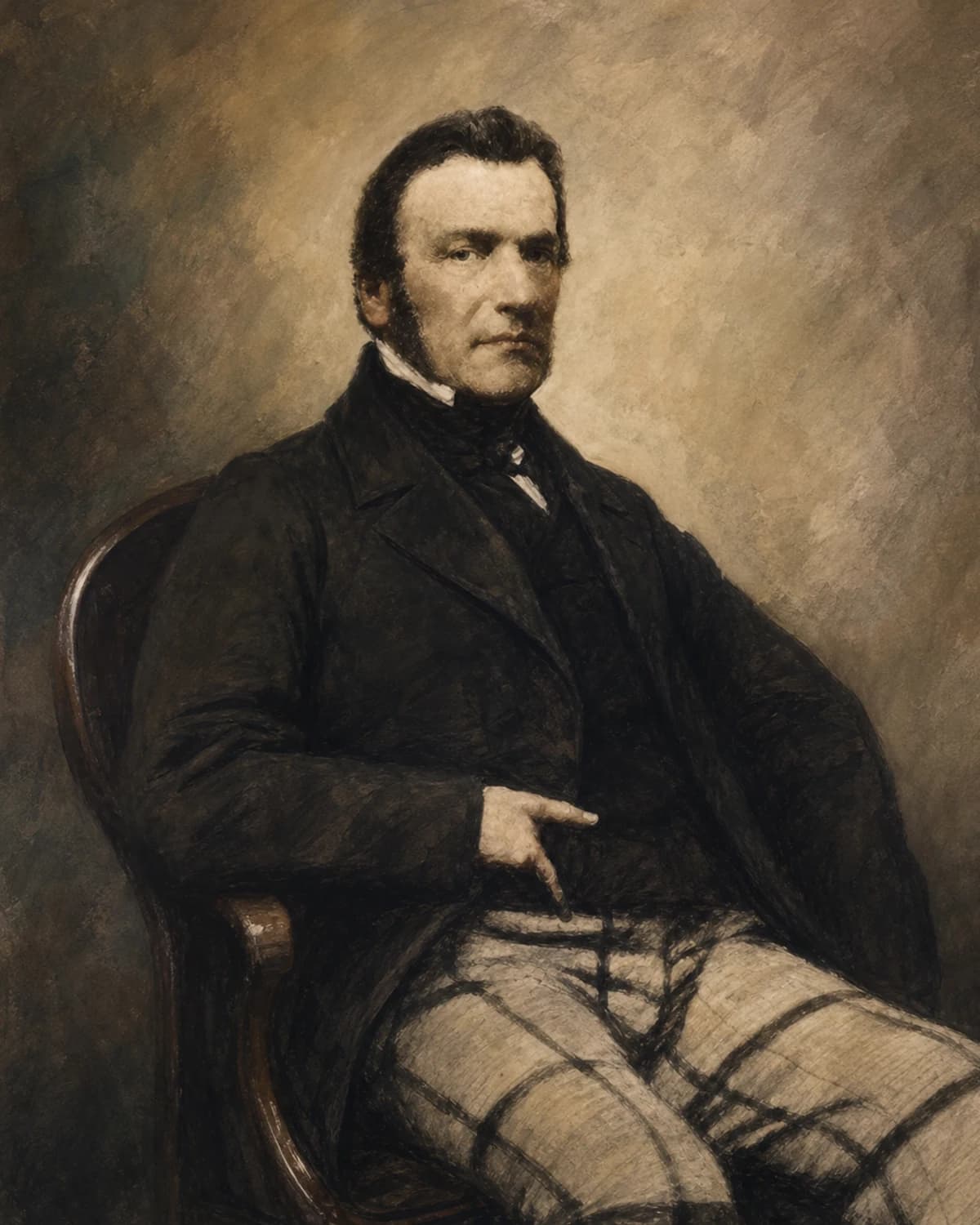
Biography
Pellegrini obtained his contract to work in Buenos Aires through Juan Larrea, a merchant with interests in Bordeaux, at the request of President Bernardino Rivadavia. He stepped ashore in November 1828 as a hydraulic engineer, and less than a year later his department was closed.
Charles Henri Pellegrini was born on 28 July 1800 in Chambéry, in Savoy, which was then occupied by the forces of revolutionary France. His mother, Marguerite Berthet, was French; his father, Bernardo Pellegrini, came from Croglio in the Italian-speaking canton of Ticino. He drew from childhood: he won a prize for his drawings while still in primary school. He studied at the University of Turin, then at the École Polytechnique near Paris, and received an engineering degree (in 1825, according to some accounts).
The hydraulic engineering department in Buenos Aires was abolished in 1829 under Governor Juan José Viamonte, and Pellegrini went back to drawing. He sold watercolours, chiefly views of the city. In October 1830 he was hired as a portraitist by the journalist and lithographer César Hipólito Bacle, also a Frenchman. By September 1831, under that contract, Pellegrini had made about two hundred portraits and earned roughly 17,000 pesos, about 700 US dollars. He worked as a portraitist and lithographer until 1837, when he bought the estancia La Figura in Cañuelas and turned to farming.
On 18 May 1841 he married María Bevans Bright, daughter of the engineer James Bevans, who had earlier been his superior in the hydraulic department. They had four children, among them Carlos. In the same year he founded, with Luis Aldana (Aldao in other accounts), the “Lithograph of the Arts”, an atelier and printing house. Later he installed his own press at his home in central Buenos Aires, but lived mostly at La Figura. By one account, he had already opened a workshop around 1839, where he printed his lithographs of the River Plate; these include an album with a view of “El Retiro” (1841) and several views of the Plaza de la Victoria. It seems to me that these sheets remain the best-known part of his legacy, although the exact contents of the album are hard to establish. After the overthrow of Governor Juan Manuel de Rosas in 1852, Pellegrini returned to Buenos Aires. In 1853 he founded the Revista del Plata and began to receive commissions as an engineer and architect. His most notable building was the Colón Theatre: the opera house, seating 2,500, opened in 1857 and remained the largest in Argentina until the new building was inaugurated in 1908.
Later he published a volume of poetry. Pellegrini died in Buenos Aires on 12 October 1875. His eldest son, Carlos, was elected vice president of Argentina in 1886 and became president in 1890. Many of his father’s watercolours are held by the National Museum of Fine Arts in Buenos Aires.
Related context
Associations
Works connected through artistic movements, cultural context and period. Priced works available in this market appear first.








Profile notes
Profile and sources
Image
Artist image
На основе открытого изображения: Unknown author Unknown author; Wikimedia Commons; Public domain.
