
22.10.1813–07.04.1882
Charles Davidson Bell
The Scot Charles Davidson Bell sailed to the Cape Colony in 1830, served there as an official and in 1848 became Surveyor-General. He drew the people of Cape Town and the peoples met on Andrew Smith’s expedition to the Limpopo, designed the first triangular postage stamp of the Cape of Good Hope, and created coats of arms that are still in use.
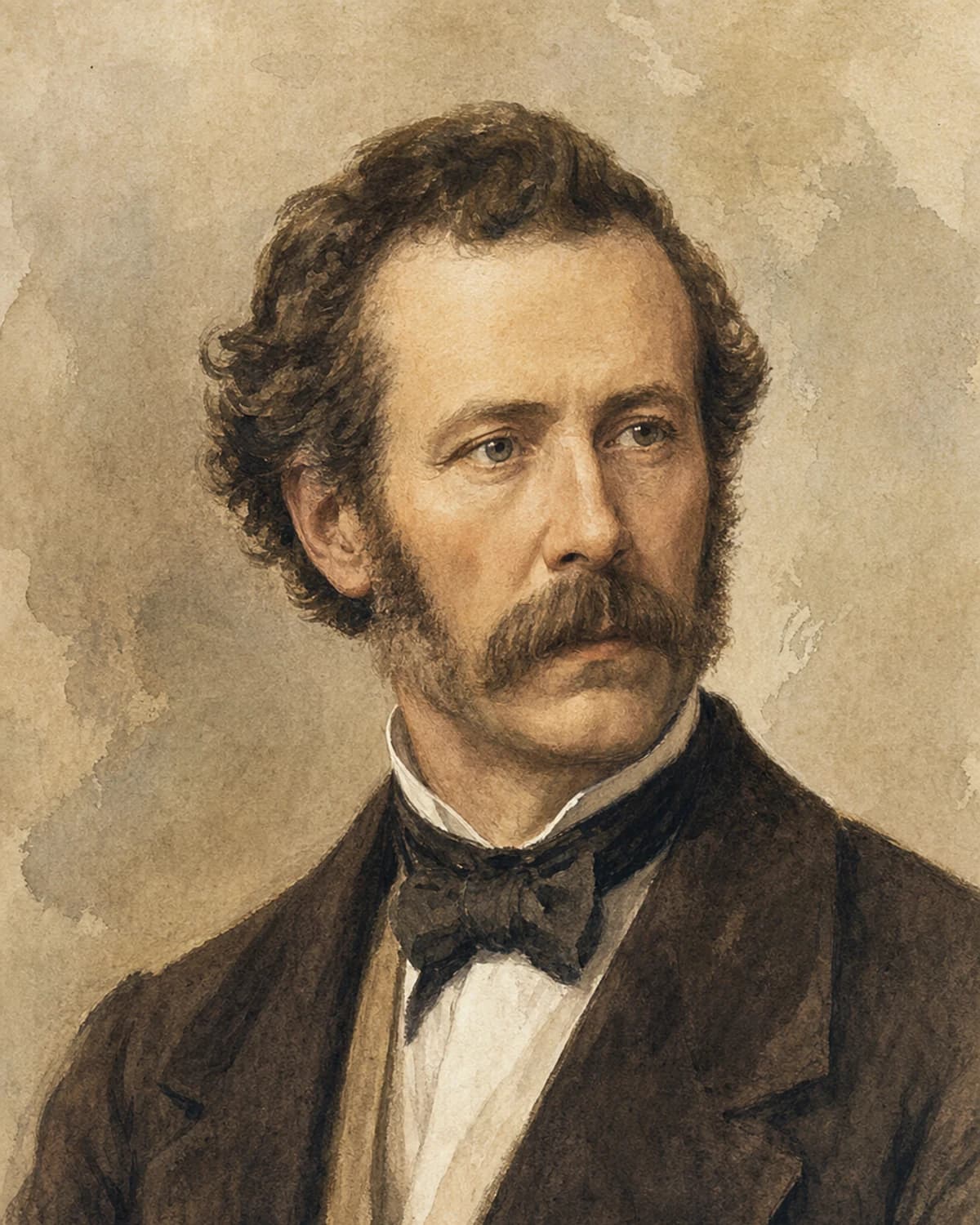
Biography
In 1852 Bell was appointed to the Cape Colony’s Postal Enquiry Board, and he designed a stamp of an unusual shape for the colony: triangular. There had been no stamps of that shape before it. His design for rectangular stamps remained in use until 1902.
By profession he was a surveyor, but he drew all his life.
Bell was born on 22 October 1813 at Newhall near Crail, in the Scottish county of Fife. In 1830 he landed at the Cape of Good Hope, and his uncle, Sir John Bell, Secretary to the Cape Government, found him a post in the civil service. In 1834 he was taken on as artist for Dr Andrew Smith’s two-year expedition, which reached as far north as the Limpopo. His career advanced steadily: from 1838 he was Acting Clerk of the Legislative Council, from 1843 Assistant Surveyor-General, and from 1848 Surveyor-General of the colony. In 1855, after a three-month visit, he wrote a report on the copper fields of Little Namaqualand. He was a Fellow of the Royal Society of Edinburgh.
Bell’s drawings and paintings are often humorous. The most valuable part of them, his attentive depictions of Cape Town’s mixed population and of the peoples he saw on Smith’s expedition, has become a record of nineteenth-century South African life. In February 1851, at Cape Town’s First Exhibition of Fine Art, he won a gold medal for the best original historical painting in oil, “Landing of van Riebeeck at the Cape of Good Hope in 1652”. That same year he designed a silver gallantry medal that Governor Sir Harry Smith presented to troops during the Eighth Frontier War; it is often called the first South African medal. He illustrated James Chapman’s book “Travels in the Interior of South Africa” (1868). Opinions of his legacy differ. The historian Russel Viljoen wrote that in several sketches Bell showed the Khoikhoi as drunkards and idlers, and that the reproduction of these images on postcards fixed a negative stereotype in the minds of colonists. It seems to me that the one does not cancel the other: the same artist left both attentive portraits and caricatured types. In 1978 a large group of his paintings returned from England to South Africa, and art historians took a fresh look at him.
He had another passion too: heraldry. Throughout his years at the Cape he copied old Dutch and Afrikaner coats of arms from memorials, seals, stained-glass windows and other objects, and in 1861 he announced that he would publish them as a book. The book never appeared. He gave the manuscript, drawings and notes to his brother-in-law, Daniel Krynauw, who was building his own collection; after Krynauw’s death both collections went to a Cape Town museum, and in 1946 to the South African Library. They were published by Cornelis Pama in a book on the arms of old Afrikaner families (1959). Bell designed the arms of the South African College, now the University of Cape Town, and the three-anchor badge of the South African Mutual Life Assurance Society, “Old Mutual”, of which he was a founder and for a time chairman. Both emblems are still in use.
In 1872 Bell retired, in 1873 he returned to Scotland, and he died there on 7 April 1882. The town of Bellville in the Cape and the village of Bell near the mouth of the Keiskamma River bear his name, and many of his originals are held by the Library of Parliament in Cape Town, the University of the Witwatersrand, the Africana Museum in Johannesburg and the University of Cape Town.
Related context
Associations
Works connected through artistic movements, cultural context and period. Priced works available in this market appear first.








Profile notes
Profile and sources
Image
Artist image
На основе открытого изображения: Charles Davidson Bell; Wikimedia Commons; Public domain.
