
29.03.1793–28.03.1851
Charles Collier Michell
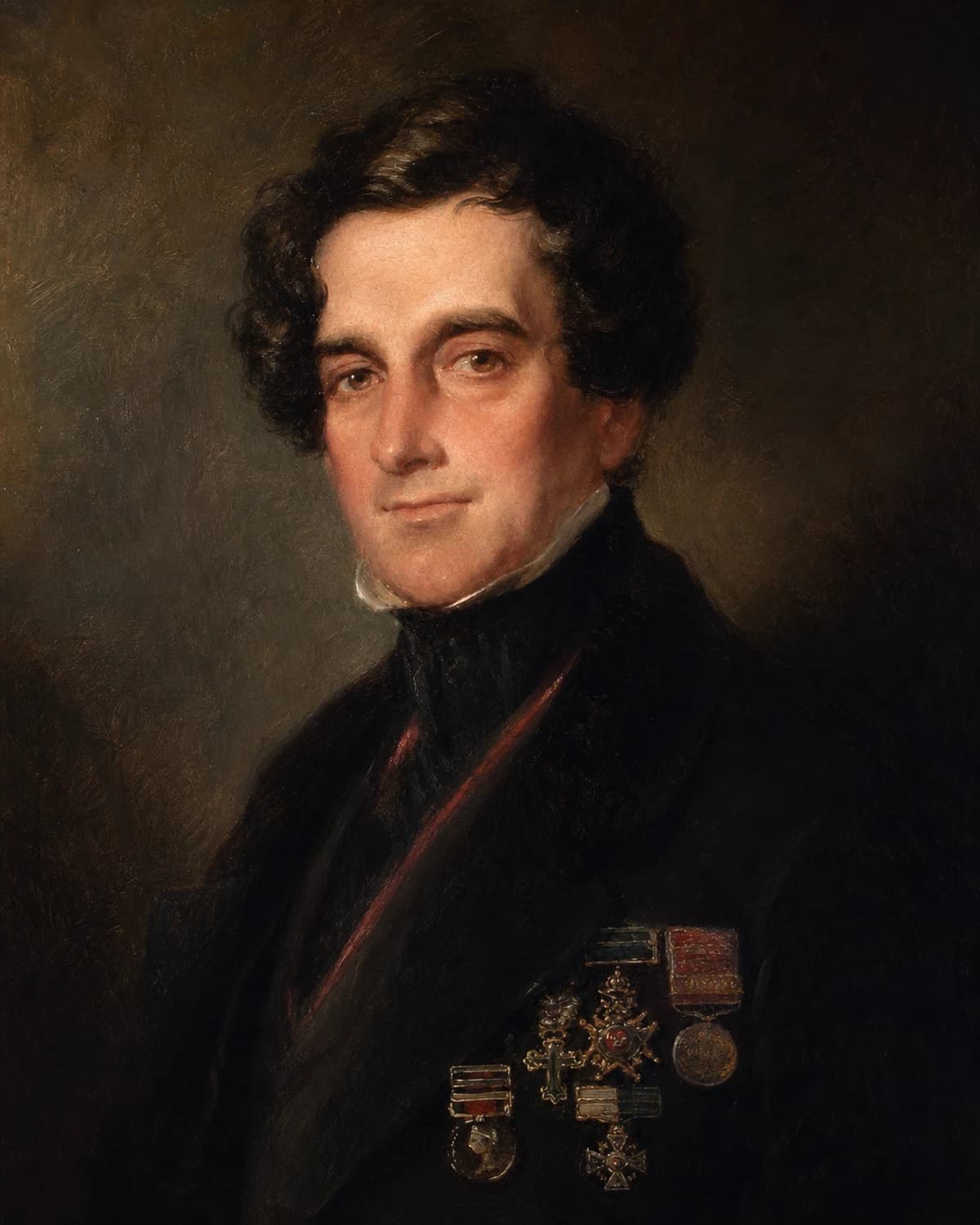
Charles Collier Michell (1793–1851), an artillery officer, fought at Vitoria, Toulouse and Waterloo, and from 1828 served as the first surveyor-general of the Cape Colony. He designed churches and lighthouses, planned mountain roads and painted watercolour landscapes. His drawings were used to illustrate a book about a journey to West Africa by his son-in-law.
Biography
Michell received his post in the Cape Colony in 1828, probably having heard of it from his cousin Rufane Donkin, at one time governor of the colony. The annual salary was £800. By then he had behind him almost twenty years of army service and teaching.
He was born on 29 March 1793 in Exeter, in Devon. His father, Sampson Michell, was an admiral, and his elder brother Frederick Thomas also became an admiral. The boy was named after Admiral George Collier, under whom his father was serving. Later he came to call himself Charles Cornwallis Michell, citing the proximity of his birthplace to Cornwall. He studied at the Royal Military Academy, Woolwich, and in 1809 was commissioned into the Royal Artillery. He commanded a brigade at the battles of Vitoria and Toulouse and took part in the Battle of Waterloo. He spoke Spanish, Portuguese and French fluently. In Toulouse, where his unit was stationed, on 10 October 1814 he married the young Anne D’Arragon, daughter of a retired officer of the army of Louis XVI; the bride’s parents opposed the match, and the couple eloped. The two elder daughters were born in Lisbon, the third in Nantes, and the youngest, in 1829, already in Cape Town. In peacetime he worked as a teacher: from 24 March 1824 he taught military drawing at the Royal Military College, Sandhurst, and from 25 December 1825 he taught fortification at Woolwich, soon receiving the brevet rank of major.
At the Cape of Good Hope he held the posts of surveyor-general, superintendent of public works and civil engineer at the same time. His duties included the detailed surveys needed for a good map of the colony, the improvement of passes and roads, and the accurate determination of borders. As an architect he built churches, among them St Paul’s in Rondebosch and St John’s in Bathurst. He proposed improvements for the harbour in Table Bay and designed lighthouses at Mouille Point, at Cape Agulhas (supposedly modelled on the Pharos of Alexandria) and at Cape Recife.
In 1834, during the Sixth Frontier War, he served as assistant quartermaster. He gave most of his energy to roads. Michell’s Pass near Ceres, which replaced the old Mostert’s Hoek Pass, and the Houw Hoek Pass near Elgin were laid out to his plans; both were built by Andrew Geddes Bain. Sir Lowry’s Pass and the Montagu Pass over the Outeniqua Mountains are also linked with his name; the latter was built in 1843–47 by an Australian road engineer, Henry Fancourt White.
Besides his official duties he painted watercolours, mostly landscapes. His illustrations appear in “Narrative of a Voyage of Observation among the Colonies of Western Africa and of a Campaign in Kaffirland” (1837), written by his son-in-law, Captain Sir James Edward Alexander, who in 1837 married Michell’s daughter Eveline.
In 1848 Michell was granted a pension and returned to England. He died on 28 March 1851 in Eltham, near London, the day before his fifty-eighth birthday.
Related context
Associations
Works connected through artistic movements, cultural context and period. Priced works available in this market appear first.








Profile notes
Profile and sources
Image
Artist image
На основе открытого изображения: Unknown author Unknown author; Wikimedia Commons; Public domain.
