
1843–1897
Chang Sŭngŏp
Chang Sŭngŏp, known by his art name Owŏn (1843–1897), was orphaned early and learned to paint in other people’s houses, yet he became a painter to the Korean royal court of the Joseon period and received a court rank. He painted landscapes, birds and animals, flowers, vessels and figures. Two of his pictures were presented to Nicholas II for his coronation in 1896; they are now in the Armoury Chamber of the Moscow Kremlin.
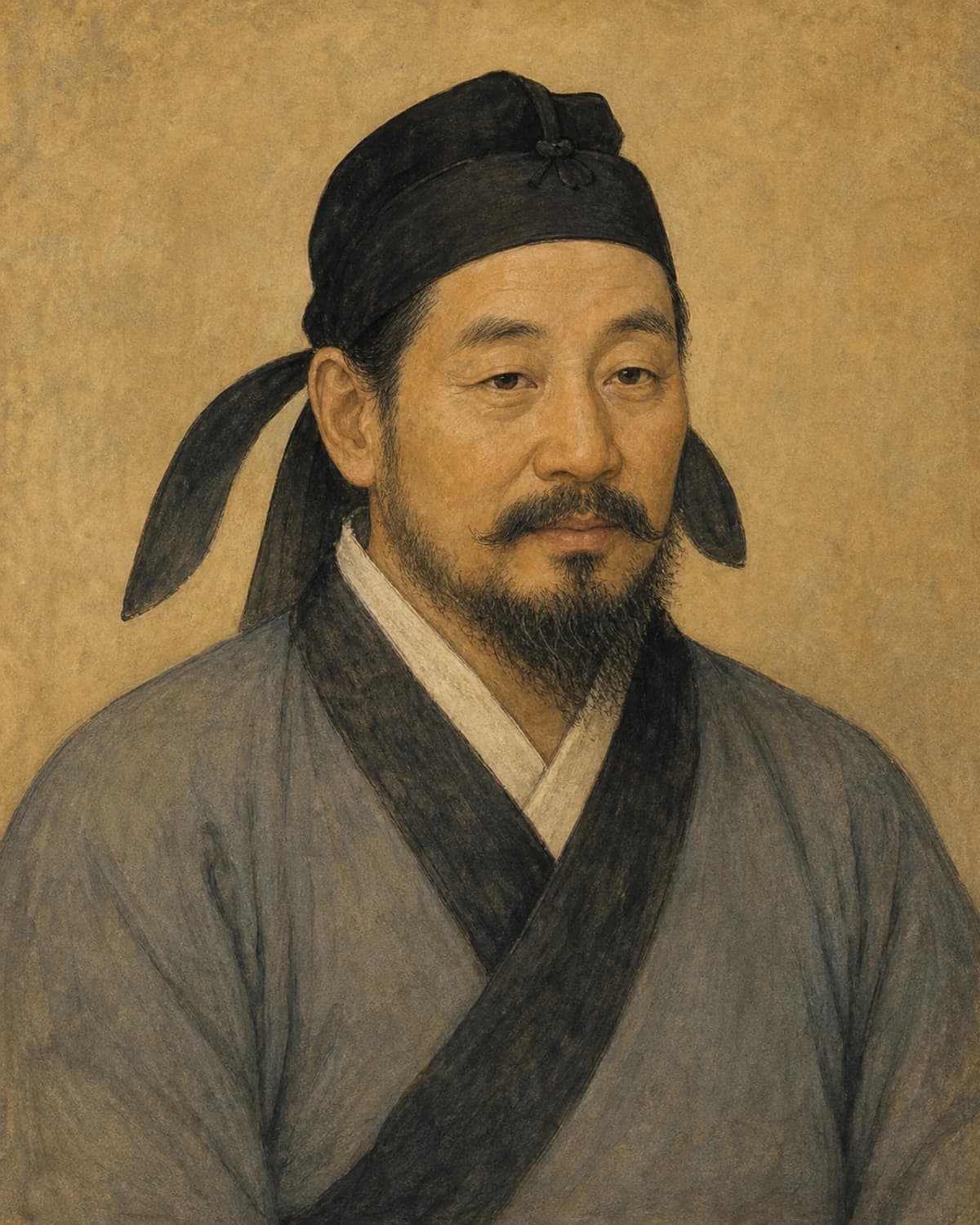
Biography
On 25 December 1885 the Qing official Yuan Shikai finished a secret letter to Liu Hanfang. Almost all of it concerns the affairs of the Korean court and the Japanese, but towards the end there is a businesslike postscript: find out whether Chang Sŭngŏp is in Hanseong (today’s Seoul), and commission a picture from him at once. The same letter mentions Pyŏn Wŏn-kyu, recently removed from office, in whose house the painter had once lived. To my mind, no court painter could ask for a better testimonial: he is remembered in the middle of political correspondence.
Chang Sŭngŏp was born in 1843 and was orphaned early. He had neither teacher nor school: he learned to draw, so it is said, by looking over other people’s shoulders.
He grew up in other families. He lived in the houses of Yi Ŭnghŏn, Pyŏn Wŏn-kyu and O Kyŏngsŏk, and there he first saw the painting and calligraphy of the old masters. At about twenty he settled with the aristocrat Yi Ŭnghŏn and only then could he work in earnest. Recognition came quickly. On the recommendation of acquaintances he was taken on as a painter in the Tohwasŏ, the royal Bureau of Painting, and later received the honorary rank of kamch’al, that is, inspector. Yuan Shikai and Li Hongzhang, tradition says, more than once begged him for works.
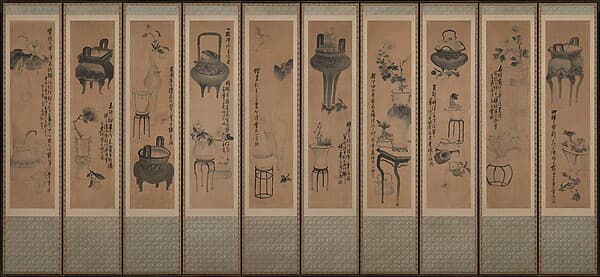
Owŏn took up almost every genre of Korean painting of his day. He painted mountain landscapes and figures in landscape, birds and animals, the “four gentlemen” (plum, orchid, chrysanthemum and bamboo), cut flowering branches beside vases and bronze vessels, fish and crabs, roosters, an eagle, horses. The Deoksugung Museum of Art holds his still life of vessels and branches; the Seoul National University Museum has a landscape with an autumn maple wood and a screen with landscapes, birds and branches. Known works include “Eight Steeds”, “Plum Blossom”, a ten-panel screen of red and white plum, “Three Old Men Asking Each Other’s Age”, “Wang Xizhi Watching Geese” and “Tao Yuanming Admiring Chrysanthemums”. He often took his subjects from Chinese antiquity and painted with broad, bold strokes. He chose his art name Owŏn (吾園), according to one account, with an eye to two famous predecessors, Danwon (Kim Hong-do) and Hyewon (Sin Yun-bok): the characters read “I too am a Won”. In 1896, when Nicholas II was crowned in Moscow, the Korean court presented him with two scrolls by Owŏn in the genre of “figures and objects”. One shows Laozi at the Hangu Pass, the other scenes from the life of the poet Li Bai. Both scrolls are still in the Armoury Chamber of the Moscow Kremlin.
Together with Danwon and Hyewon, who worked earlier, Owŏn is counted among the “Three Wons”, the finest Korean painters of the eighteenth and nineteenth centuries; by another reckoning he is ranked with An Gyeon and Kim Hong-do. In 2002 his life became the basis of Im Kwon-taek’s film “Chi-hwa-seon”, which won the prize for best director at Cannes. Owŏn was played by Choi Min-sik.
Chang Sŭngŏp died in 1897. I have found neither the place nor the circumstances of his death in the material available to me.
Artist works
Works by the artist
Works by Chang Sŭngŏp available in this edition of NEOARCA.
Related context
Associations
Works connected through artistic movements, cultural context and period. Priced works available in this market appear first.








Profile notes
Profile and sources
Image
Artist image
На основе открытого изображения: 장승업 (張承業 1843~1897), Jang Seungeop, or Owon; Wikimedia Commons; Public domain.
