
13.01.1893–09.08.1943
Chaïm Soutine
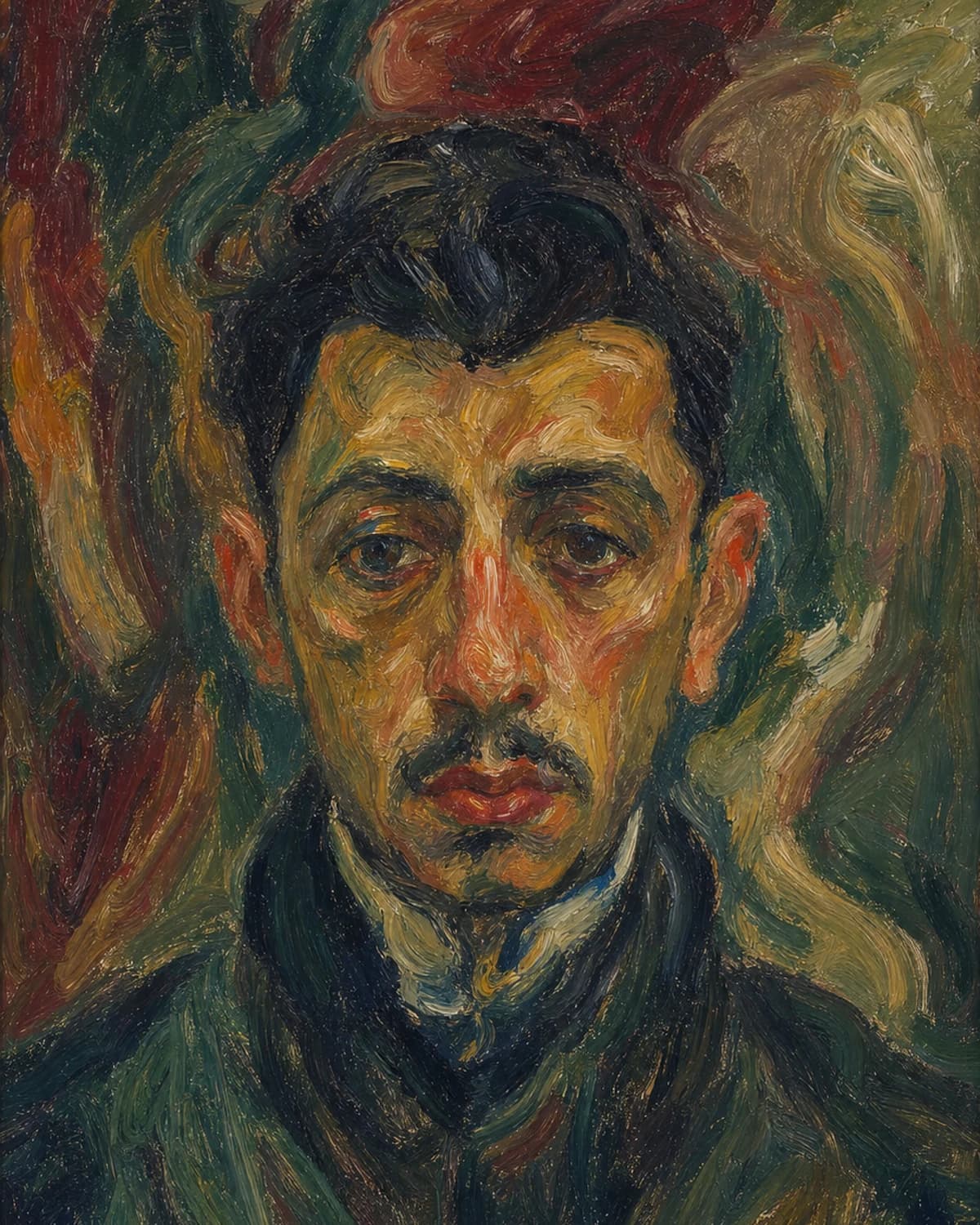
Chaïm Soutine (1893–1943), a native of the shtetl of Smilovichi near Minsk, arrived in Paris in 1913 with no money and almost no French and became one of the leading painters of the School of Paris. He painted the warped landscapes of Céret and Cagnes, beef carcasses, plucked chickens, young cooks and hotel bellboys. He was a friend of Modigliani; during the Occupation he hid in the provinces, and he died in Paris.
Biography
In the mid-1920s Soutine kept a beef carcass in his studio so as to paint it from life. The neighbours could not bear the smell and called the police. The painter gave the policemen a lecture on why art matters more than hygiene. There is also a story that Chagall saw blood that had seeped from under the door into the corridor and ran out shouting that Soutine had been murdered. The series of ten carcasses, begun under the spell of Rembrandt’s “The Slaughtered Ox” in the Louvre, became the best-known part of his legacy.
He was born in Smilovichi, in Minsk Governorate, the tenth of eleven children in a poor Jewish family; his father was, by some accounts, a tailor, by others a synagogue beadle. His birthday is usually given as 13 January 1893, though by other accounts he was born in 1894.
His parents did not want their son to become an artist, and in 1907 he ran away to Minsk, to Yakov Kruger’s drawing school. Around 1910, together with his friend Michel Kikoïne, he moved to Vilna, to the school of fine arts. In 1913 Soutine, Kikoïne and Pinchus Krémègne left for Paris. Soutine enrolled in Fernand Cormon’s studio at the École des Beaux-Arts, but his real school soon became the Louvre: Fouquet, Chardin, Ingres, Goya, Courbet and, more than any of them, Rembrandt. The sculptor Chana Orloff recalled how he stood in front of a Rembrandt repeating that it was so beautiful it was driving him mad. He himself later said that in a hole like Smilovichi one could not even imagine that there were cities like Paris and music like Bach’s.
His first years in Paris were spent in poverty. He lived at La Ruche, a hostel for poor artists in the passage de Dantzig, where Archipenko, Zadkine, Brâncuși, Chagall and Lipchitz were to be found; when he had no corner of his own he slept at Krémègne’s or Kikoïne’s, or even on staircases and benches. He learned French in the back room of the Café de la Rotonde, whose owner, Victor Libion, let artists come in to warm up without insisting that they order anything. Lipchitz introduced him to Modigliani, and the two became friends. Modigliani painted Soutine at least five times, in 1917 directly onto the door of the flat of their shared dealer, Léopold Zborowski. It was Zborowski, too, who supported Soutine during the war and took him along to the south.
He spent nearly seven years in the south of France: Vence, Cagnes-sur-Mer, and from 1919 Céret in the Eastern Pyrenees. The locals called him “the dirty painter”: he lived in utter poverty on a meagre allowance from Zborowski. Zborowski wrote to a friend that Soutine got up at three in the morning, walked twenty kilometres with his canvases and paints looking for the right spot, and when he came back forgot to eat. Sometimes he had only one canvas, and he painted the new picture over the one from the day before. In 1920–1922 some two hundred paintings were made in Céret. The landscapes in them sway and twist as if caught in a whirlpool, and houses and trees seem to be tearing themselves out of the ground. He also painted the local people: young cooks, café boys, people at prayer, always full face, with disproportionately large working hands. Later he came to dislike these Céret pictures, and the town as well. I think it was here, in these crooked streets, that he found himself.
Everything changed in a single encounter. In 1923, at a viewing arranged by the dealer Paul Guillaume, the American collector Albert Barnes bought some sixty of his paintings on the spot. Soutine, the story goes, ran straight out into the street, hailed a taxi and told the driver to take him to Nice.
From 1925 he worked in a spacious studio on the rue du Mont-Saint-Gothard, painting carcasses, plucked chickens and turkeys, skates and pheasants, and portraits alongside them: “The Little Pastry Cook” (1922–1923) and “The Bellboy” (1927) from the Musée de l’Orangerie, “Girl with a Doll” (1926–1927). In 1927 his first solo exhibition opened, and he did not go to the private view. From 1929 the critic Élie Faure, who wrote the first book about him, took him up; Faure considered Soutine one of the rare religious painters in the world, because the matter of his painting is so utterly of the flesh. From 1930 to 1935 Madeleine and Marcellin Castaing looked after him, he spent long stretches at their house in Lèves, and his portrait of Madeleine Castaing is now in the Metropolitan Museum. In 1935 his pictures were shown in the United States for the first time, in Chicago, and in 1937 twelve of his works hung in a large Paris exhibition of independent art, where he was at last recognised as a major master. On the whole he was reluctant to exhibit.
When France was occupied, Soutine, as a Jew, had to hide from the Gestapo. From the beginning of 1941 he moved from place to place and sometimes slept in the woods. With his companion Marie-Berthe Aurenche and with false papers he reached the village of Champigny-sur-Veude in Touraine, where they eventually rented a house on the road to Chinon. The painter Marcel Laloë brought him canvases and paints, and Soutine worked again. In the landscapes of 1941–1942 hardly any warm tones remain, but light-hearted subjects appeared too: “The Pigs”, “Return from School after the Storm”, children, mothers with babies.
In the summer of 1943 he left his hiding place and went back to Paris, where he died on 9 August. A few friends followed the coffin, among them Picasso and Jean Cocteau. Soutine was buried in the Montparnasse Cemetery, and until the end of the war the grave bore no name. Then a plaque appeared on it with the dates “1894–1943”, later corrected to “1893–1943”. In 1960 Marie-Berthe Aurenche was laid in the same grave.
Related context
Associations
Works connected through artistic movements, cultural context and period. Priced works available in this market appear first.








Profile notes
Profile and sources
Image
Artist image
На основе открытого изображения: Chaïm Soutine; Wikimedia Commons; Public domain.
