
19.08.1903–10.01.1956
César Moro
César Moro, born Alfredo Quíspez-Asín Mas, began as a self-taught artist in Lima, went to Paris at twenty-two and entered André Breton's circle. He wrote most of his poems in French. In 1935, with Emilio Adolfo Westphalen, he organised the first Surrealist exhibition in Latin America, in Lima, and in 1940 he organised the International Exhibition of Surrealism in Mexico City.
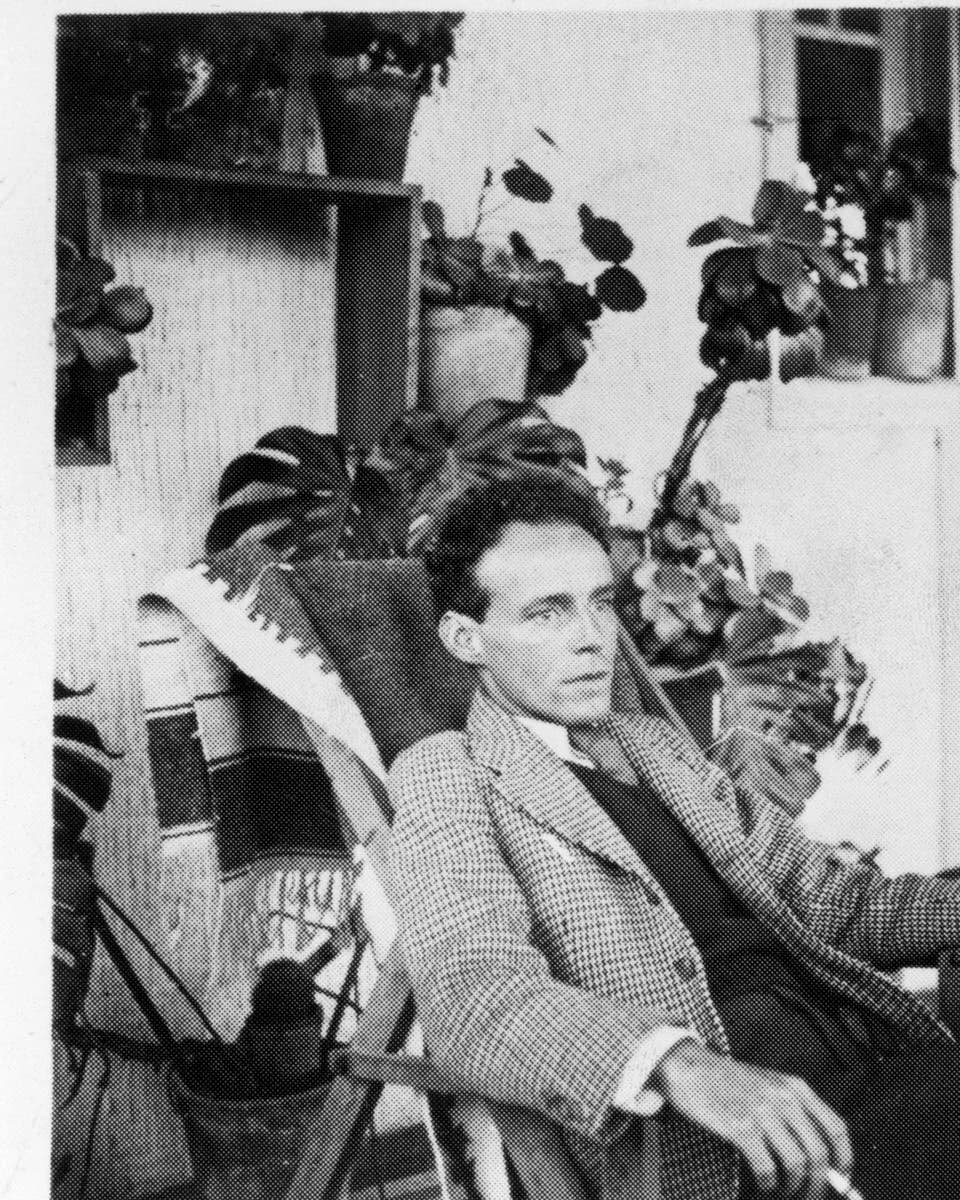
Biography
In 1921 a drawing appeared with the signature “César Moro”. It was the name of a character in the Spanish writer Ramón Gómez de la Serna, and the young man born in Lima as Alfredo Quíspez-Asín Mas kept it for the rest of his life.
He was born on 19 August 1903. He studied at the Jesuit school of La Inmaculada, and taught himself painting and drawing. His older brother, Carlos Quíspez-Asín, also became an artist. Moro's friend, the French poet André Coyné, explained the abandoning of the family name not by the fact that the family already had one artist: name and vocation, in his words, had come into conflict.
In 1925 Moro went to Paris, at first for ballet: he took dance classes, but had to give them up, and concentrated on painting and poetry. His first exhibitions took place in 1926 and 1927. He also took part in a group exhibition at the Cabinet Maldoror in Brussels, together with Santos Balmori, Jaime Colson and Isaías de Santiago. Around 1926 he briefly turned to a more Cubist manner and moved away from Peruvian subjects; scholars see this as a response to the expectation of “primitivism” and national subject matter from Latin Americans in Paris. In 1928 he joined the Surrealist group and began writing poems in French, and in the 1930s he became fully part of it. His texts were included in the anti-war manifesto “Mobilization Against the War Is Not Peace”. The collection Ces poèmes belongs to the Paris period.
At the end of 1933 Moro returned to Lima. He hoped to become a centre of Surrealism in South America, continuing what César Vallejo and José Carlos Mariátegui, who had written about Surrealism, had begun. He founded a museum and gave drawing classes for patients at the Larco Herrera Hospital. In 1935, together with the poet Emilio Adolfo Westphalen, he organised the first Surrealist exhibition in Latin America at the Academia Alcedo; the participants included the Chileans Jaime Dvor, Waldo Parraguez, Gabriela Rivadeneira, Carlos Sotomayor and María Valencia. A fierce polemic followed with the Chilean poet Vicente Huidobro, whom Moro accused of imitating Pierre Reverdy.
In 1938 he had to leave. Together with Westphalen and Moreno Jimeno he published a bulletin in support of the Spanish Republic, and because of this activity he faced arrest. Moro went to Mexico and lived there for about ten years. He grew close to Wolfgang Paalen, Alice Rahon, Xavier Villaurrutia, Remedios Varo, Gordon Onslow Ford and Leonora Carrington. In 1940, with Paalen's help and with Breton's participation, he organised the International Exhibition of Surrealism at the Galería de Arte Mexicano. Four of his works were included: “Pedestrian” (1926), “Untitled Painting with the Inscription ‘Eluard’” (1926), “The Art of Reading the Future” (1935) and “Cover for the Blind” (1939). He also wrote the preface to the catalogue, calling Surrealism “the magic word of the century”.
In Mexico he wrote “La tortuga ecuestre” (“The Equestrian Turtle”), his only book in Spanish: thirteen poems of 1938 about desire and love. It could not be printed in his lifetime, because not enough subscribers came forward. Only two collections in French were published while he lived, “Le château de grisou” and “Lettre d'amour”. By 1945 at the latest he had broken with orthodox Surrealism: according to Coyné, he now placed poetry above Surrealism. He grew close to the Mexican poets of the Contemporáneos circle.
In 1948 Moro returned to Lima and taught French at the Alliance Française and at the Leoncio Prado Military School; his pupils included the future writer Mario Vargas Llosa. In 1955 he finished “Amour à mort”, one of his principal books. Moro died in Lima on 10 January 1956.
His manuscripts and texts were gathered and published by André Coyné. “La tortuga ecuestre” appeared in 1957, and the prose collection “Los anteojos de azufre” (“The Sulphur Spectacles”) in 1958.
Related context
Associations
Works connected through artistic movements, cultural context and period. Priced works available in this market appear first.








Profile notes
Profile and sources
Image
Artist image
Unknown author Unknown author; Wikimedia Commons; Public domain.
