
22.07.1948–present
Cecilia Vicuña
Cecilia Vicuña (born 1948), a Chilean poet and artist, has made “precarios”, tiny sculptures from found debris, since the mid-1960s, and later monumental “quipus” of raw wool. After the 1973 coup she remained in exile, living in London, Bogotá and New York. She has received the Velázquez Prize (2019) and the Venice Biennale’s Golden Lion for Lifetime Achievement (2022).
Biography
For her exhibition “Otoño” (“Autumn”) in 1971, Cecilia Vicuña filled one of the rooms of the National Museum of Fine Arts in Santiago with dry leaves; the gardeners of the Parque Forestal and the Quinta Normal helped her gather them. She herself said that it was an inner rather than an outer piece: the idea and the experience of making it mattered more than the sculpture itself. The museum’s director, Nemesio Antúnez, explained to her that what she was doing was conceptual art. It was the first time she had heard the term.
That same year Cecilia Vicuña completed her master’s degree at the University of Chile.
She was born on 22 July 1948 in Santiago and grew up in La Florida, in the Maipo valley. As a child she learned English at an English school, and in her own studio in the garden she painted large abstract pictures. In 1966, on the beach at Concón, she began arranging compositions of sticks, pebbles, feathers and threads right at the water’s edge and photographing them before the waves washed them away. She called these works “precarios”, fragile things destined to disappear. The same year she entered the architecture school of the University of Chile, but switched to the school of fine arts. In 1967 she founded the group Tribu No and wrote the “No Manifesto” for it, and the group staged poetic actions in the streets of Santiago. Her first poems were published by the Mexican magazine El Corno Emplumado.
In 1972, on a British Council scholarship, she went to London to the Slade School of Fine Art. On 11 September 1973 a military coup took place in Chile, the government of Salvador Allende was overthrown, and Vicuña remained in England as an exile. Between June 1973 and August 1974 she made more than four hundred precarios, calling the series “A Journal of Objects for the Chilean Resistance”; the twelve books of this journal are now in the Tate. The edition of her collection “Sabor a mí” prepared in Chile was not allowed to appear, and two months after the coup an artist’s book of the same name came out in England, a testimony to the coup. In 1974 she became one of the founders of Artists for Democracy and organised a festival at the Royal College of Art in support of democracy in Chile. Also in London at that time she began her “palabrarmas”, word-weapons: she split words into parts, and a hidden meaning emerged from inside them. Her paintings of the late 1960s and early 1970s are modelled on the indigenous painters of the sixteenth century who painted angels and saints for the Church: in her pictures the place of the saints is taken by Karl Marx, Lenin, Allende, Ho Chi Minh and women poets. The portrait of Marx from the series “Heroes of the Revolution” was bought by the Guggenheim Museum in 2018, and “Violeta Parra” (1974) by the Tate in 2017.
In 1975 she moved to Bogotá, travelled through Colombia, Venezuela and Brazil, studied the art of indigenous peoples and designed sets for the Teatro La Candelaria. In 1979, in the action “El Vaso de Leche” (“The Glass of Milk”), she spilled a glass of white paint in front of an audience in protest against the deaths of children from contaminated milk, to which paint had been added for profit; by one estimate there were about 1,920 of them. In 1980, in Bogotá, she made the film “What Is Poetry to You?”, which is now in the Museum of Modern Art in New York.
Since 1980 she has lived in New York, working also in Santiago.
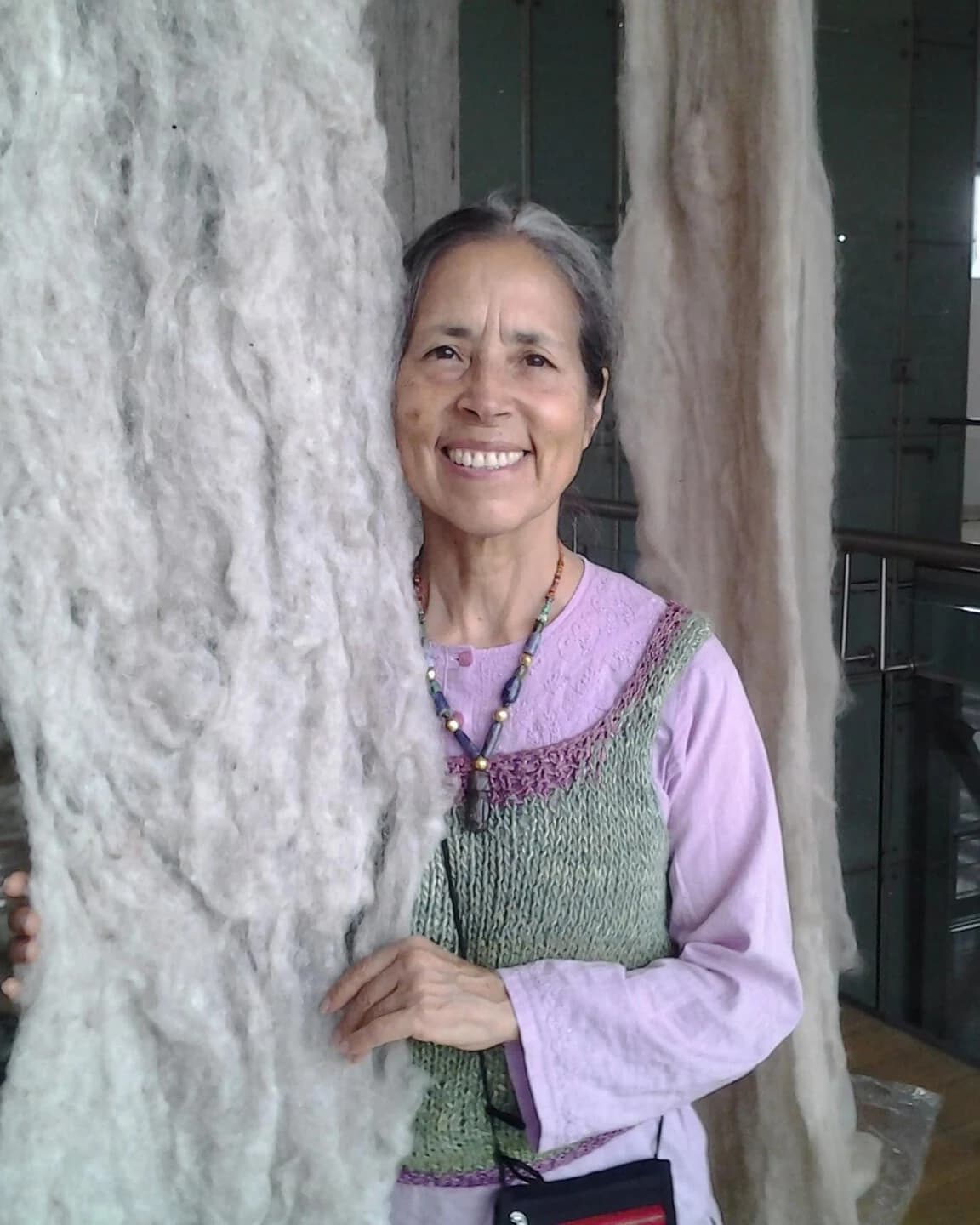
There she joined the feminist Heresies collective, in 1981 showed work at the Museum of Modern Art in New York for the first time, in 1983 published the book “Precario/Precarious”, and in 1990 opened her first solo exhibition in the United States. Her main form became the quipu. This was the name of the Andean system of record-keeping in knots on cords, suppressed by the Spanish colonisers. In Vicuña’s hands it becomes threads and strands of raw wool, most often red, hanging from the ceiling or stretched across a landscape; viewers often see blood in them. Her first quipu she called “the quipu that remembers nothing”; it was an empty cord. In the series “Cloud-Net” (1998–1999) she used the wool of the vicuña, the Andean animal whose name she shares. In 2010 she returned to Concón to make the film “Kon Kon”, about how the sea is dying there and an old tradition is vanishing. In my view, her whole path fits into this circle: from the precarios on the beach to the quipus in museum halls.
Recognition came late, and from everywhere at once. At documenta 14 in 2017 her quipus hung in both Athens and Kassel; in 2018 the exhibition “Disappeared Quipu” was shown by the Brooklyn Museum and the Museum of Fine Arts, Boston. In 2019 she received Spain’s Velázquez Prize, and in 2022 the Golden Lion for Lifetime Achievement of the 59th Venice Biennale. That same year the Guggenheim mounted her first solo exhibition at a major New York museum, and her “Brain Forest Quipu” went on view in the Turbine Hall at Tate Modern. In 2023 she received Chile’s National Prize for Plastic Arts, and in 2025 the Roswitha Haftmann Prize.
Profile notes
Profile and sources
Image
Artist image
Cecilia Vicuna; Wikimedia Commons; CC BY 4.0.
