
05.09.1774–07.05.1840
Caspar David Friedrich
Caspar David Friedrich (1774–1840), a native of Swedish Pomerania, studied in Copenhagen and from 1798 lived in Dresden. For his first years he worked in sepia and ink, and he began painting in oil in 1807. His “Tetschen Altar” raised the question of whether a landscape could stand in place of an altarpiece. Among the buyers of his work were the Prussian king and the Russian imperial family.
Biography
In 1809 the critic Basilius von Ramdohr published a long article against a single painting. He wrote that landscape should not “sneak into the church and creep onto the altar”. The picture was “Cross in the Mountains”, or the “Tetschen Altar”, by Caspar David Friedrich: a lone cross on a summit, with fir trees around it. The artist answered with a written explanation, comparing the rays of the evening sun to the light of God the Father. He never left another interpretation of his own work in such detail.
Friedrich was born on 5 September 1774 in Greifswald, in Swedish Pomerania, the sixth of ten children. His father, Adolf Gottlieb, was a soap boiler and candle maker, and the household followed strict Lutheran rules. His mother died in 1781, when the boy was seven, and then two sisters died, one after the other. In 1787 his younger brother Christoffer drowned. Family tradition says that the boys capsized in a boat on the town moat; later accounts by contemporaries put him through the ice, and by one version the brother died while trying to save Caspar David. The exact details are hard to establish.
Around 1790 he began to study drawing with Johann Gottfried Quistorp, the university’s architect and drawing teacher. Quistorp took his pupils out to draw in the open air, in Pomerania. Through him Friedrich came to know the theologian Ludwig Gotthard Kosegarten, who saw in nature a revelation of God, and the work of Adam Elsheimer. From 1794 to 1798 he studied at the Royal Danish Academy of Fine Arts in Copenhagen: first he copied drawings and prints, then worked from plaster casts and from life. Painting was not taught there as a subject, but the city had collections of Dutch landscape painters.
In spring 1798 he returned to Greifswald, and in the summer he settled in Dresden. From 1800 he made his living by selling sepia drawings, as one of the first independent artists not dependent on a princely court. He walked a great deal: to Rügen, to Greifswald, to Saxon Switzerland, to the Harz, to Bohemia and to the Giant Mountains. From sketches of the ruined Eldena monastery, the cliffs of Rügen and the banks of the Elbe he later assembled his compositions. His pencil studies are exact down to topographical notes, while the subtle effects of light were painted from memory. In 1801–1805, according to some accounts, he was troubled by severe depression; in 1803–1804 he was ill for a long time and hardly worked.
In 1805, at the competition of the Weimar Friends of Art run by Goethe, he shared the first prize for two sepia drawings, “Procession at Dawn” and “Autumn Evening by the Lake”. Goethe gave the award although the works did not treat an ancient legend, as the theme required. His first oil paintings appeared in 1807. “The Monk by the Sea” and “The Abbey in the Oakwood” were shown in autumn 1810 at the exhibition of the Berlin Academy; Heinrich von Kleist praised them in print, and the Prussian king bought both at the wish of his fifteen-year-old crown prince. On 12 November 1810 Friedrich was elected a member of the Berlin Academy.
During the Napoleonic Wars he lived in Saxony, an ally of France, and answered the occupation in paintings: “Old Heroes’ Graves” (1812) and “Chasseur in the Forest” (about 1813). In 1813 he helped his friend, the painter Georg Friedrich Kersting, with money when Kersting joined the Lützow Free Corps, and fell into debt himself. In 1816 he applied for Saxon citizenship and received it, and in 1818 he joined the Dresden Academy with a salary of 150 thalers. He was made professor only in January 1824, and then as an extraordinary professor, without a regular chair: he had counted on the post of Johann Christian Klengel, but his political views probably stood in the way.
On 21 January 1818 he married Caroline Bommer, the daughter of a dyer. They had two daughters and a son, Gustav Adolf, later a painter as well. To this time belongs “Chalk Cliffs on Rügen”, painted after the honeymoon journey: its colours are lighter than usual. His friends became the Norwegian Johan Christian Clausen Dahl, who lived in the same house, and the physician and natural philosopher Carl Gustav Carus. In 1820 Grand Duke Nikolai Pavlovich visited his studio, and in 1821 the poet Vasily Zhukovsky. Both bought paintings, and these purchases supported Friedrich for years; of his paintings, seventeen are now in Russian collections, most of them in the Hermitage. Zhukovsky visited the artist again shortly before his death.
By the middle of the 1820s his paintings grow darker. “The Sea of Ice”, or “The Wreck of the Hope” (1823–1824), with floes crushing a wooden ship, was received coldly by the public.
In 1830 he set down his aphorisms: before painting, one must close the bodily eye and see the picture with the spiritual eye. At the start of the 1830s he also painted “The Great Enclosure” and “The Stages of Life”.
On 26 June 1835 Friedrich suffered a stroke with paralysis; the money for treatment in Teplitz came from the sale of paintings to the Russian court through Zhukovsky. He hardly painted in oil again, apart from “Seashore by Moonlight” (1835–1836); the remaining years brought sepia drawings and watercolours with motifs of death. The family lived in want. He died in Dresden on 7 May 1840 and was buried in the Trinity Cemetery. He was rediscovered around the turn of the twentieth century: the Norwegian art historian Andreas Aubert began writing about him in the 1890s, and in 1906 thirty-two of his paintings were shown in Berlin.
Artist works
Works by the artist
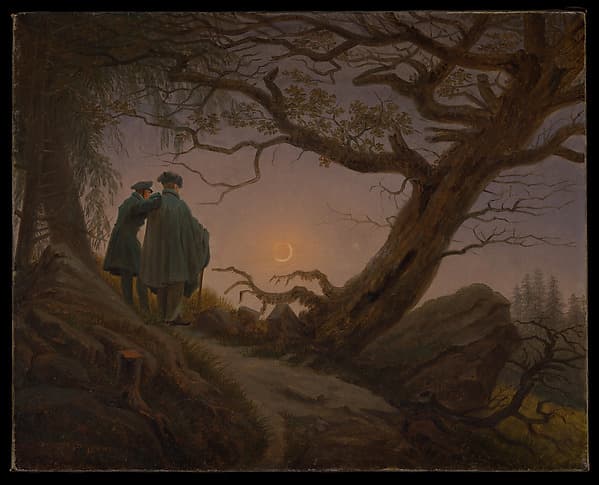
Works by Caspar David Friedrich available in this edition of NEOARCA.
Profile notes