
24.04.1826–08.01.1889
Casimiro Castro
Casimiro Castro (1826–1889) drew Mexico City from a balloon and from rooftops: the views of the city and its surroundings in the album “Mexico and Its Environs” (1855–1856) made him the best-known Mexican lithographer of the nineteenth century. Later he and other artists produced the chromolithographs for an album on the country’s first railway, from Veracruz to the capital.
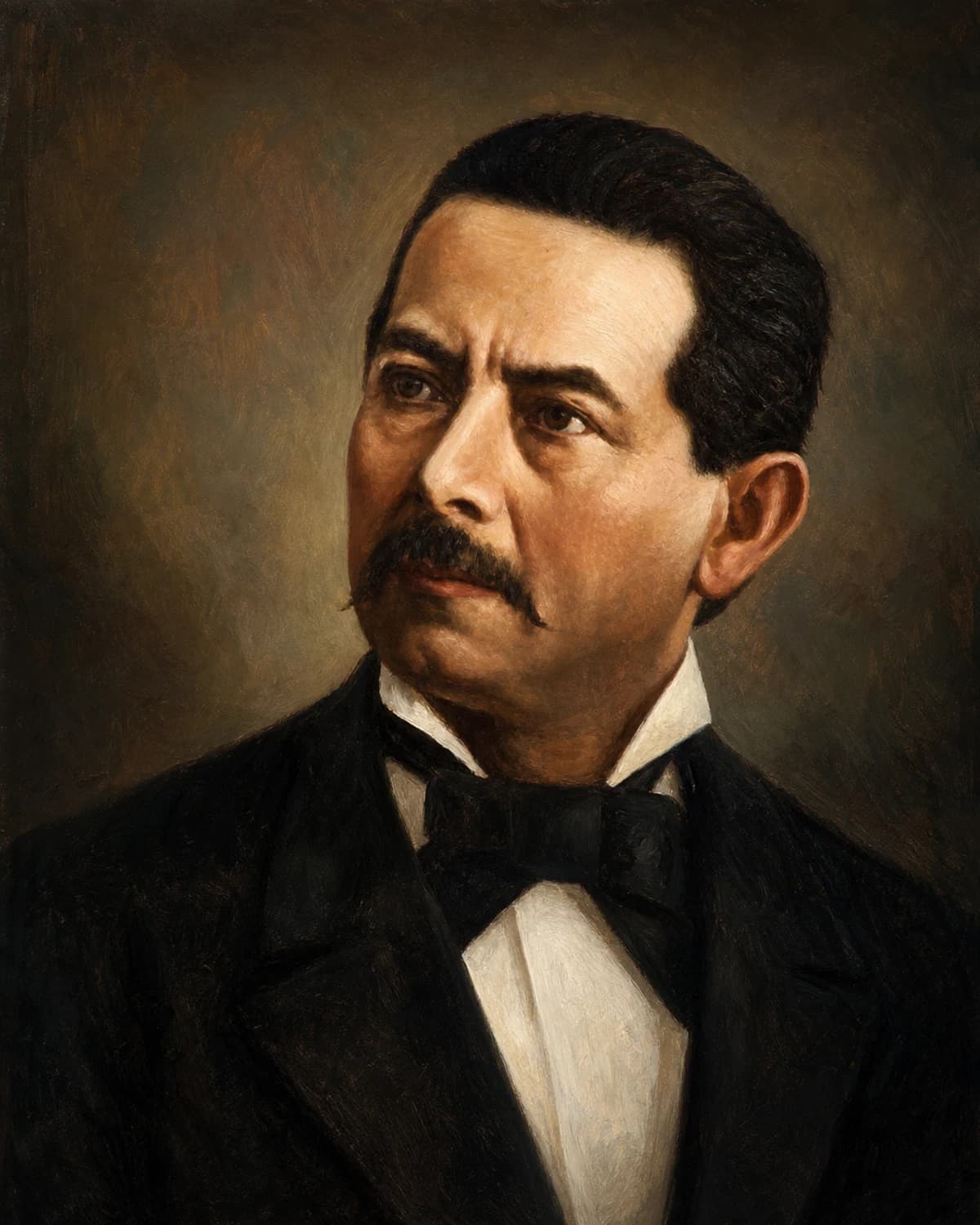
Biography
Among the plates of the album “Mexico and Its Environs” there are views of the capital made from a balloon, which for the mid-1850s looks almost audacious. Other plates were drawn from city rooftops. Most of these views were the work of Casimiro Castro.
He was born on 24 April 1826 in Tepetlaoxtoc, in what is now the State of Mexico, the son of Cristóval Castro and Mariana Feliciana Blancas. Mexico had only just won its independence, and throughout his life the country was shaken by wars, foreign invasions and changes of government. He died during the third term of Porfirio Díaz.
Castro studied at the Academy of San Carlos in Mexico City under the Italian-born Pietro Gualdi. He was also influenced by Claudio Linati, who had introduced lithography to Mexico. This technique, as scholars write, gave more freedom than the academic rules. Castro’s first prints appeared in religious and literary publications: by some accounts, in the magazine “The Mexican Museum” in 1843, then in “El Gallo Pythagorean” in 1845. In 1849 he made illustrations for the memorial service for Agustín de Iturbide; by other accounts, his first work was a depiction of the transfer of the ashes of the “liberator”, and two years later he began contributing to the publication “La Ilustración Mexicana”.
His main work was the album “Mexico and Its Environs”, published in 1855–1856. It contains 42 plates of the capital and its surroundings; Castro worked on them with Julián Campillo, Luis Auda and another artist named Rodríguez. How many plates are Castro’s own is hard to say: both thirty and thirty-one are given. He drew the façades of wealthy houses and poor neighbourhoods, monuments, promenades, lakes and canals, eighteenth-century architecture, and also water carriers, muleteers, fruit sellers and porters. The album was presented to Maximilian as he prepared to become emperor of Mexico. It had no print run in the usual sense: copies were printed as the market demanded, and one edition appeared in 1864 from the Imprenta Lithographica de Decaen.
To my mind, these plates are a convenient way to follow the changes in the city: in the clothing one can see republican austerity giving way to the fashions of the age of the Industrial Revolution.
His second large project was tied to the first railway, which ran from the port of Veracruz to the capital. Castro made the “Album del Ferrocarril Mexicano” (Mexican Railroad Album), with 24 or 25 chromolithographs (the number is given differently), together with other artists, among them Sigogne; the texts were written by the engineer Antonio García Cubas. The views, painted from nature, showed the route and the surrounding landscapes, bridges and slopes. The album was published in 1877 by Víctor Debray. The work had begun much earlier: by some accounts in 1872, by others the preparation went on for about forty years.
After a trip to Europe Castro produced prints of views of Italy and Spain. He made architectural drawings and plates of Mexican towns, interiors, and posters for fairs and fashion houses, some of which show traces of Art Nouveau.
Casimiro Castro died on 8 January 1889 in Mexico City. In 2009 the foundation Fomento Cultural Banamex showed an exhibition of his work at the Palacio de Iturbide: selected lithographs, 204 watercolours and drawings, and the artist’s personal belongings.
Related context
Associations
Works connected through artistic movements, cultural context and period. Priced works available in this market appear first.








Profile notes
Profile and sources
Image
Artist image
На основе открытого изображения: Unknown author Unknown author; Wikimedia Commons; Public domain.
