
12.02.1813–10.09.1894
Carlos Morel
Carlos Morel (1813–1894) trained as a painter at the art school of the University of Buenos Aires, and in 1845 published an album of 24 lithographs, “Manners and Customs of the Río de la Plata”, showing city streets, shops and gauchos. A large part of his work dates from his first thirty years; he spent his last decades in Quilmes and painted mostly religious subjects.
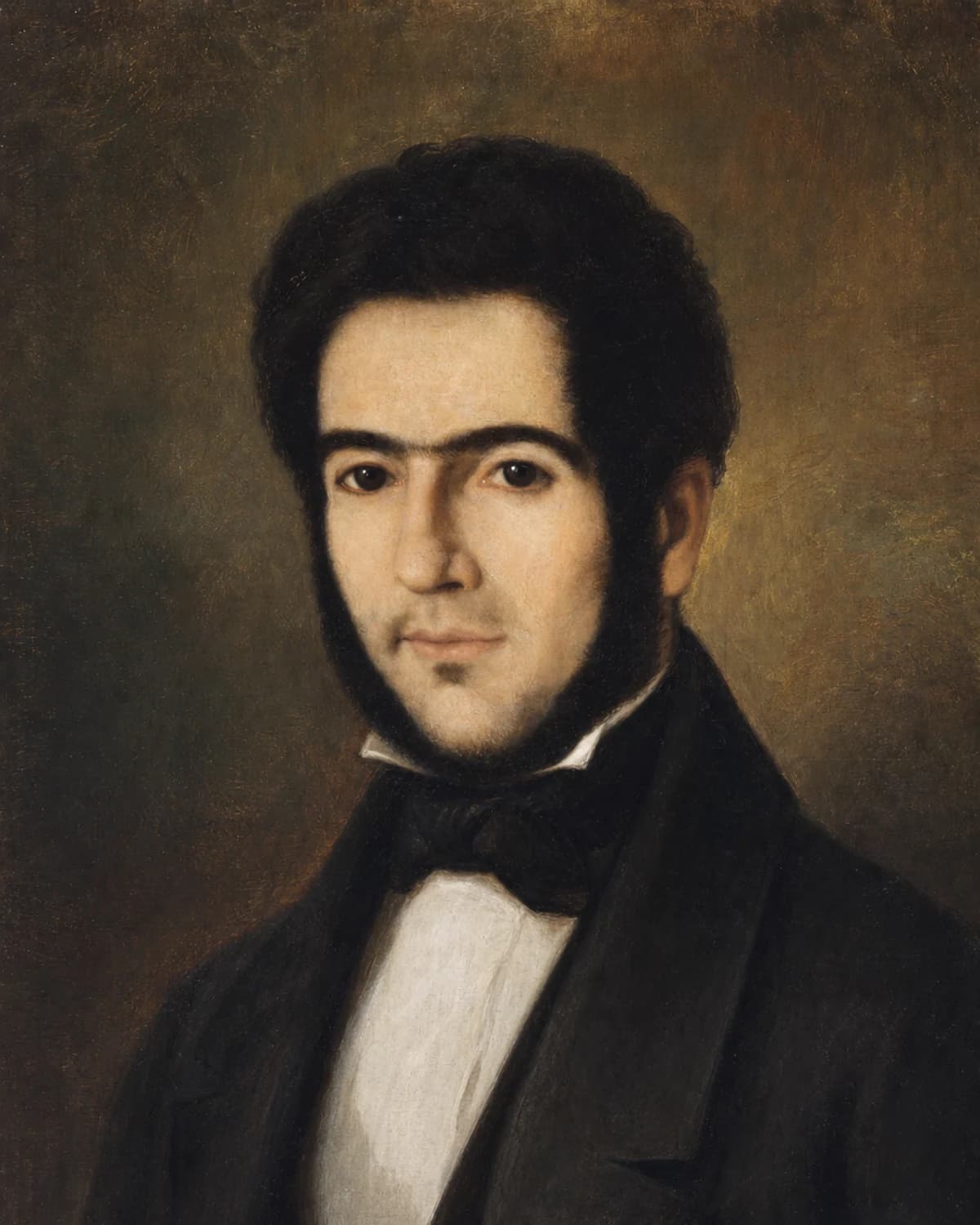
Biography
In 1845 an album of twenty-four lithographs, issued in two parts of twelve plates each, appeared in Buenos Aires. It showed the streets of the city, its shops, gauchos and other figures from the early decades of independent Argentina. The author of the album, Carlos Morel, was thirty-two, and by then he had already done his best work.
He was born on 12 February 1813 in Buenos Aires, the son of a wealthy Spanish merchant, José María Morel y Pérez, and Juliana Miró, the daughter of a customs official. His father died on 6 June 1825, when the boy was twelve. Carlos and his brother Estanislao started work in their father’s business at an early age. In 1827 he entered the art school of the University of Buenos Aires. He studied under the Swiss artist José Guth and, after graduating in 1830, for about another year under the Italian Pablo Caccianiga. Among his fellow students was Fernando García del Molino, who later helped him on some of his works. In 1830 his mother married the Italian painter Cayetano Descalzi; he seems to have given his stepson lessons too, though this is hard to check. Eight years later the couple legally separated.
As early as 1837 Marcos Sastre, opening a literary salon, described Morel as a promising young painter. By then he was painting portraits, miniatures, genre scenes and battle scenes. His first lithograph, “The Descent”, dates from 1836. It was in this medium that he reached his greatest skill: “Buenos Aires Cathedral”, “Startled Horse”, “Cuirassiers” and “Cavalry” are especially fine in composition. Among his sitters were Florencio Escardó and Patricio Peralta Ramos; he also painted miniatures of General Juan Manuel de Rosas and his wife, Encarnación Ezcurra.
On 22 February 1842 Morel sailed for Rio de Janeiro. The city was going through a cultural revival: artists who had left France after the restoration of the absolute monarchy were living there, and Emperor Pedro II supported them. Morel learned the daguerreotype, invented in 1839. Opponents of the regime of Rosas were living in Rio as well: Prilidiano Pueyrredón, Bernardino Rivadavia, José María Gutiérrez and Juan Bautista Alberdi, and he grew close to many of them. In April 1842, during disturbances in Buenos Aires, his brother-in-law José María Dupuy was arrested and killed. When he heard of it, Morel soon painted a miniature portrait of him.
In 1844 he came home. After that, by general agreement, the quality of his work declined.
“Combate de los bajíos de Arregui” appeared in 1848, and after that no other works by him are known until 1870. In 1870 he moved to Quilmes, to the home of his half-sister, Indalecia Morel Dupuy de Dupuy. After her husband’s murder she had run a bakery in Buenos Aires, and in 1853, when his confiscated property was returned, she moved to Quilmes; she died in 1879. In a Quilmes business directory for 1870 Morel is listed as a photographer. His late paintings are mostly religious, and they are not regarded as his best. In 1877 he made an altarpiece for the church of Quilmes. Carlos Morel died on 10 September 1894 in Quilmes, aged eighty-one, and was buried in the town cemetery. The local School of Fine Arts bears his name.
Related context
Associations
Works connected through artistic movements, cultural context and period. Priced works available in this market appear first.








Profile notes
Profile and sources
Image
Artist image
На основе открытого изображения: Fernando García del Molino; Wikimedia Commons; Public domain.
