
04.02.1929–present
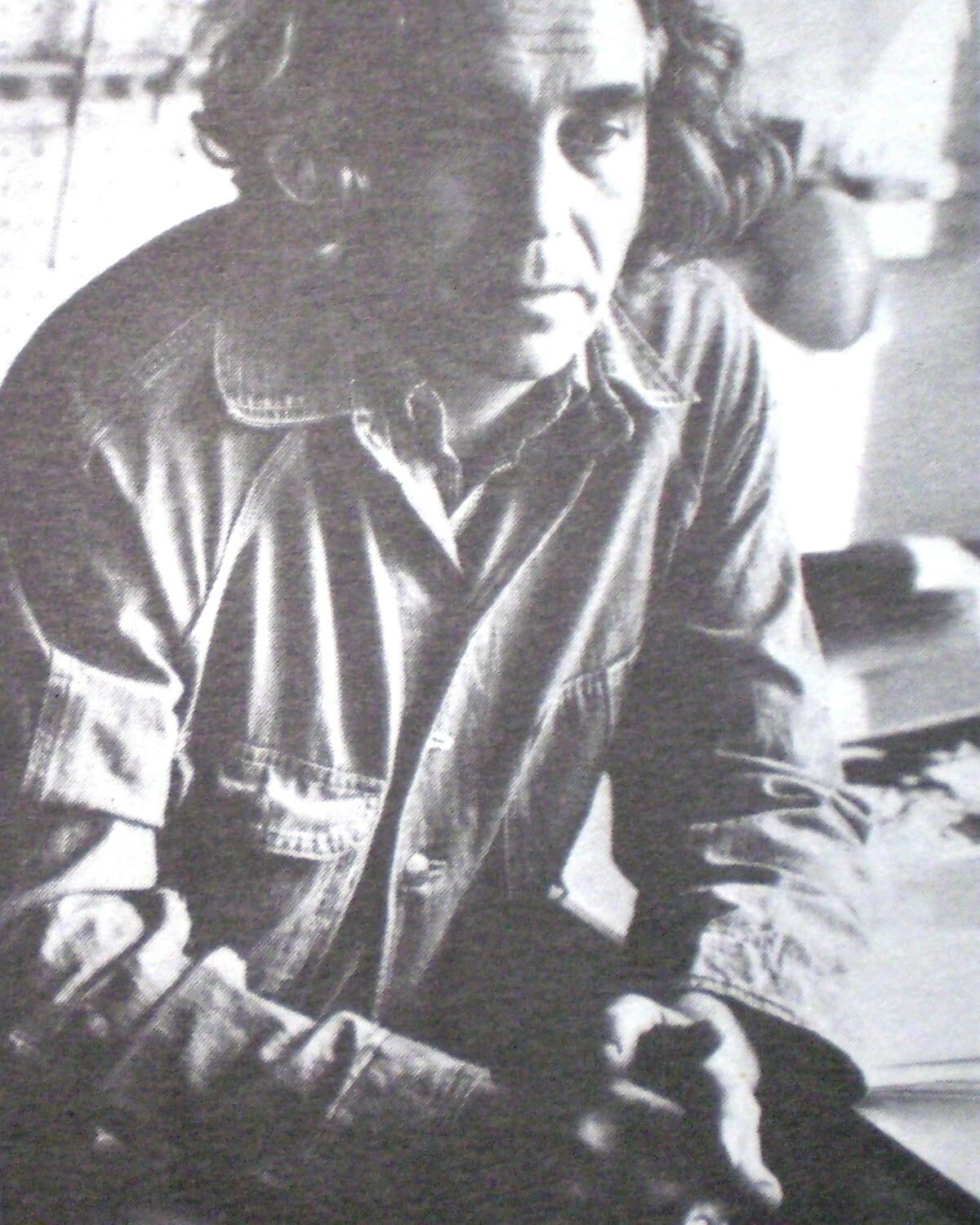
Carlos Alonso
Carlos Alonso (1929–2026) entered the National Academy of Fine Arts in Mendoza at fourteen, and in 1957 won the Emecé publishing house competition to illustrate part two of “Don Quixote”. He later made a series of drawings after the “Divine Comedy” and illustrated “Martín Fierro”. After the coup of 1976 and the disappearance of his daughter he lived in exile in Italy and Spain, returning in 1981.
Biography
In 1963 postcards with illustrations to “Don Quixote” were printed in the Soviet Union. The pictures chosen for them were by Gustave Doré, Honoré Daumier, Pablo Picasso and the Argentine Carlos Alonso, who was not yet thirty-five.
He was born on 4 February 1929 in Tunuyán, in Mendoza Province. He lived there until he was seven, and then the family moved to the city of Mendoza. At fourteen he entered the National Academy of Fine Arts at the University of Cuyo. Sergio Sergi taught him drawing and engraving, Lorenzo Domínguez sculpture, and Francisco Bernareggi and Ramón Gómez Cornet painting. Later he studied with Lino Enea Spilimbergo, one of the notable Argentine painters of the day; among his other teachers the sources name Pompeyo Audivert, Víctor Rebuffo and Lajos Szalay. He received his first award in 1947, at a student salon. In 1951 Alonso took first prizes at the Salon of Painting in San Rafael, at the North Hall in Santiago del Estero, and for drawing at the Salón del Norte in Tucumán. In the same year he painted a fresco about the grape harvest in the Faraón winery in General Alvear. In 1953 he had an exhibition at the Viau gallery in Buenos Aires. The proceeds, by some accounts, helped him travel to Europe, where he showed his work in Paris and Madrid. In France, according to one account, he shared a studio with Antonio Seguí, but not every source confirms this.
Then came the books. In 1957 the publisher Emecé Editores chose his drawings for part two of Cervantes’s “Don Quixote”, and in 1959 he illustrated José Hernández’s “Martín Fierro”. In 1961 Alonso received the Chantal Prize at the Salon of Watercolourists and Engravers in Buenos Aires. In London that same year he came across acrylic and began painting with it almost at once: the paint dries quickly, which allowed him to lay down transparent layers and to combine painting with drawing and with collage of pasted paper. Later he also illustrated Roberto Arlt’s “Mad Toy”, Esteban Echeverría’s “The Slaughterhouse” and poems by Pablo Neruda.
In 1967 the Art Gallery International in Buenos Aires showed about 250 of his works on the “Divine Comedy”. Two years later he settled in Florence and made the series “Carlos Alonso in Hell” there. He was exhibited in Mexico City and at the National Museum of Fine Arts in Havana (where tapestries and collages were shown), and in 1971 at the Villa Giulia gallery in Rome, Eidos in Milan and the Bedford in London.
In 1976 a military coup took place in Argentina. Alonso’s exhibition, according to one source, was censored. In 1977 his daughter Paloma, born on 25 July 1956, disappeared. One source states that she was murdered; others speak only of a disappearance, and I would keep to that wording. Alonso left for Italy, moved to Madrid in 1979 and returned in 1981. The loss became one of the main themes of his later art, alongside memory, violence and eroticism.
In 1990 Alonso and Teresa Nachman founded the Paloma Alonso Painting Biennial. In the 1990s he was commissioned to paint the central panels of the dome of the Teatro del Libertador General San Martín in Córdoba. In 2005, for the four-hundredth anniversary of part one of “Don Quixote”, the Eduardo Sívori Museum in Buenos Aires showed his prints and original drawings for the novel. He was awarded the Platinum Konex Award twice, in 1982 and 1992, as the best draftsman of the decade, and in 2012 he received a Konex Special Mention for his whole career. The congress and exhibition centre in his native Tunuyán bears his name.
In his last years he lived near Córdoba, in Unquillo. Alonso died on 21 September 2026, aged 97.
Profile notes
Profile and sources
Image
Artist image
Unknown author Unknown author; Wikimedia Commons; Public domain.
