
05.10.1941–11.12.1989
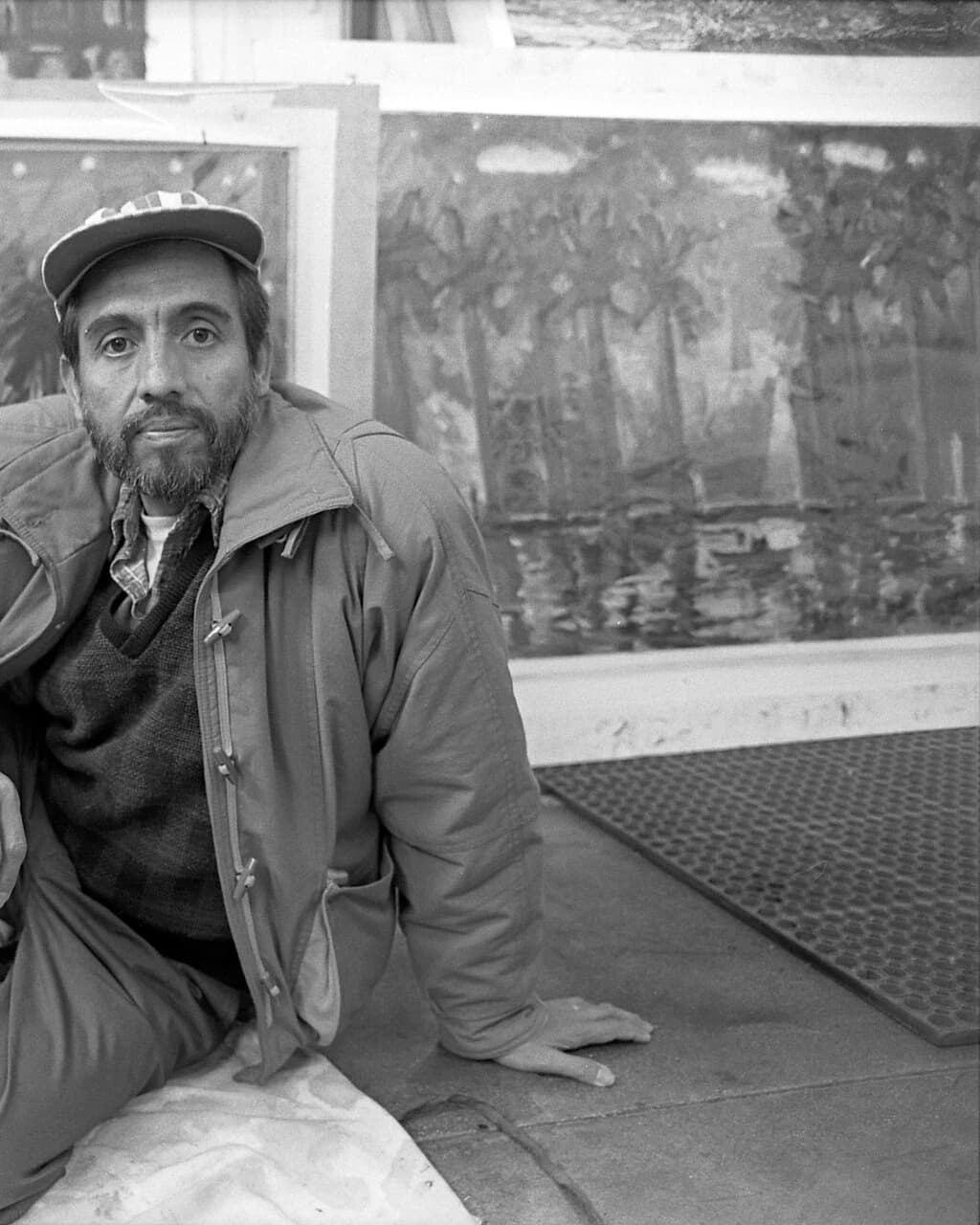
Carlos Almaraz
Carlos Almaraz (1941–1989) was born in Mexico City, grew up in Chicago and Los Angeles, and became one of the first artists of the Chicano movement. In 1973 he joined the group Los Four and later helped found the Centro de Arte Público. He became best known for the “Echo Park” series and for canvases of car crashes set against bright sunsets.
Biography
Almaraz traced his first impression of art to trips to Mexico City from Chicago, where his family had settled when he was very small. He called it both horrifying and absolutely magical, that is, “sublime”. He was born on 5 October 1941 in Mexico City, to Roe and Rudolph Almaraz.
In Chicago his father ran a restaurant for five years and then worked for four in the steel mills of Gary. The neighbourhood was multicultural, and Almaraz and his brothers, Rudolph Jr. and Ricky, grew up in that mixture of cultures.
When he was nine the family moved to Los Angeles: a doctor had advised his father to seek a warm climate because of his rheumatism, and there were family difficulties too. They settled first in Wilmington, then in Chatsworth, still rural at the time, where they lived in communal housing with other Mexicans, then in Beverly Hills and finally in a barrio of East Los Angeles. His interest in art, which had begun in Chicago, grew stronger in California. The habit of constant moving, by his own account, later helped him find common ground with migrant farmworkers and their children.
In 1959 he graduated from Garfield High School and studied at Los Angeles City College under David Ramirez, taking summer classes at Loyola Marymount University. Loyola offered him a full scholarship, but he turned it down in protest at the university’s support for the Vietnam War and stopped practising Catholicism altogether. At California State University, Los Angeles, he became friends with Frank Romero, but the structure of the art department discouraged him. He switched to night classes at the Otis Art Institute under Joe Mugnaini, and earned an MFA there in 1974; he also studied at the University of California, Los Angeles.
In 1965 he went to New York with Dan Guerrero, son of the singer Lalo Guerrero, but returned after six months to take up a scholarship at Otis. He then lived in New York again from 1966 to 1969. It was a hard time for a painter there, amid the new movements of the day. He wrote poetry and philosophy; they are said to have filled fifty books, a figure I would want to check.
After returning to California in 1971 Almaraz nearly died and was given the last rites. It is said that during his convalescence he had an experience of God. By 1972 he was already working with César Chávez and the United Farm Workers (UFW). In 1973, with three other artists, he founded the group Los Four; in 1974 Judithe Hernández, a friend and fellow student from Otis, joined as the fifth member and the only woman. For the next decade the group exhibited and made public art together, and it is credited with bringing Chicano art to the attention of major American museums. Almaraz also painted for Luis Valdez’s Teatro Campesino, the farmworkers’ theatre company, and some of his murals clearly show the influence of its actos, short agitprop plays. In 1977–1979 he was among the founders of the Centro de Arte Público in Highland Park.
The “Echo Park” series is named after the Los Angeles park that Almaraz could see from his apartment window. It became known internationally and has been shown in many museums. Critics see in it a blend of Monet, Van Gogh and Californian influences: dark tones on the left, light on the right, ragged brushstrokes, orange stars that turn green in the left-hand panel. The paintings are filled mostly with couples, in boats, by the lake, on the bridge. On 12 November 1978 he wrote: “Because love is not found in Echo Park, I’ll go where it is found.”
Another well-known work, “Boycott Gallo”, became a cultural landmark of East Los Angeles, but it was taken down in the late 1980s. His later period is marked by series of car crashes: “Sunset Crash” (1982), “Crash in Phthalo Green” (1984), “Car Crash” (1987, now in the Los Angeles County Museum of Art). Burning cars fall from a freeway ramp against a beautiful sky. In 1989 he painted “Greed”, with fearsome dogs, unusual for him, since his creatures are usually kindly. Almaraz’s colour and loose manner influenced many California artists, and Adan Hernandez of San Antonio.
In 1981 he married the Chicana artist Elsa Flores; they had a daughter, and together they made the work “California Dreamscape”. Almaraz died on 11 December 1989 in Los Angeles. In 1992 the Los Angeles County Museum of Art showed 28 drawings and prints donated by his widow. Six of his works are in the Smithsonian American Art Museum and one is in the Whitney Museum of American Art. In 2020 the documentary “Carlos Almaraz: Playing With Fire” appeared, directed by Elsa Flores Almaraz and Richard Montoya; the papers of Almaraz and Flores are held at the Smithsonian Institution.
Profile notes
Profile and sources
Image
Artist image
Ellen Jaskol, Los Angeles Times; Wikimedia Commons; CC BY 4.0.
