
29.12.1903–06.02.1962
Candido Portinari
Candido Portinari (1903–1962), the son of Italian immigrants on a coffee plantation in the state of São Paulo, painted thousands of pictures of Brazilian workers, refugees from the north-east and his childhood in Brodowski. He was the first in Brazil to paint in fresco, decorated a ministry in Rio, the Library of Congress in Washington and a church at Pampulha, and his panels “War” and “Peace” hang at the United Nations Headquarters.
Biography
On 6 September 1957 two monumental panels, “War” and “Peace”, a gift from Brazil, were unveiled at the United Nations Headquarters in New York. They had taken four years and some hundred and eighty studies, and the Secretary-General, Dag Hammarskjöld, called them the most important monumental work of art donated to the organisation. The artist was not invited to the ceremony because of his left-wing views.
His 1947 exhibition in the United States turned out to be his last there for twelve years.
Candido Portinari was born on 29 December 1903 on the Santa Rosa coffee plantation near present-day Brodowski, in the state of São Paulo, the second of twelve children. His parents had come to Brazil from the Veneto at the end of the nineteenth century, and in 1906 they left the plantation and set up as small traders in a neighbouring village. He got no further than the third year of school, painted his first picture at ten, and in 1918, together with a school friend, joined a wandering band of Italian painters and sculptors who decorated churches in Brazilian towns. One of them, Vittorio Gregolini, became his first teacher.
In 1919 he went to live with relatives in Rio de Janeiro. At first he failed to get into the National School of Fine Arts, but he was admitted in 1920 and studied there until 1928, under Lucílio de Albuquerque and then João Batista da Costa. From 1922 he showed at the school’s annual Salons and won prizes and medals, and in 1928 his “Portrait of Olegário Mariano” earned him the prize of a trip to Europe at public expense. In May 1929 his first solo exhibition, twenty-five portraits, opened in Rio.
He stayed in Europe until early 1931, mostly in Paris, with trips to London, Spain and Italy. He painted little there and spent more time in museums. Giotto and Piero della Francesca affected him most, and among his contemporaries Matisse and van Dongen. In Paris he met a Uruguayan, Maria Victoria Martinelli, who was to share his life for almost thirty years.
Back home, he settled in Lapa, the bohemian district of Rio, and began to paint what he had known since childhood: rural and urban labour, refugees fleeing poverty in the north-east of the country, childhood itself. “I am the son of the red earth,” he said of himself. The dark soil and blue sky of the plantation gave him his palette: blues, browns, reds. “The Mestizo” appeared in 1934, a peasant standing confidently against cultivated fields, and in 1935 “Coffee”, in which the workers have huge hands and feet, short bodies and round heads. “Coffee” won recognition at the Carnegie Foundation’s international exhibition in Pittsburgh and was bought for the National Museum of Fine Arts. In 1936 the minister of education, Gustavo Capanema, invited him to decorate the ministry’s new building, then going up to designs by Lúcio Costa and Oscar Niemeyer. Portinari chose fresco, a technique no one in Brazil had used before him, and finished the murals in 1944. He was reproached for having supported Getúlio Vargas’s dictatorship with this work.
Three of his paintings hung in the Brazilian pavilion at the 1939 New York World’s Fair; in 1940 New York’s Museum of Modern Art showed one of his canvases for the first time; and he had solo exhibitions in Detroit and New York. In 1941, together with his brother Luiz, he painted four murals in two months in the Hispanic Reading Room of the Library of Congress in Washington: “Discovery of the Land”, “Entry into the Forest”, “Teaching of the Indians” and “Discovery of Gold”. In New York he saw Picasso’s “Guernica”, and its traces show in the series of biblical paintings he made soon after his return for the Tupi radio station in São Paulo. After the war began, colour almost disappeared from his painting, and many canvases are kept to greys. In 1945 he painted and tiled the Church of Saint Francis of Assisi built by Niemeyer at Pampulha, a district of Belo Horizonte. The paintings there are blue; because of protests against its architecture and decoration, the church was consecrated only fifteen years later.
At the end of 1945 he stood for the Senate on the Communist Party list and was not elected; in 1946 he spent almost a year in Paris, where he received the Legion of Honour; then he ran for the Senate again and lost again. In May 1947 the party was banned, and in November he went alone into voluntary exile in Montevideo, returning in June 1948. In 1950 his six paintings at the Venice Biennale were coolly received by the critics; a year later the first São Paulo Biennial gave him a room of his own.
In 1956, at the invitation of the Israeli government, he showed an exhibition there in four cities and brought back studies from which his Israeli cycle grew.
In April 1958 his “Burial in a Hammock” was selected for the Brussels exhibition “50 Years of Modern Art”, and in Mexico City, at the First Inter-American Exhibition of Painting and Prints, where he sat on the jury, he alone was given a room of his own. In 1960 he separated from Maria Martinelli. That same year his granddaughter Denise was born, and in less than two years he painted at least sixteen portraits of her. To my mind, these portraits and the poems he wrote in the same years say most about the late Portinari. Candido Portinari died on 6 February 1962 in Rio de Janeiro and was buried in the Cemetery of Saint John the Baptist; the state of Guanabara declared three days of mourning.
In 1979 his son João Candido launched the Projeto Portinari and tracked down more than five thousand paintings and thousands of drawings and documents; in 2004 the complete catalogue of his work appeared, the first such catalogue for a Latin American painter. On 20 December 2007 his “Coffee Farm Worker” was stolen from the São Paulo Museum of Art together with Picasso’s portrait of Suzanne Bloch. The police found both paintings on 8 January 2008, and they went back to the museum unharmed.
Related context
Associations
Works connected through artistic movements, cultural context and period. Priced works available in this market appear first.








Profile notes
Profile and sources
Image
Artist image
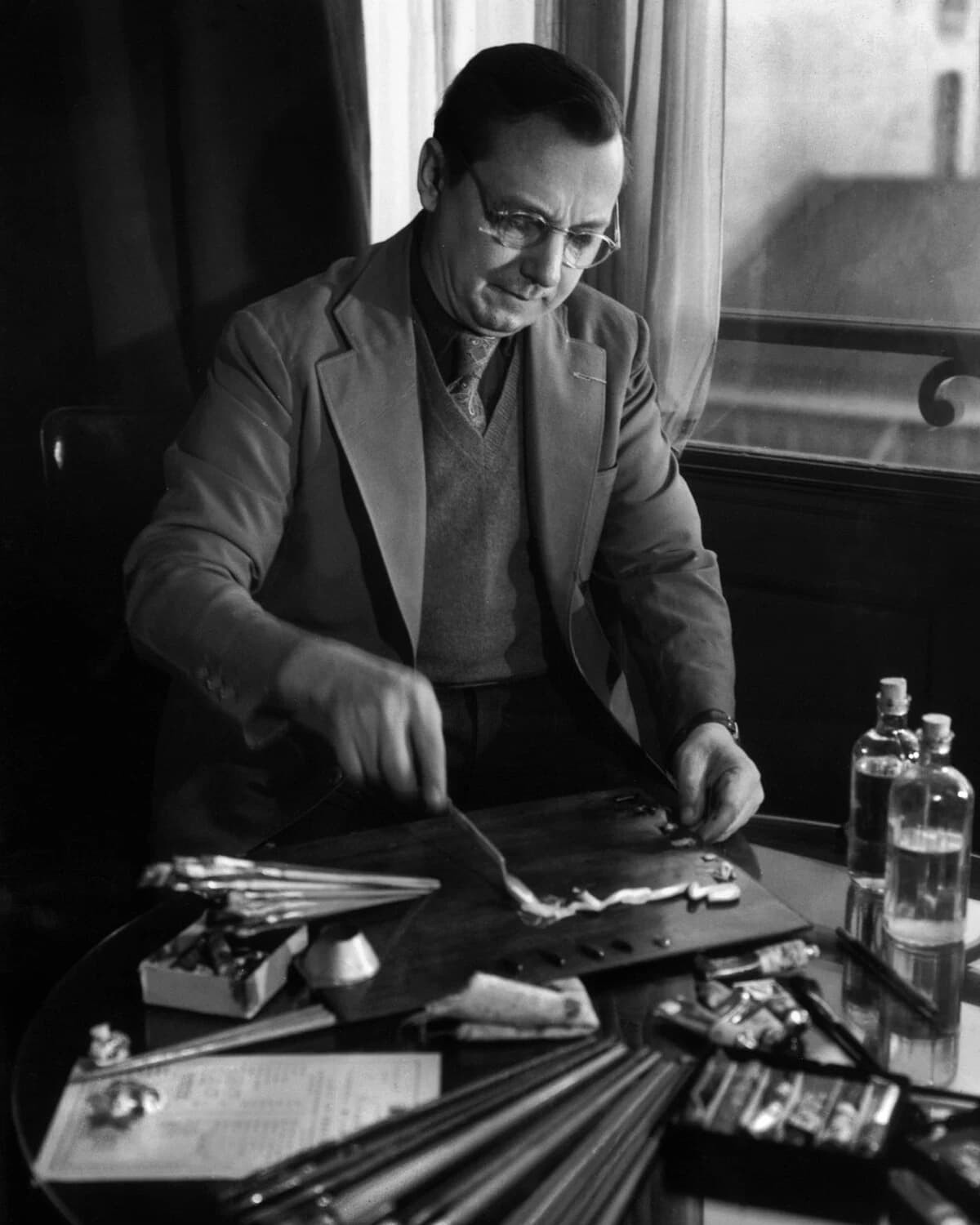
Annemarie Heinrich; Wikimedia Commons; Public domain.
