
29.08.1840–31.12.1903
Cándido López
Cándido López (1840–1902) went to the Paraguayan War as a second lieutenant, lost his right arm at Curupayty in September 1866 and by 1869 had taught himself to paint with his left. His battle canvases, stretched horizontally in a proportion of one to three, with tiny figures of soldiers under calm skies, were painted from his front-line sketches in 1888–1902 with the support of the former president Bartolomé Mitre. Of the hundred pictures he planned, he finished 52.
Biography
Many of Cándido López’s canvases are signed “Zepol”: his surname read backwards. He signed them with his left hand.
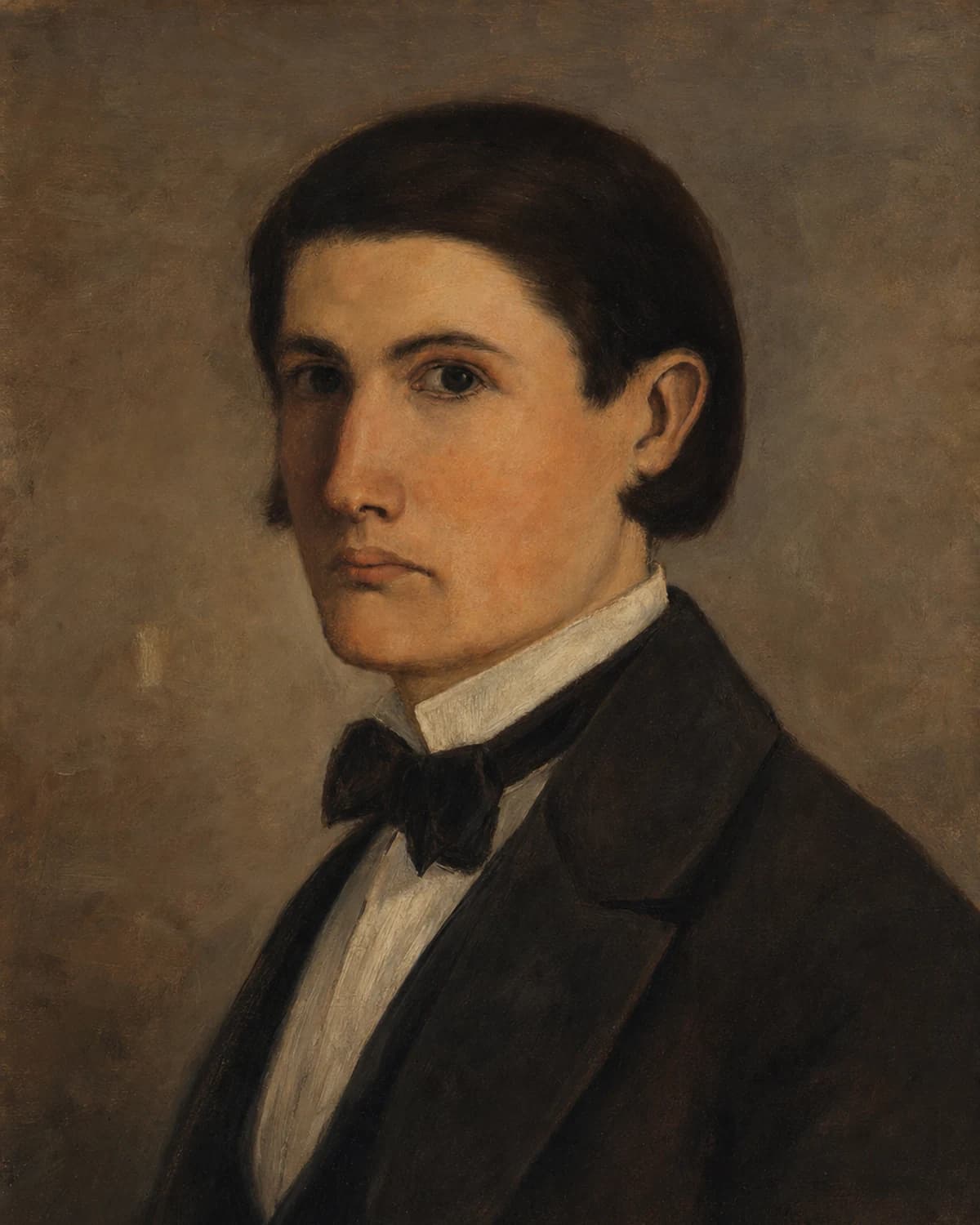
He was born on 29 August 1840 in Buenos Aires and started out in 1858 as a daguerreotypist, a pupil of the portrait painter and photographer Carlos Descalzi. The daguerreotype demanded that the picture be planned in advance, and López got into the habit of making preparatory sketches; from these, it seems, he came to painting. His first oil painting, “The Beggar”, and a self-portrait are dated to that same year, 1858. In 1859–1863 he toured the small towns of Buenos Aires Province and the south of Santa Fe Province, photographing their inhabitants; from 1860 he kept a studio in Mercedes, where in 1862 he painted a portrait of the newly elected president Bartolomé Mitre, and then moved to San Nicolás de los Arroyos. In 1863 he made friends with the Italian muralist Ignacio Manzoni, who advised him to work on colour and perspective and introduced him to another Italian, Baldassare Verazzi, from whom López took lessons. He was planning to go and study in Europe when the Paraguayan War broke out.
López joined the army; since he could read and write, he was given the rank of second lieutenant in the San Nicolás infantry battalion, in the division of General Wenceslao Paunero. In the lulls between engagements he painted landscapes and views of the camps and sent them to Buenos Aires, where they sold readily: the public wanted to see everything to do with the front. He went through Estero Bellaco and Boquerón, and in September 1866 at Curupayty a grenade fragment shattered his right wrist, and the arm was amputated above the elbow. He was discharged as an invalid; after Corrientes he returned to San Nicolás and began learning to paint with his left hand. Only by 1869 did he judge that he commanded it well enough.
From then on he painted almost nothing else: the battles and camps of that war. He lived in San Antonio de Areco, in Merlo, in Carmen de Areco, and never got clear of poverty. In 1887 he wrote to the former president Mitre asking for his intercession, and Mitre took him under his patronage: a subsidy in exchange for a series of pictures documenting the war. From his front-line sketches of 1865–1870 López painted his principal works in 1888–1902; of the hundred he planned he managed to finish 52, nine of them devoted to Curupayty. For six years he lived in the house of another patron, Dr Norberto Quirno Costa, giving himself wholly to this work.
His canvases are recognisable at once. The format is stretched in a proportion of one to three, say 40 by 120 or 48.5 by 152 centimetres; the viewpoint is raised high, so that the plain opens out to a distant horizon and the soldiers of both armies become tiny coloured figures in parade uniforms. There is almost no war as suffering in them: there are the yatay palms at Empedrado, the sunset sky over “Winter Quarters of the Uruguayan Army”, river crossings, camps, formations. It seems to me that this detachment is his way of telling of a war in which he himself lost an arm. He is usually placed among the naïve painters. His still lifes, his second subject, are vertical and dark: groups of fruit and objects glow brightly against a dark ground.
López died on 31 December 1902 in Buenos Aires, in a house on Güemes Street. He was buried with military honours in La Recoleta Cemetery, in the pantheon of the warriors of the Paraguayan War. His works are held in the National Museum of Fine Arts, the National Historical Museum, the Mitre Museum and the museums of Luján and San Nicolás; in 2005 a documentary film, “Cándido López: The Battlefields”, was made from his paintings.
Related context
Associations
Works connected through artistic movements, cultural context and period. Priced works available in this market appear first.








Profile notes
Profile and sources
Image
Artist image
На основе открытого изображения: Luis Candido Lopez; Wikimedia Commons; Public domain.
