
10.07.1830–13.11.1903
Camille Pissarro
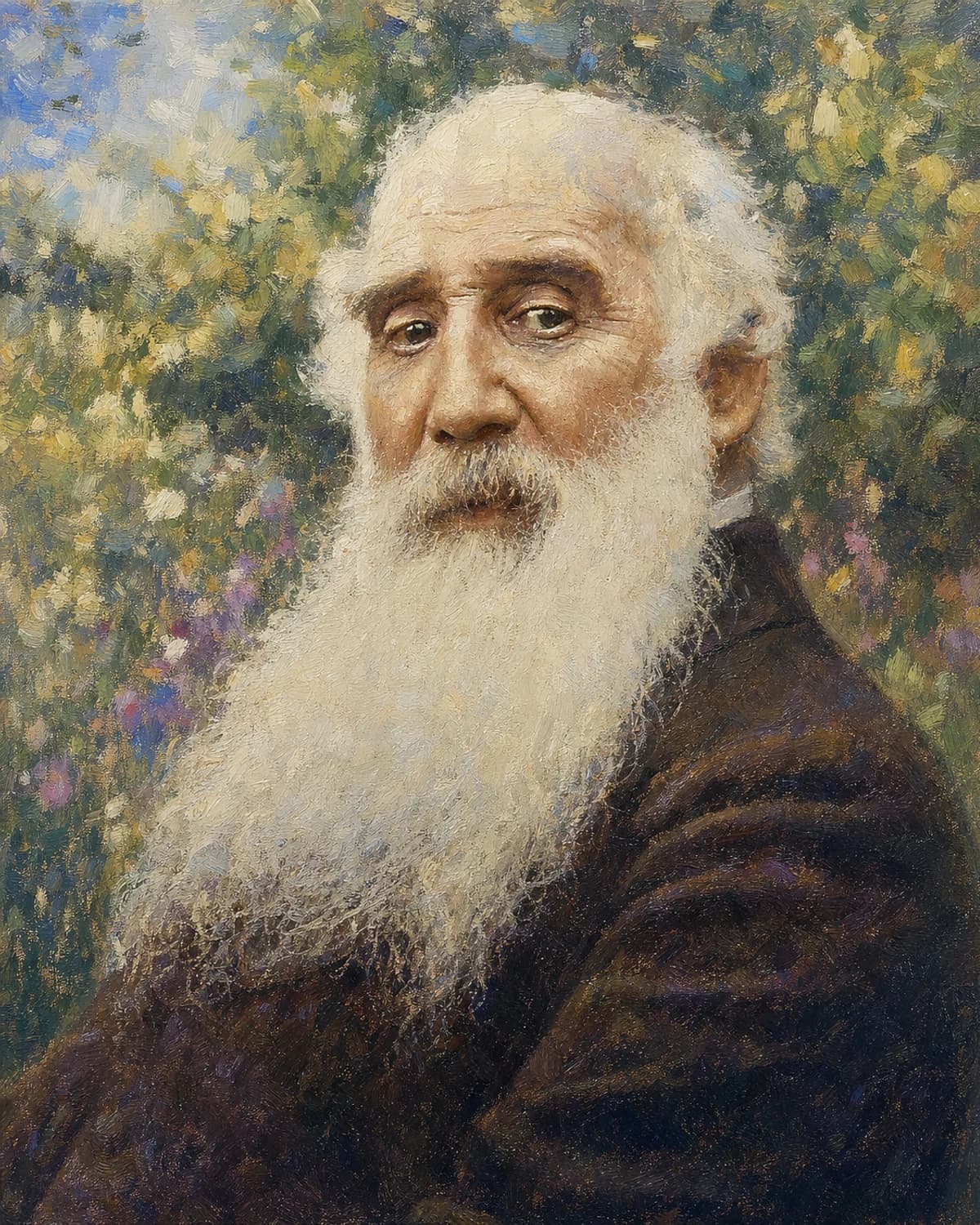
Camille Pissarro (1830–1903), a native of the Danish island of St Thomas, was the only Impressionist to show at all eight of the group’s exhibitions, wrote the first charter of their society in 1873 and, at fifty-four, took up Seurat’s dotted manner. Cézanne called him a father, Gauguin one of his masters; his late views of the Paris boulevards were painted from hotel windows.
Biography
Returning from London in 1871, Camille Pissarro found about forty paintings in his house outside Paris. Before the war there had been almost fifteen hundred there, everything painted in twenty years: the Prussian soldiers billeted in the house had laid the canvases in the mud at the door to wipe their boots on.
He was forty-one. Because of that loss it is hard to judge how Impressionism took shape in his hands before 1870.
He was born on 10 July 1830 at Charlotte Amalie on the island of St Thomas, in the Danish West Indies, and was given the names Jacob Abraham Camille. His father, Frederick Pissarro, a French subject of Portuguese Jewish descent, had come to the island to run the hardware store of a dead uncle and married the uncle’s widow, Rachel Manzano; the small Jewish community held the marriage to be a breach of the law, the children were refused admission to the Jewish school, and they attended an all-black primary school instead. At twelve Camille was sent to France, to the Savary boarding school in Passy, where the proprietor himself taught him to draw and advised him to work from nature when he got home. At home he spent five years as a clerk in his father’s business and drew in the breaks, until at twenty-one he met the Danish painter Fritz Melbye. With him he went to Venezuela and worked for two years in Caracas and La Guaira, filling sketchbooks. In 1855, at twenty-five, Pissarro moved to Paris, became an assistant to Anton Melbye, Fritz’s brother, attended classes at the École des Beaux-Arts and the Académie Suisse, found their methods “stifling” and asked Corot for lessons. In 1859 he was admitted to the Salon for the first time; that same year, at the Académie Suisse, he fell in with Monet, Guillaumin and Cézanne. Corot finished his landscapes in the studio, whereas Pissarro preferred to paint on the spot and at one sitting: bushes, mounds of earth, trees at various stages of growth. The critics called it vulgar. In 1863 his work hung in the Salon des Refusés; in the catalogues of 1865 and 1866 he still named Melbye and Corot as his masters, in 1868 no one at all, and Zola wrote that Pissarro was “one of the three or four true painters of this day”. By thirty-eight he rivalled Corot and Daubigny as a landscapist; around the turn of the 1870s Japanese prints caught his imagination.
The war of 1870 found him a Danish subject: the French army would not take him, and he moved his family to Norwood, then a village on the edge of London. The pictures did not sell there (“my painting doesn’t catch on, not at all”, he wrote to Duret), but in London he met the dealer Paul Durand-Ruel, who sold his work for most of the rest of his life, and with Monet he looked at Constable and Turner. Twelve canvases painted in Norwood, among them “The Avenue, Sydenham” in the National Gallery in London and “Lordship Lane Station”, show suburbs to which the railway had only just been brought. In 1871, in Croydon, he married Julie Vellay, formerly his mother’s maid; of their seven children six became painters. Back in France the family settled in Pontoise and lived there from 1872 to 1884.
From 1872 Cézanne walked out to Pontoise to paint with him. In 1873 Pissarro drew up the first charter of the “Société Anonyme des Artistes, Peintres, Sculpteurs et Graveurs”, fifteen members in all; at forty-three, with a prematurely grey beard, he was regarded in the group as the “wise elder”, though he worked alongside the others as an equal. At the first exhibition in 1874 he showed five landscapes; in 1876 the critic Albert Wolff asked someone to “make M. Pissarro understand that trees are not violet”. Of all the participants he alone showed at all eight exhibitions, from 1874 to 1886. In the late 1870s he planned a journal of original prints with Degas and Mary Cassatt; the scheme fell apart when Degas withdrew, yet of all the Impressionists Pissarro was the most devoted to printmaking, to etching, lithography and monotype, and even set up a lithographic press at home. Cassatt spoke of him as a teacher who “could have taught the stones to draw correctly”. It was he who introduced Gauguin, then a young stockbroker, to Degas and Cézanne.
In April 1884 Pissarro rented a house at Éragny-sur-Epte near Gisors, “superb”, as he wrote to his son Lucien, with a garden and meadows; he lived there for the remaining nineteen years. In 1885 he grew close to Seurat and Signac and for three years, until 1888, painted in small dots of pure colour; at the eighth exhibition in 1886 these works hung in a separate room with those of Seurat, Signac and Lucien. He himself called the new method “a new phase in the logical development of Impressionism”, but by the end of the decade he gave it up: the system got in the way of responding to changes in nature and to movement. In 1889 he put together for his niece an album of thirty drawings, “Turpitudes sociales”, caricatures of society’s vices; he read anarchist papers and supported them with money. In 1892 the house at Éragny was put up for sale, and Monet, who lived nearby at Giverny, helped with money; in 1893 Pissarro converted the barn into a studio with an arched north window about three metres wide. In 1998 the garden and studio were listed as a historic monument of France.
In old age an eye complaint kept him from working outdoors in the cold, and he began painting the street from the windows of upper-floor hotel rooms: Rouen, Paris, Le Havre, Dieppe, and in 1890, 1892 and 1897 London again. This produced the 1897 series of the Boulevard Montmartre, in the morning, at night, in spring and on Mardi Gras, “Rue Saint-Honoré in the Afternoon. Effect of Rain”, and the Place du Théâtre Français of 1898. Pissarro died in Paris on 13 November 1903 and was buried at Père Lachaise. Three years later Cézanne, by then a master to a new generation himself, had himself entered in an exhibition catalogue as “Paul Cézanne, pupil of Pissarro”.
Artist works
Works by the artist
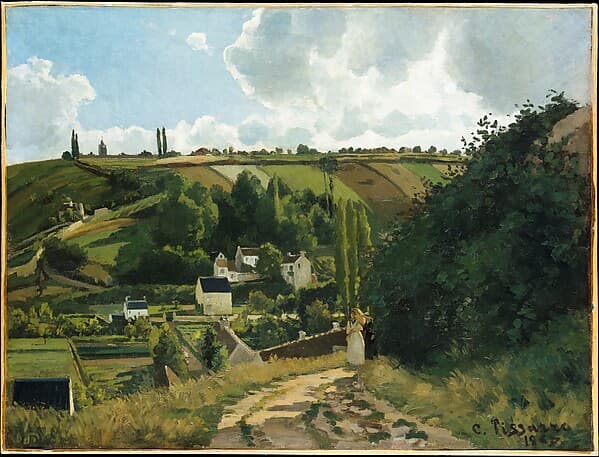
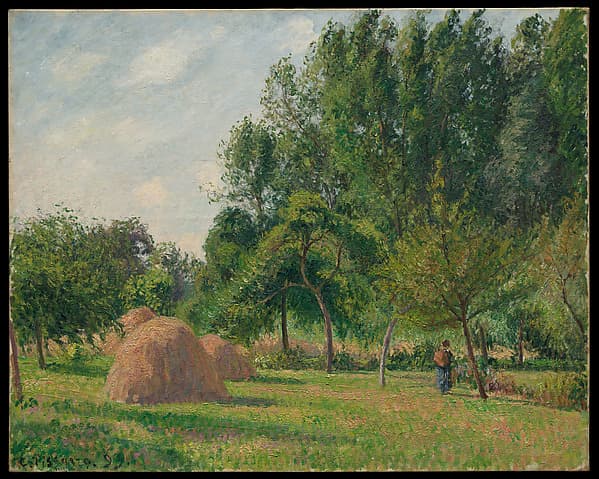
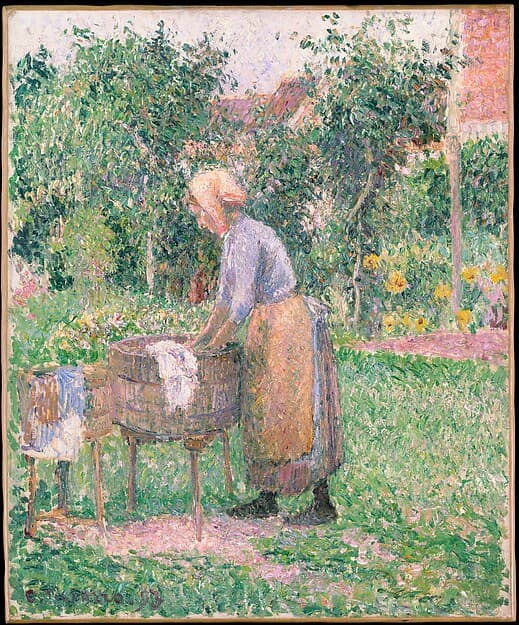
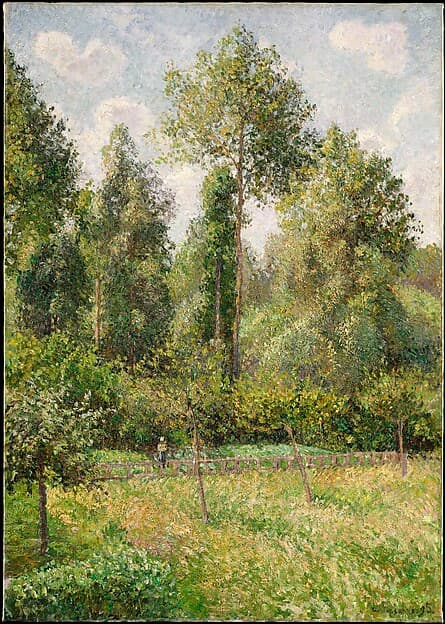
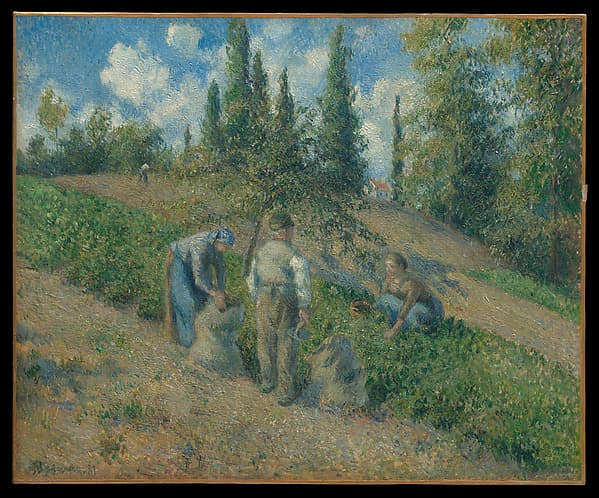
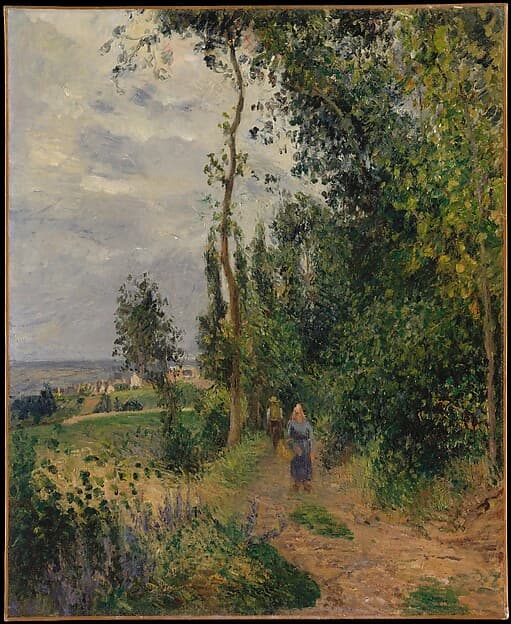
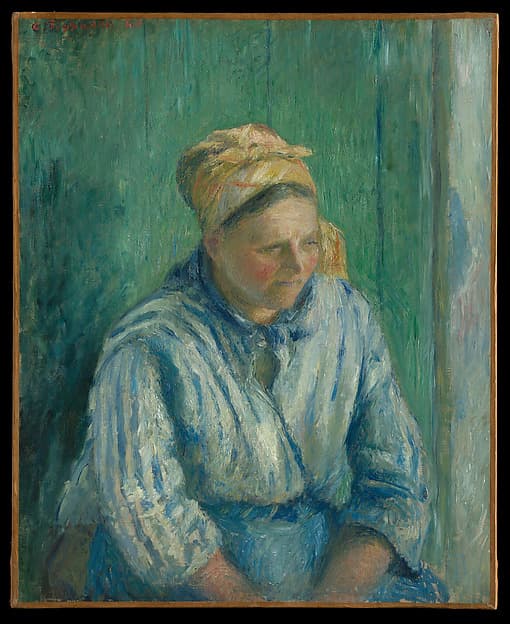
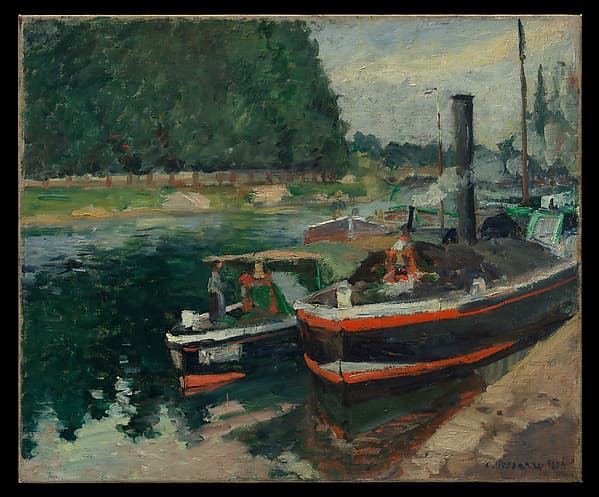
Works by Camille Pissarro available in this edition of NEOARCA.
Related context
Associations
Works connected through artistic movements, cultural context and period. Priced works available in this market appear first.








Profile notes
Profile and sources
Image
Artist image
На основе открытого изображения: Unknown author Unknown author; Wikimedia Commons; Public domain.
