
24.05.1875–04.08.1920
C. G. Finch-Davies
Claude Finch-Davies (1875–1920) served in the Cape Mounted Riflemen, and on postings to remote places in the Eastern Cape he began to paint birds: by 1905 he had about two hundred watercolour portraits of species. His plates appeared in Major Boyd Horsbrugh’s book on the game birds and waterfowl of South Africa (1912), and he gave several of his last sketchbooks to birds of prey.
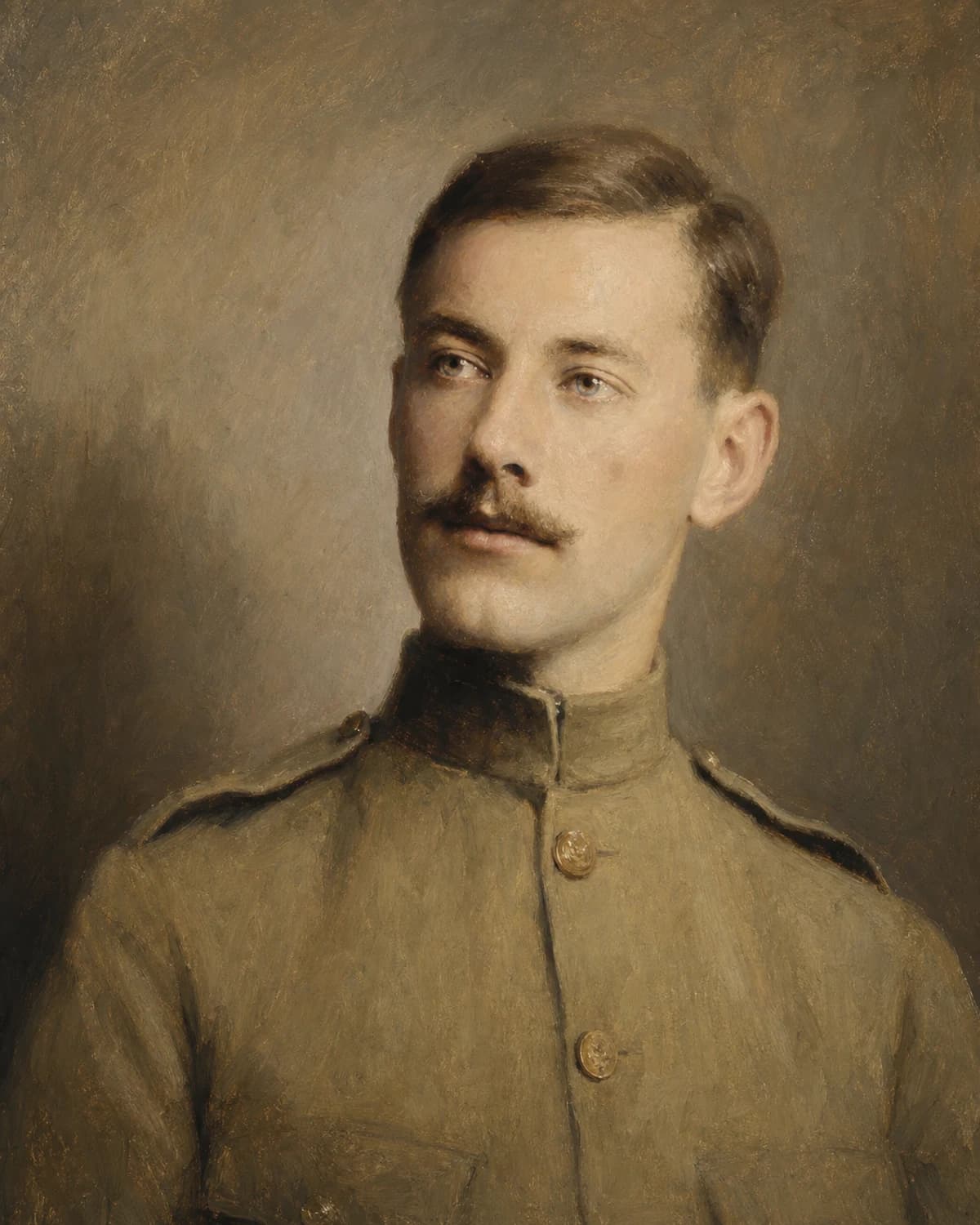
Biography
In early 1920 the library of the Transvaal Museum in Pretoria discovered that about 230 plates had been cut out of its reference books. The man who had done it was Finch-Davies, the officer who spent more time over those books than anyone else.
He was born on 24 May 1875 in Delhi, the third child and eldest son of Major-General Sir William Davies. His mother, it was said, knew a great deal about Indian snakes. At six he was sent to school in England, as was the custom, and he did not take to it. In 1893 he enlisted in the Cape Mounted Riflemen at their recruiting office in London, and that same year he was with his regiment in Pondoland, which had just been annexed by the Cape Colony.
His service took him to remote posts in the Eastern Cape, and it was there, apparently, that his interest in birds began. Within a year or two he was collecting specimens and making his first sketches. In his field sketchbooks he wrote notes on every species: first his own observations, later information from books and scientific journals. His manner changed quickly: the plumage is painted in detail, but the birds remain lifelike. By 1905 there were some two hundred paintings of consistently high quality.
In 1897 he went to London with fifteen men of his regiment for Queen Victoria’s Diamond Jubilee and was promoted corporal on his return. The Anglo-Boer War put the birds aside for a time, but it let him travel widely in southern Africa; he kept up his notes and collected the odd specimen. After the war, in 1902, he went back to Pondoland as a sergeant. The next twelve years were quiet: he covered the Eastern Cape thoroughly and painted roughly one picture a week. He sent his finished sketchbooks to his mother in England. She transcribed his pencilled notes and had unidentified birds checked at the British Museum (Natural History). He began to publish in scientific journals, among them the first volume of the journal of the South African Ornithologists’ Union, of which he was a founder member.
The Union’s president at the time was Alwin Haagner, an assistant at the Transvaal Museum; the two knew each other through the birds Finch-Davies sold and donated to the museum. Haagner used his illustrations in his own publications describing new forms and species. About then Major Boyd Horsbrugh appeared, looking for an artist for his book. The result was “The Game-Birds and Waterfowl of South Africa” (1912): colour plates by Finch-Davies and many of his observations.
In 1910, after the formation of the Union of South Africa, the regiment, now the 1st South African Mounted Riflemen, was posted to Matatiele in East Griqualand. There he fell under the spell of the raptors: the whole of his twentieth sketchbook is given to them, and seven more of his last ten. For help with difficult identifications he turned to professional ornithologists, for example William Robert Ogilvie-Grant at the British Museum.
With the outbreak of the First World War the regiment was sent to Port Nolloth, near the southern border of German South-West Africa, where it patrolled the border along the Kalahari. Most of the local birds were new to him. The regimental medical officer, Dr Louis Clifford Thompson, was also a bird enthusiast and lent him books from his small library. It was then that his correspondence with Austin Roberts of the Transvaal Museum began. The regiment returned briefly to the Orange River Colony to suppress a minor rebellion, then was ordered to Walvis Bay, and on arrival Finch-Davies was promoted lieutenant. The German troops surrendered on 1 July 1915. After that he went to Cape Town for medical treatment and returned to South-West Africa early in 1916. He probably met Aileen Singleton Finch, daughter of Captain Finch, head of the Society for the Prevention of Cruelty to Animals, on that visit: on 4 August 1916 they were married, and from then on he was known as Finch-Davies.
By 1918 he was publishing papers on the birds of Okahandja and Outjo, in what is now Namibia, and he went on sending specimens to the Transvaal Museum in exchange for access to its journals and collections. When he heard that the regiment would soon return, he took a month’s leave to study the coastal birds of Walvis Bay. In early 1919 he was stationed at Roberts Heights near Pretoria, and the family had two children, a son and a recently born daughter. His wife was unhappy about his preoccupation with birds, and he spent long hours in the museum library.
In January 1920 the museum found about 230 plates missing; in May Louis Péringuey, director of the South African Museum in Cape Town, reported that about 130 were missing from theirs. The museum brought no charges, but the affair became public. Finch-Davies’s paintings were held as security until he could pay for the damaged books. His act was judged impulsive and was put down to an obsession with illustrating birds, but the damage to his reputation was irreparable. He was transferred to Cape Town, where Aileen, who gave birth to their second son in June, joined him. Those who knew him could see that he was deeply distressed.
On the morning of 4 August 1920 his orderly found him dead in his bed. He was buried with military honours at Maitland Cemetery in Cape Town.
In 1940 and 1941 Austin Roberts edited “Roberts Birds of South Africa” and “Our South African Birds”; the illustrations in them, to my mind, plainly reproduce the Finch-Davies plates held by the Transvaal Museum, but his name is not given.
Related context
Associations
Works connected through artistic movements, cultural context and period. Priced works available in this market appear first.








Profile notes
Profile and sources
Image
Artist image
На основе открытого изображения: Unknown author Unknown author; Wikimedia Commons; Public domain.
