
16.09.1939–24.11.2024
Breyten Breytenbach
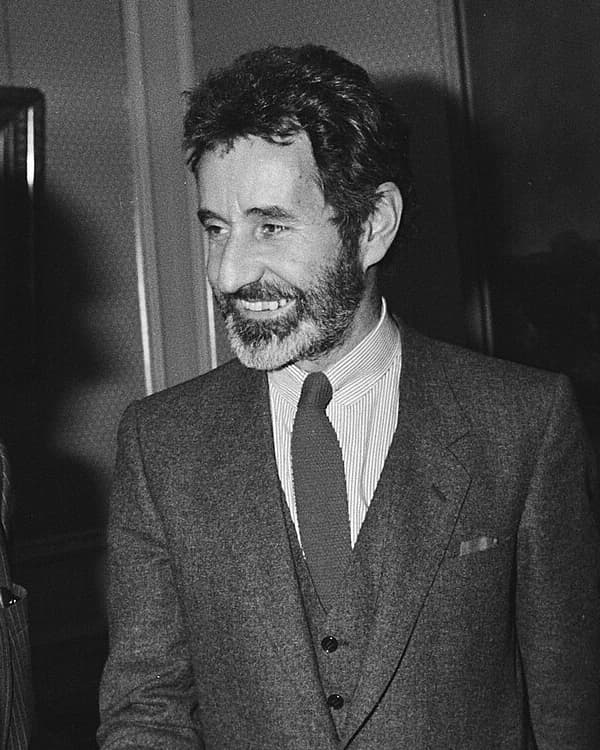
Breyten Breytenbach (1939–2024), a South African poet, prose writer and painter, wrote mainly in Afrikaans and was among the founders of the Sestigers literary movement. His painting, often Surrealist, with human and animal figures in captivity, was exhibited in Amsterdam, Paris, New York, Stockholm and Hong Kong. From the early 1960s he lived in Paris and was a French citizen.
Biography
In October 2018 the Stevenson gallery in Cape Town opened a solo exhibition of Breyten Breytenbach’s work: new pieces mixed with old ones. The artist was seventy-nine, and at home he was known above all as one of the leading poets writing in Afrikaans.
He had, however, also studied painting.
Breyten Breytenbach was born on 16 September 1939 in the Union of South Africa, in Robertson (or, by other accounts, in Bonnievale). He finished secondary school in Wellington and then entered the University of Cape Town, where he studied fine art at the Michaelis School of Fine Art as well as philology. His elder brothers took other roads: Jan became an army commander, Cloete a war correspondent.
In 1961, together with André Brink, he was at the origins of the Sestigers, a dissident literary movement of Afrikaner writers. In the early 1960s Breytenbach left the country and lived in London and Paris. In 1962, in Paris, he married Yolande Ngo Thi Hoang Lien, daughter of the South Vietnamese ambassador to France. The laws of his homeland at the time forbade marriages and relations between people of different races, and he could no longer return home; only in 1973 was the couple granted a special visa to travel to a writers’ congress at the University of Cape Town. His first book, “The Iron Cow Must Sweat”, appeared in 1964. In Afrikaans poetry it was seen as a breakthrough: the poems did without traditional metre and attractive imagery. In Paris he wrote several books about his life as an émigré, and a book of 1972, published in the Netherlands, was banned from sale in South Africa.
In 1975 he travelled to South Africa on a false passport, intending to help black workers organise trade unions and to recruit supporters for the organisation Okhela (“Spark”), and was arrested. The Supreme Court in Pretoria tried him under the Terrorism Act; Breytenbach admitted that he had come to found a branch of Okhela and was sentenced to nine years’ imprisonment, the first two in solitary confinement. In 1977 he was tried again, on new charges, but was found guilty only of smuggling letters and poems out of prison and was fined. In prison he wrote five books of poetry and prose. After seven years, in December 1982, he was released thanks to international protests and the intervention of the French president François Mitterrand. He returned to Paris and took French citizenship. His prison experience became the basis of “The True Confessions of an Albino Terrorist” (1984), in which neither the narrator nor his confessor has a stable name or identity.
From December 1993 he again visited South Africa regularly. He was a founding member and executive director of the Gorée Institute in Dakar, which grew out of the Dakar Conference of 1987, and later taught there. From January 2000 he spent three years as a visiting professor at the University of Cape Town, and he also taught at the University of Natal and at Princeton, and for more than ten years at New York University. In 2013 he became curator of the poetry festival in Stellenbosch.
Breytenbach’s paintings and prints were shown in Amsterdam, Paris, New York, Stockholm, Hong Kong, Brussels, Edinburgh, Johannesburg and Cape Town. They are most often Surrealist scenes with people and animals in captivity, and he drew inspiration from Goya and Hieronymus Bosch. It seems to me that these captive figures are hard to look at without remembering the seven years in prison, though such a link is difficult to prove. Among his awards is also the Jacobus van Looy Prize, given for literature and visual art together.
He received many literary awards: the Hertzog Prize (the first of which, in 1984, he refused), the Max Jacob Prize (2010) and the Zbigniew Herbert International Literary Award (2017). In France he was made a Chevalier of the Legion of Honour and a Commandeur of the Order of Arts and Letters. His poems were translated into Russian from 1975 by Evgeny Vitkovsky.
Breyten Breytenbach died on 24 November 2024 in Paris, in the 14th arrondissement, at the age of 85.
Profile notes
Profile and sources
Image
Artist image
Rob Croes / Anefo; Wikimedia Commons; CC0.
